
Iran-US War Scenario: Can Tehran Rely on China and Russia for Military Support?
Examining strategic partnerships, BRICS membership, sanctions pressure, and why direct military intervention remains unlikely.

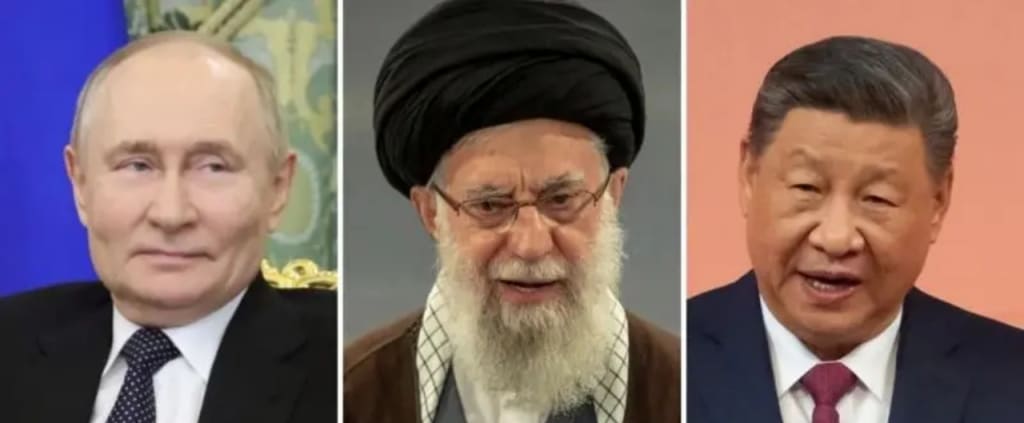
With every new wave of tension between Tehran and Washington, the same question resurfaces: if the conflict escalates into war, what would China and Russia do? Can Iran truly rely on the support of these two powers, or are the relationships largely temporary and strategic rather than a firm alliance?
The core issue lies in the nature of Iran’s relationships. Media narratives often use terms like “axis” or “bloc,” but in reality, Iran has no formal military alliance with either Russia or China. In international relations, an alliance means that if one country is attacked, the other is obligated to come to its defense. No such commitment exists between Iran and these two countries.
However, “strategic partnerships” in certain areas have led some observers to speak of a new level of relations among Iran, China, and Russia. In the most recent example, the Iran–Russia strategic partnership agreement signed in January 2024 emphasized defense and security cooperation, yet it did not include any commitment to direct military intervention if one party were attacked. The agreement contains clauses preventing the use of either country’s territory against the other, but this differs significantly from a comprehensive defense pact.
Yes, there is a “strategic partnership” in certain sectors, including defense and security cooperation, but it does not guarantee direct military assistance.
International relations expert Hamidreza Azizi noted in an interview that alliances represent the highest level of relations between states, and in Iran’s case, no such alliance exists with China or Russia.
He believes that even if war breaks out, the likelihood of direct military intervention by Russia or China is low, and their activities would mainly remain at the diplomatic level.
Although some Western security reports and analyses portray Iran as part of an anti-Western alliance with Russia and China—or as an equal threat alongside them—many international relations analysts argue that Tehran’s alignment with Moscow and Beijing is more about “alignment of interests in the face of U.S. pressure” than a full security partnership.
In other words, their shared opposition to Washington’s policies does not guarantee that Russia and China would be ready to directly confront the United States in defense of Iran.
Why Direct Intervention Would Be Costly
Another important dimension of this scenario is geopolitics. Both China and Russia have diverse and complex relationships in the Middle East. Beijing is a major economic partner of Saudi Arabia, the United Arab Emirates, and even Israel. Moscow, while aligned with Tehran, also maintains ties with Tel Aviv and several Arab countries. Entering a direct war alongside Iran could jeopardize these relationships.
Russia is already entangled in the war in Ukraine, and its military and political resources are limited. China, strategically, is focused on its competition with Washington, particularly in East Asia and over Taiwan. Opening a new and risky front in the Middle East even indirectly does not align with their priorities.
However, Professor Yulia Roknifard of Taylor’s University in Malaysia offers another perspective. She closely follows Iran–Russia relations.
According to her, Russia and China may see recent developments as an opportunity to demonstrate support for a key partner. Iran is not only a member of BRICS but also of the Shanghai Cooperation Organization. Moscow and Beijing cannot afford to let the credibility of these cooperative frameworks be undermined or called into question through what they view as illegitimate processes.
Nevertheless, most Russian observers emphasize that Moscow seeks to maintain the balance of power in the region, not to jump into a war that would create further instability. From China’s perspective as well, avoiding direct intervention and pursuing a political solution remains the priority.
A similar approach was observed in the Ukraine war, where China provided Russia with behind-the-scenes political and economic support without directly entering the conflict or openly bearing the costs of overt backing.
The Experience of the 12-Day War
To better understand China and Russia’s role, one can look at the example of the 12-day war between Iran and Israel. During this brief conflict, neither Moscow nor Beijing offered Iran assistance beyond cautious rhetoric and political support. There was no military cooperation and no open political backing.
Iran also made clear that it had not requested assistance from either country. After the war, in November 2025, a spokesperson for the Islamic Revolutionary Guard Corps stated that “we have no defense treaty with these two countries, and there was no need to request help.”
According to Hamidreza Azizi, although there has been no fundamental shift in China and Russia’s broader strategy toward Iran, certain aspects have been reassessed.
He argues that concerns about a potential U.S. attack disrupting the regional balance of power have compelled China and Russia to reconsider some of their policies.
These reassessments have occasionally led to new developments, such as China supplying missile fuel to Iran or Russia and China providing Tehran with direct intelligence regarding U.S. military movements.
Azizi believes that if tensions escalate, the more likely pattern will be continued limited informational, diplomatic, or technical support without direct involvement in the war.
Professor Roknifard, however, suggests that Russia and China do not necessarily need to make their support public, much as Iran maintained ambiguity about the assistance it provided to Russia during the early stages of the Ukraine war.
Fear of Regime Change
Some analysts also argue that a regime-change scenario in Iran could alter Moscow and Beijing’s calculations. Iran is a member of BRICS and the Shanghai Cooperation Organization and serves as a crucial geopolitical link between Central Asia and the Middle East.
From this perspective, a complete collapse or overthrow of Tehran’s political system could be seen by Moscow and Beijing as a blow to the credibility of the multilateral mechanisms they aim to strengthen.
Meanwhile, concerns about a government in Iran more aligned with Western governance models represent another factor that could influence Chinese and Russian policy calculations.
Roknifard noted that the prospect of Iran’s fragmentation or the rise of a new government could be perceived by Moscow and Beijing as a threat to their interests, given the possibility that such a scenario could transform Iran into a platform for pressure against Russia.
However, many observers believe that even in this scenario, their response would not necessarily be military. Economic, intelligence, and arms cooperation might increase, but direct entry into war would still appear to be a costly option.
The Economy what Iran Needs Most
An essential part of the equation is economic. Relative economic stability could help the government in Tehran endure. China plays a significant role in this sphere, though recent experience suggests Beijing has been highly cautious in practice.
Recent reports indicate that Beijing has significantly reduced its purchases of Iranian oil in recent months. According to tanker-tracking company data, China’s oil imports from Iran—which at times reached 1.4 million barrels per day last year—have recently fallen to around 800,000 to 900,000 barrels per day, a decline of roughly 30 to 40 percent.
Some estimates suggest that at certain points last month, the figure dropped below 750,000 barrels per day. This decline followed increased pressure from U.S. sanctions and tighter insurance and shipping conditions for tankers. If tensions rise further, Iran’s ability to maintain foreign currency earnings could be directly affected.
Since the autumn of 2025, the volume of Iranian crude accumulating in tankers and floating storage has reached record highs, signaling unusual pressure at the final stage of Iran’s oil export chain.
Recent remarks by President Masoud Pezeshkian that certain Chinese financial projects have not been implemented serve as a reminder that even at the peak of pressure on Tehran, Beijing is unwilling to risk U.S. secondary sanctions. This has led some in Iran to speak of China’s “unfulfilled promises.”
Russia, too, has demonstrated in recent years that its cooperation with Iran is largely driven by mutual and temporary interests. From the Bushehr power plant case to delays in supplying defense systems, political considerations have often played a role.
Political and Diplomatic Backing—but Not Military Intervention
Overall, it appears that in the event of escalating tensions or even a limited conflict between Iran and the United States China and Russia would likely adhere to a familiar pattern.
They would oppose Washington’s actions diplomatically, attempt to manage the crisis, and possibly increase technical or intelligence cooperation with Tehran. But based on past experience and current analysis, direct military intervention seems unlikely.
Roknifard argues that at present, China and Russia’s primary goal appears to be sending a deterrent message to prevent the United States from expanding its presence and mobilizing forces further in the region.
Hamidreza Azizi similarly contends that if war occurs, direct military intervention by China or Russia in support of Iran should not be expected.
It seems that although both powers may wish to prevent a shift in the regional balance of power that would completely weaken or eliminate Iran, they are not prepared to engage in direct war with the United States to preserve that balance.
In other words, what exists between Tehran, Moscow, and Beijing is not a military alliance but rather a cautious alignment and coordination in the face of Western pressure.
About the Creator
Keep reading
More stories from Real content and writers in Chapters and other communities.
India vs Vietnam: Will 2026 Free Trade Agreements Transform India’s Export Economy?
From a commercial perspective, the year 2026 is likely to be considered historic for India. March has not even begun yet, and New Delhi has already concluded what is being called the “mother of all trade deals” with the European Union. At the same time, it has signed an agreement with the United States that is now being described as the “father of all trade deals.”
By Real contenta day ago in Chapters
The Cave Part 6
If you have ever heard a tale about yourself that you cannot remember and doubtless think is made up, you will know how I felt when Tharkin related all that the eagle had seen of me before my memories were scattered. Of far distances and traveling companions that I did not recall, camping out under the stars and making our way to the mountains with deliberate purpose. The great bird had lost contact with my party once we entered the forests, and the seven other members were not seen again by him or his brethren since.
By Jamye Sharp7 days ago in Chapters
The Cave Part 5
Tharkin never answered my question. I tried to get him to interpret the vision I had seen in the smoke, but he claimed he had not seen what I had. This was no more satisfying for me than it would be for anyone else, but after several days of working with him maintaining the extensive gardens and tending to the livestock, I learned that he was master of what he would reveal and when. If I wanted to learn more of the voice in the cave, I would have to seek it out, or stumble on the answer in my own time.
By Jamye Sharp7 days ago in Chapters


Comments
There are no comments for this story
Be the first to respond and start the conversation.