
1 - In the Beginning
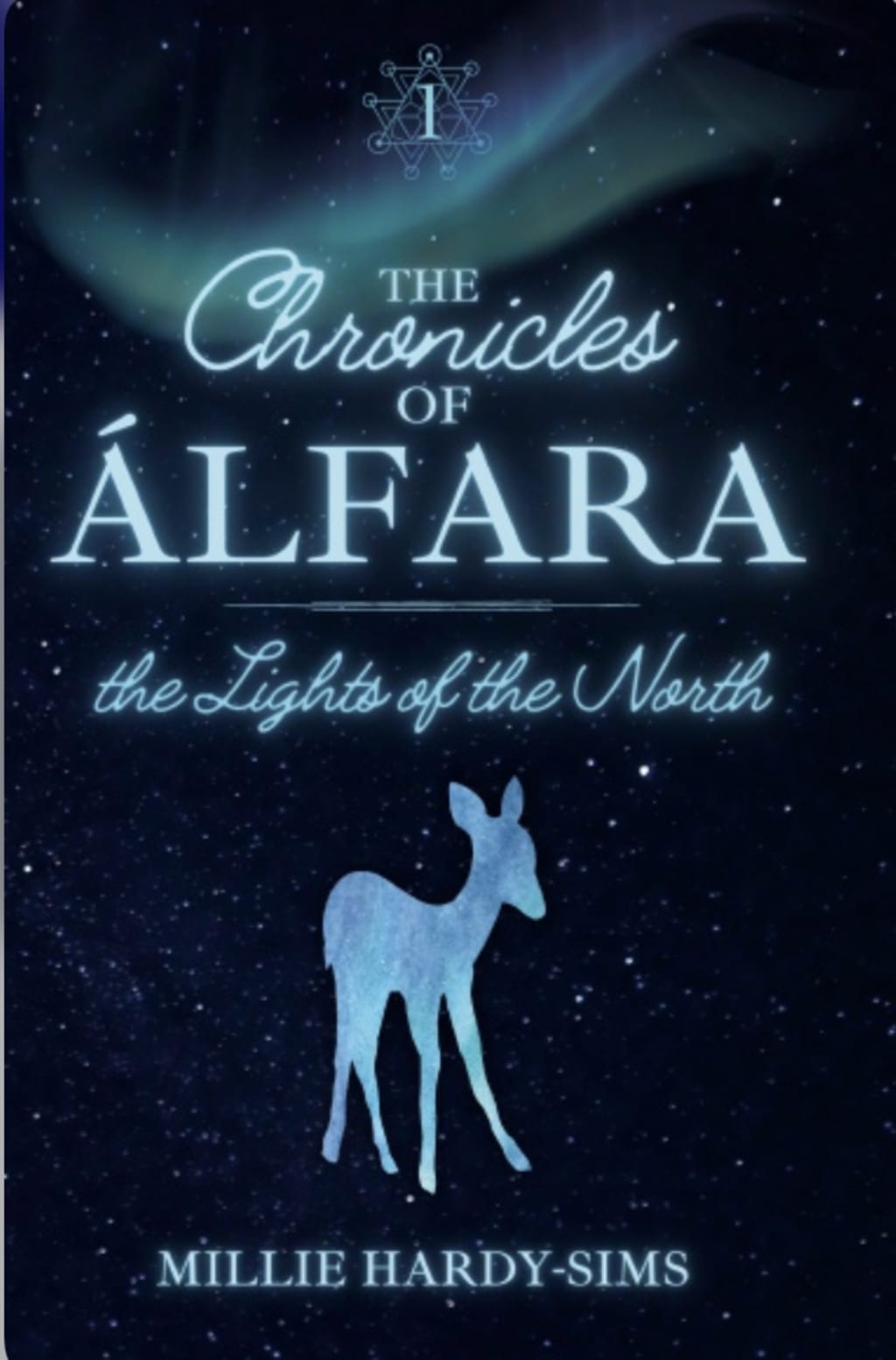
The Chronicles of Álfara: Book One - The Lights of the North
Long ago, the world of Heimur was created by the Gods.
These Gods were not terrifying, they did not punish without just cause, nor did they live above their humble beginnings, but they should not be messed with all the same.
They furnished their new world with hundreds of species of animals: some magical, some not. They created Björnings, great furry beasts with their mighty paws and thick jaws, capable of surviving the frozen climates and climbing the densest of trees. They formed the Hvafn, flying beasts of jet black feathers who were easily the most intelligent of all creatures. They made the Rensdyr, great gentle creatures with branches upon their heads, moulded from pure starlight. They invented the Ulfurs, creatures of dense fur and sharp teeth who preferred isolation in the wilderness, but were fiercely protective of those that they trusted. They created Nisse, small, wise, bearded beings, to care for these animals and all of the others, entrusting them with the races they had forged. Then, once the animals had made their home with the Nisse by their sides, the Gods created three great beings in their own image. Of these three great beings in particular, above all of the others, the Gods were most proud.
The first to be created, the Banvænn, they built from the dirt and the earth itself. These beings were much like you and I in appearance and personality. They had life spans of up to 100 years, they lived in houses and had jobs in order to maintain the society which they continuously built for themselves. They did not heed much to the magical elements of the world that surrounded them, and it seems that such ignorance kept them alive for generation after generation. Of course, they could not escape the magical beings with which they shared their homeland, nor the beasts that roamed free around them, but they did not pay them much mind if they did not pay mind to them. They were a simple folk who lived life their way, and had done for centuries.
The second creation of the Gods were forged with the first sun beams of the winter and the crisp frost of a cold morning, manipulated and bent to form petite creatures with pointed ears and large eyes that reflected the lightness of their souls in shades of green, blue and purple. These beings, very different to the Banvænn, were reinforced with the powers of nature and creation. They were given the name Ljósálfar, and were talented in many ways that the Banvænn were not. They made a home within the woods and forests of the world, using their talents to befriend and care for the animals with which they shared their home, using their skills of creation to invent and concoct items to better the world around them. The Gods were proudest of these creations, tending them as one tends a garden and rearing them to reflect the Gods themselves. These were creatures of kindness and fortune as the Gods believed they themselves were. The Ljósálfar took time to care for all around them, although they rarely ventured near the Banvænn and instead kept to themselves inside their enchanted woodlands. The Banvænn began to think of them as nothing but legends, stories to tell their children.
The third and final being that the Gods made in their own image was that of the Dökkálfar, forged from the flame, the ash and the soot. Where Ljósálfar were made from all things light and caring, the Dökkálfar were made from darkness and waste. Their sole purpose was to bring balance to this world that the Gods had lovingly created. In contrast to their light cousins, the Dökkálfar were instead dark in features, their eyes ranging in shades of grey, red and black. They dabbled in nightmarish things such as grief, pain and anguish, stalking shadows where the Ljósálfar dared not tread. They were every part as powerful as the Ljósálfar, but they instead used such powers to cause suffering. Where the Ljósálfar were skilled in creation and loyalty, the Dökkálfar were instead skilled in warfare and manipulation. They favoured isolation over companionship, even with one another, and the darkness of their souls shone through their eyes, causing fear in all who looked upon them. The Gods had been most unhappy to unleash such beings upon the world, but it had to be done in order to balance this new world. For, without darkness there cannot be light.
Heimur, the world where all of these races dwelled, was made up of four great forests, three mountain ranges, two citadels and a whole lot of nothing in between. The three great beings of the world, the Ljósálfar, the Dokkalfar and the Banvænn, rarely ventured outside of their own territories. The forests were dominated by the light-giving Ljósálfar, the mountains by the secretive and calculating Dökkálfar, and the citadels by the Banvænn. The only creatures to venture outside of what they knew would be the animals and the lesser beings, such as Nisse, the Huldi and the Dverger. They alone did not fear the beings who dominated Heimur in their tribes, and instead sought to simply survive and share their talents in moderation. The four great forests: Norðurtre, Suðurskog, Vesturskove and Skógur Hanna Huldu, made up the four points of the compass. Norðurtre, the Northern trees, were barren and habitable only by a select few Ljósálfar who could survive there. It was mostly inhabited by Björnings and was surrounded by the Kaltspids, the larger of the three mountain ranges. To the West was Vesturskove, the forest of the hardier Ljósálfar who made their living tending to the Ulfur who roamed there. They were deemed as the most feral to all of those who spoke of the Vesturskoven, wild beings with sharp teeth and wide eyes, hunters who ran in packs. To the South, past the small Banvænn Citadel of Einmana, was the water forest of Suðurskog, where the resident Ljósálfar made their living from the great river Storflojt that flowed through their centre. Here they fished in the evergiving waves and built boats to sail along, keeping the peace. Sudurskog was bordered by the mountain range of Dimmtfjall, the smallest of the ranges, where the Dökkálfar were negligible in their appearance and presence and shared their home with the small, bearded, quick-to-anger Dverger. These Dökkálfar were the most insignificant of their brethren, and as a result passed beyond most common memory. In the very centre of Heimur was the largest mountain range, the Miðjasvid, which the majority of Dökkálfar called home. It spanned most of Heimur’s land mass, meaning the Dökkálfar could live their isolated preferential life in companionable solitude, equal halves together and apart, just how they liked it. Finally, to the East, spanned the largest Banvænn Citadel, that of Stöfnfé. Stöfnfé was home to most of the Banvænn population, and bore high stone walls to keep the Ljósálfar and the Dökkálfar out. These walls had been built as the Great Forest of Secrets in the East, Skógur Hanna Huldu, held all manner of things inside, things the Banvænn did not care to acknowledge. Skógur Hanna Huldu was home to the most powerful of Ljósálfar, and within the dark trees there came many whispers throughout the years, whispers the Banvænn wished not to heed.
For centuries the three great beings lived in parallel harmony, continuing their own lives and existences far away from one another. The Banvænn built villages for their growing population and busied themselves creating civilisation without the use of magic. The Ljósálfar hid within the woodlands and forests, tending to the animals in their charge and using their powers of creation to care for the nature around them. The Dökkálfar, unhappy with their lot, retreated into the caves and mountains to live in the darkness that reflected their very souls, plotting and damning. All was manageably content in the world that the Gods had created.
Until, that is, the rise of Kollungr.
Kollungr, a particularly powerful Dökkálfar, resented the Ljósálfar for all that they had been given by the Gods. For years he watched them, jealous of their temperament and the love they held. He saw their contentment in their homes, their use of magic to tend to the Earth and its occupants, and Kollungr was envious. He wanted what they had, and he was going to take it.
Kollungr stood menacingly above all, the tallest and most intimidating of the Dökkálfar. The appearance of the Dökkálfar race had been lost in living memory, but legend states that Kollungr had the palest skin, the darkest eyes and the sharpest of smiles. His armour was said to be forged from a dying star, his gramr from the cold moonlight of a blue moon. It was no wonder, really, that the Dökkálfar had rallied to follow him.
Whereas before the Dökkálfar had lived in isolation, they now found themselves uniting under the desire of Kollungr, either by force or by decision. They envisioned the images he painted with his promises, craved the joy that he swore must come from living in the forests and towns occupied by the Ljósálfar and Banvænn, and so they followed Kollungr into battle. To begin with the war was small. Kollungr and his Dökkálfar followers made a point of attacking small pockets of Banvænn, not wanting to prompt a rebellion but instead hoping to take what was not theirs with stealth. They were, after all, skilled in logic and warfare. They could plan in secret and execute their plans without so much as a whisper. However, word of the coup eventually reached the Ljósálfar, carried on the wind by elemental spirits who wished to help stop an onslaught. The Ljósálfar assembled in order to stop the coming war, to prevent the abolition of their homeland and all they knew and held dear. The Gods had given them compassion and they were set to use it. The Ljósálfar rallied together to make a stand against Kollungr and his army of darkness. They appointed a King where none had been before, electing the strongest and most trusted amongst them to act on their behalf: Einar. Einar was a humble Ljósálfar from the Northern forests. Though he had never seen battle, as there had never been a need, Einar was logical and fearless. He had the best interests of his people at heart, and so his people believed in him in return. It was his fierce loyalty to the survival of not only his own people, but the Banvænn too, and all of the creatures who shared their great earth, that had won him the crown and the title that would destroy the wicked, envious Kollungr.
The Banvænn did not thank Einar for his bravery and sacrifice, nor did they wish to aid the onslaught. Instead, the limited minded, short sighted Banvænn retreated from the slaughter, wanting to keep their people away from the magic and the uncertainty. They sealed all borders against magical beings and raised their children with no knowledge of magic. For generations to come they would have no knowledge nor pay a mind to the battles between light and dark. All the Banvænn would know would be all that was before them. There would be no need to acknowledge the whispers in the darkness or the light carriers who brought news. For one hundred years, generation after generation, the Banvænn remained separate from the waging war. They did not live as long as their magical brethren, and so through the generations they eventually, simply, forgot why they carried such a deep seated fear of anything different from them to begin with. This was how they liked it, and so it would be. The wars of spiritual beings meant nothing to them, nor did the simple lives of the Banvænn.
And so it was, after a century of battle, that Einar and Kollungr met in the final field of war. It was not just a war for the Earth any longer, but a war for light in the darkness. The conflict of light and dark is as common as night and day, but this final stand was far more dangerous and all-consuming. The future of Heimur hung in the balance. The battle was long and bloody, a century of slaughter and bloodshed, with Dökkálfar and Ljósálfar losing their lives on both sides. Einar grew desperate to defeat Kollungr and stop him and his followers plunging the delicate world into darkness. Countless of each kind had lived and died for the cause. Einar wanted nothing more than to end it for the sake of themselves. He decided to put an end to it once and for all, choosing to finally meet Kollungr on the field himself, to lay waste to this dictatorship once and for all. One night, on a snowy plain, the two ancient, exhausted, Alven Kings alone fought to the last man, and it was during their duel that Einar and Kollungr defeated one another, and ended the uprising with their martyrdom. As their spilled blood mixed, the black of Kollungr and the white of Einar, their many followers laid down their arms and agreed on peace for the first time in a century. Kollungr had been foolish, even the Dökkálfar could, at last, see that, and many had simply followed him out of fear. The Dökkálfar returned to their caves and mountains and balance was once more restored. The Banvænn must have known that the battle was over, they must have felt a shift in the world around them, but they were content to continue to ignore the existence of magic. They had made a life for themselves in the past century, ignorant of the plights of others, and so it would stay for the good of their survival.
After the battle, the Ljósálfar retreated back into their forests, and this time they too closed their borders. The Dökkálfar, what was left of them, faded from mind and memory. For centuries to come neither Ljósálfar nor Banvænn spoke of the war. If there were Dökkálfar still out there, they would not know, nor did they care. The defeat had been enough to deter the Dökkálfar from ever uprising again.
At least, so they thought.
About the Creator
Keep reading
More stories from writers in Chapters and other communities.
The Cave Part 6
If you have ever heard a tale about yourself that you cannot remember and doubtless think is made up, you will know how I felt when Tharkin related all that the eagle had seen of me before my memories were scattered. Of far distances and traveling companions that I did not recall, camping out under the stars and making our way to the mountains with deliberate purpose. The great bird had lost contact with my party once we entered the forests, and the seven other members were not seen again by him or his brethren since.
By Jamye Sharpa day ago in Chapters



Comments
There are no comments for this story
Be the first to respond and start the conversation.