
Reflections on "Everything I Never Wanted to Know"
A Review of Sorts

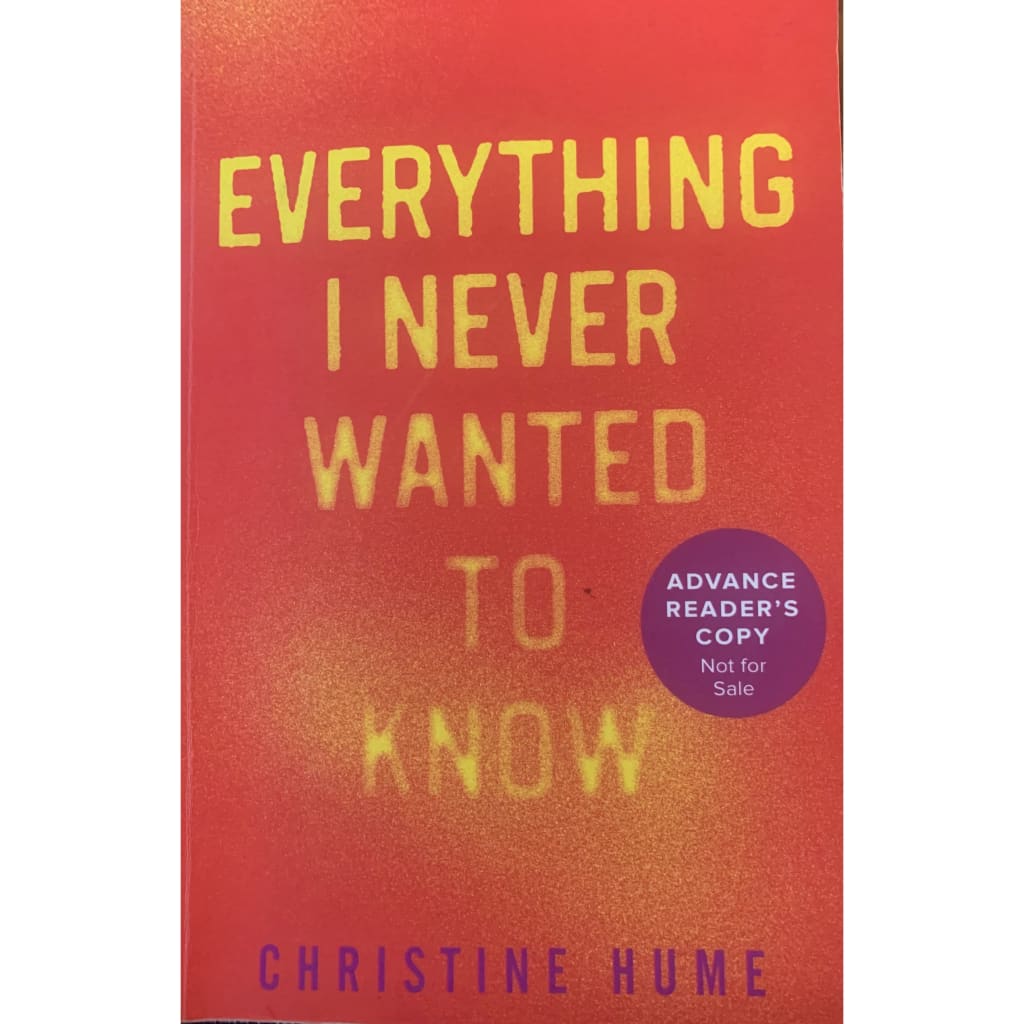
I read this book two years ago as one might regard a holy text. I underlined, dog-eared, and wrote in the margins of this remarkable meditation—a hunt for explanations that I haven't stopped thinking about since.
The harrowing picture depicted by my college mentor may be bleak, but it is powerful, incisive, and necessary. It's not new, and it's not prescriptive, but clear and fiery. Christine Hume's prose informs, haunts, shocks, and gently soothes the nervous system. Which of these essays is the best? Standing alone, perhaps none, perhaps all. But it is the piece as a whole that rocks the foundation of our perceptions. The message would not be the same without any part of this pivotal text–the opening essay "Question Like a Face," or the photographic meditation on "All the Women I Know" book-ending everything in between. The gift is the cultivation of these individual works to create a striking image of the realities of people assigned female at birth and those who are transfeminine.
From front to back, cover to cover, contents to acknowledgments, I experienced dendritic growth. Hume presents the kind of feminist thinking and cultural critique that reminds me why I kept taking classes with her.
She uses personal anecdotes, sociological research, and anthropological studies to explain the harsh realities of men's violence against women and girls. She references the National Sex Offender Registry to expose the disparities in what we consider "justice" in these cases of sexual misconduct. The line from the violence of men against women is short to the violence of the State against Other (read Black, Brown, and poor people).
Interestingly, she isn't offering a solution but shining a bright light on the depth of inequality in our judicial system, our cultural imagination, and our own homes. She's opening a dialogue.
****
The book starts in Ypsilanti, Michigan, the town of my alma mater, and where I lived for ten years. An assault upon her neighbor while she is moving into her new house immediately sours her feelings about this big transition. The jarring violence and inequity she notices in the coming days and weeks only deepen her worry.
She walks to the local university, where she is a professor, from her home a block away. She sees a woman's face posted on street lamps, power boxes, and crosswalks. She wonders who she is and comes to learn of Aura Rosser, the forty-year-old woman shot and killed by Ann Arbor police, who were called to her house for a domestic disturbance. It was a mental health crisis, one which led to an argument between Aura and her boyfriend, where she brandished a knife in defense of herself. The fish knife remained in her hand as the police entered the scene and shot her for approaching them. One officer chose to fire his taser, and the other chose his gun.
The result was the same as it has been a thousand times over in this country. Aura Rosser died, and the officer responsible for killing her was found not liable for her death. "Self-defense," the judge ruled.
"Question Like a Face" was one of the first essays I read by Hume. Initially published in 2017 as a standalone, book-length essay, "Question Like a Face" ruminates on this image of Aura plastered around town, using it as scaffolding to paint a larger picture of systemic violence. It opens the first section of "Everything I Never Wanted to Know," labeled:
ONE: Consider
The following essays, "Consider the Sex Offender" and "The Unregistered: Glances Toward and Away," weigh the disparate experiences within our social structures for justice and rehabilitation. The first title might seem as though Hume is asking us to empathize and "consider" the position of a sex offender before casting judgment. However, it is more in the vein of questioning what we do to seek justice and how this "justice" is inequitably dished out.
She points out that a quick scroll through the Sex Offender Registry will show that the majority of people on the list are Black or Brown men. She reminds the reader that white men are guilty of sexual assault, too. She references high-profile cases such as Larry Nassar and Robert Anderson at Michigan State University and the University of Michigan, respectively, to show the disparity in belief of victims and action against perpetrators depending on race and ethnicity.
The truth about police brutality and violence against Black and Brown bodies in the United States is horrifying. Mass incarceration is more than a talking point in critical race theories; it is the crippling reality of our American society.
According to the Prison Policy Initiative, the United States is the "undisputed global leader in mass incarceration." In fact, each state within the U.S. incarcerates more people per capita than most nations.
Think about that for a moment. Even a small state like New Hampshire, with a prison population of just over 2,000 people, vastly outnumbers the number of incarcerated individuals in most developed countries.
Imagine now a much larger state like Texas, which has the highest number of prisons and prisoners in the U.S., or California, with incarceration rates notable on most international scales.
The U.S. is leading the world in one thing: captivity.
The essays in the second section examine the culture that allows such dehumanization to exist. They hold a magnifying glass up to the artifacts and attitudes that have oppressed us for centuries.
TWO: Yes, But
In "Icy Girls, Frigid Bitches, and Frozen Dolls," we are asked to question the role of the doll in girl's make-believe play. Hume offers that the sterilized, domesticated, and heteronormative play of little girls with dolls, particularly the "Frozen Charlotte," leads to the expression of norms that otherwise would not manifest: silence, obedience, and binaries.
I was unaware of the historical significance of "Young Charlotte." This Victorian-era doll is a pale, naked, porcelain rendering of a young woman. Hume describes the mold seams holding her together as keloid scars running down each side of her diminutive body. Unable to stand, the dolls must lie, stacked in neat piles or boxes. Hume compares this image to a mass grave, offering a bleak parallel for the women and girls they are meant to represent.
The piece "All the Women I Know" is a lyrical meditation on the harsh realities of womanhood and femininity. Nearly every line begins with the declaration, "No woman I know," and ends with an experience that many, if not most, women can relate to. From the mundane, "No woman I know knew her grandmother's peach cobbler recipe by heart," or "No woman I know could count on her mother listening," to a brief rumination on the offered definitions of the word "ravish," we are shown that women are always in a double-bind. "(1) to fill with joy (2) to seize and carry off by force (3) to rape a woman," Hume says we're backed into a corner with language like this. We're told we're having the time of our lives while simultaneously being stripped of our bodily autonomy.
The expectations placed on women are impossible, and the silence we are meant to maintain while enduring the untenable is part of the violence we experience.
"Don’t you remember a time when you were filled with joy? As if being murdered by a man you know isn’t the easiest way for a woman—daughter, sister, wife, aunt, mother, grandmother—to die in our country."
Hume shows that we bear a great burden that impacts our sanity, health, and livelihood.
"No woman I know had a great night’s sleep."
These words, set against images of the backs of women's heads, give us a poetics of the female lived experience, granting a universality to the binds that hold us hostage. The women could be anyone.
And they are all of us.
Hume explains that the culture that normalizes little girls going to sleep away camp without a single fret from parents or that protects abusers in the home, church, and schools who might exploit their position of power is a culture that does not value women and little girls. It is a culture that chews them up and spits them out for consumption later in life. It grinds away little girls' confidences and identities, making them easier to manipulate and take advantage of. Parents and childless adults alike protect, exacerbate, and maintain this culture of hypersexualization and abuse, whether they realize it or not.
Hume explains that we are all products of this dangerous and exploitative society and offers that the first step to changing the culture is to recognize the structures and norms that dictate our actions and to critically assess what purpose they serve in the oppression of Others. We must see how we have become a tool in perpetuating this process and disentangle ourselves from the patriarchal project.
This text is revealing. As I read it, I felt as though I had experienced an avulsion of sorts. My skin had crawled off my body, and I felt raw and exposed. By the time I finished it, Hume had applied a thick salve to my wounds and begun treating my pain with fennel and poetry.
I will survive to think about these things for another day, and I have a new vision of the trials and battles we face in the coming years.
I have restored faith, knowing people are dismantling these cultural norms daily. However, for rapid shifts to occur, we must all engage with this process.
We must all strive to unlearn misogyny, gender norms, and patriarchal standards of living and expression. Our efforts will collectively work to save us.
About the Creator
kp
I am a non-binary, trans-masc writer. I work to dismantle internalized structures of oppression, such as the gender binary, class, and race. My writing is personal but anecdotally points to a larger political picture of systemic injustice.
Self Help: Grifters' Gospel
On Self-Help, Snake Oil, and the Illusion of Change Psychology professionals and students can be imagined on two opposite sides of a line called self-help books: likely a larger group opposes pop-science and step-by-step manuals filled with talk of success, journaling, and not giving a f**k; others love them, but they aren’t many.
By Avocado Nunzella BSc (Psych) -- M.A.P about 23 hours ago in BookClub
7 Books For When You're Ready To Change But Afraid To Start
Facing change can feel overwhelming, standing as one of life’s greatest tests of courage. Whether it’s switching careers, ending a toxic relationship, starting a new habit, or pursuing a lifelong dream, the first step often feels impossible. We understand that feeling—the mix of excitement and fear, hope and hesitation. Fortunately, books have the power to guide, inspire, and embolden us when courage feels out of reach. Below is a list of 7 books for when you're ready to change but afraid to start.
By Diana Merescabout 17 hours ago in BookClub
Dead and Wearing Green
She was wearing that green dress when I first saw her, five years ago to the day. Flowing meadow fabric draped over long legs, thick auburn hair flowing down her back. That smile. Of course, she is still beautiful now. But now she is no longer alive.
By Karen Cave5 days ago in Fiction


Comments (2)
I love titles like this, and it is another for my TBR list
The cleanest thing I've read all day "By the time I finished it, Hume had applied a thick salve to my wounds and begun treating my pain with fennel and poetry."