
Paschal Beverly Randolph
Mystic, Healer, Revolutionary Thinker

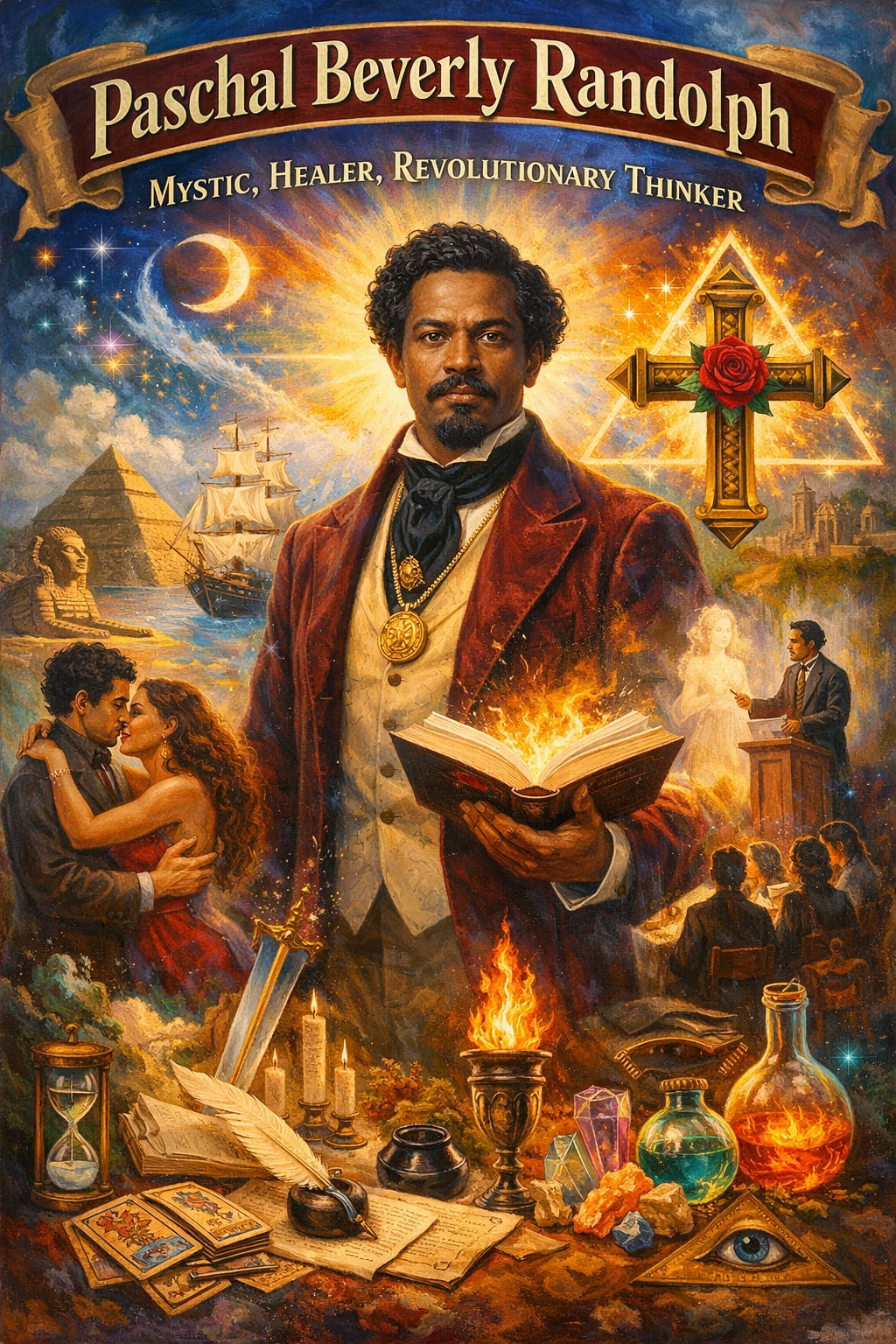
The Revolutionary Path of Paschal Beverly Randolph
A life forged along the edges of social orthodoxy and spiritual experimentation can illuminate overlooked intersections of culture, metaphysics, and social evolution. Nineteenth century America sustained rigid racial stratification, institutional religious authority, and restrictive moral expectations governing intimacy, gender roles, and personal agency. Within such an environment, Paschal Beverly Randolph rose as an intellectual and esoteric pioneer whose work unsettled dominant assumptions surrounding spirituality, human relationships, and self-determination. Historical records place Randolph among the earliest American occult philosophers to integrate Western esotericism, Spiritualist practice, medical speculation, and radical social commentary into a unified philosophical system.
Born on October 8, 1825, in New York City, Randolph entered a society structured by racial discrimination and economic hardship. Maternal lineage traced to African American and Malagasy ancestry, while paternal identity remains historically disputed, with several accounts suggesting European heritage. Early childhood unfolded amid poverty and limited access to formal education. Adolescence included maritime labor as a sailor, providing exposure to international ports, diverse religious traditions, and cross-cultural philosophical ideas. Such travel contributed to intellectual development and encouraged engagement with Hermeticism, Rosicrucian traditions, Mesmerism, and emerging Spiritualist movements gaining popularity across Europe and North America during the mid-nineteenth century.
Randolph later established recognition as a trance medium, lecturer, herbal medical practitioner, and prolific author. Publications such as Eulis! The History of Love, released in 1874, and Love and Its Hidden History, published in 1861, advanced controversial arguments linking spiritual evolution with consensual sexual union within committed relationships. Randolph presented sacred intimacy as a transformative force capable of fostering emotional harmony and metaphysical insight. Such assertions diverged sharply from prevailing Victorian moral standards and generated both fascination and condemnation across religious and academic circles.
Professional activity also included participation in abolitionist discourse and advocacy for racial equality during a period marked by intensifying national conflict over slavery. Randolph maintained connections with reformist intellectual networks and reportedly served as a medical attendant during the American Civil War, though documentation regarding military service varies across historical accounts. Founding leadership within Rosicrucian fraternal organizations further cemented Randolph’s legacy within Western esoteric traditions, influencing later occult societies in both American and European contexts.
Randolph’s death on July 29, 1875, in Toledo, Ohio, concluded a career characterized by philosophical innovation, public controversy, and enduring influence on occult literature, alternative spiritual movements, and modern discussions surrounding sacred sexuality. Archival correspondence, published treatises, and fraternal records continue to position Randolph as a catalyst for ongoing scholarly examination of race, mysticism, and personal liberation within nineteenth century American intellectual history.
Hardship, Global Exposure, and Intellectual Awakening
Paschal Beverly Randolph entered life on October 8, 1825, in New York City, a rapidly expanding port shaped by immigration, commerce, and stark racial division. New York maintained gradual emancipation laws during the early nineteenth century, yet racial discrimination influenced employment, education, housing, and civic participation. Randolph emerged from a background identified by historians as containing African American and Malagasy ancestry through maternal lineage. Paternal lineage remains uncertain, with several nineteenth century sources suggesting European roots, though definitive archival confirmation remains unavailable. Early childhood unfolded under conditions marked by economic instability and social exclusion common among free Black communities in northern urban centers.
Maternal death during Randolph’s youth created a severe disruption in domestic stability. Contemporary accounts and later autobiographical reflections indicate that early survival required resilience shaped by poverty and inconsistent guardianship. Formal education remained irregular and limited. Literacy and intellectual development progressed largely through independent study, exposure to urban street culture, and interaction with working class maritime laborers. Nineteenth century New York harbors served as entry points for global goods, sailors, and religious ideas, transforming waterfront districts into informal cultural crossroads. Such an environment fostered curiosity that extended beyond conventional educational pathways.
Employment aboard merchant vessels introduced Randolph to transatlantic maritime culture during adolescence. Merchant shipping routes connected New York to Mediterranean ports, British territories, and commercial hubs along the African coastline and Middle Eastern trade corridors. Maritime labor demanded adaptability, physical endurance, and cooperation among ethnically diverse crews. Travel exposed Randolph to Islamic philosophical traditions, North African healing practices, European occult literature, and fragments of Eastern mystical concepts circulating among sailors and port communities. Exposure to mesmerism, a popular nineteenth century theory proposing invisible energetic forces influencing human health and consciousness, likely occurred through European intellectual exchange networks connected to port cities such as Liverpool and Marseilles.
Cultural encounters during maritime years broadened Randolph’s understanding of spirituality as a universal human pursuit rather than a phenomenon confined to institutional Christianity. Observation of ritual healing, trance practices, herbal pharmacology, and folk metaphysics contributed to an evolving belief system integrating bodily experience with metaphysical speculation. Maritime journals and autobiographical material suggest that exposure to cross cultural healing traditions encouraged later development of Randolph’s holistic views linking emotional, physical, and spiritual well being.
Return to the United States during the early 1850s marked a transition from maritime labor to intellectual and professional pursuits. Randolph pursued medical education through apprenticeship models common before widespread standardization of American medical schools. Herbal medicine, eclectic medical theories, and alternative therapeutic systems influenced Randolph’s early clinical practice. Simultaneous study of Hermetic philosophy, Rosicrucian symbolism, alchemical traditions, and Western occult literature expanded intellectual horizons. Spiritualism gained national prominence following widely publicized mediumistic demonstrations during the late 1840s, particularly events associated with the Fox sisters in New York. The Spiritualist movement emphasized direct communication with spirit entities, trance mediumship, and democratized access to supernatural knowledge outside ecclesiastical authority.
Public lectures, trance demonstrations, and early publications gradually elevated Randolph’s reputation within American Spiritualist circles. Contemporary newspaper advertisements and lecture announcements document appearances across northeastern states during the 1850s. Randolph distinguished philosophical perspectives through emphasis on disciplined spiritual development combined with practical methods intended to harmonize emotional intimacy, physical vitality, and metaphysical awareness. Such perspectives diverged from conventional Spiritualist focus on passive mediumship by encouraging intentional personal transformation through ritual practice and ethical conduct.
Historical context surrounding Randolph’s emergence as a public intellectual includes escalating sectional conflict over slavery, growing abolitionist activism, and widespread religious experimentation across American society. Randolph’s contributions developed within this climate of social upheaval and spiritual exploration, positioning intellectual work at the intersection of racial identity, metaphysical philosophy, and alternative medical practice.
Spiritualism, Healing, and the Formation of an Esoteric Philosophy
Nineteenth century Spiritualism emerged as a structured response to industrialization, social unrest, and widespread dissatisfaction with established religious institutions. Urban expansion, migration, and political turbulence created a population seeking certainty, meaning, and reassurance amid rapid societal transformation. Mediumship, trance communication, and public séances became cultural touchstones, promising tangible contact with spirits and validation of life beyond death. Paschal Beverly Randolph entered this environment with a unique combination of practical medical knowledge, firsthand exposure to global spiritual traditions, and a disciplined approach to consciousness study acquired through years of maritime and intellectual exploration.
Public demonstrations of mediumship represented rigorous exercises in observation, discipline, and philosophical inquiry rather than performance or spectacle. Randolph developed techniques for inducing altered states of awareness, integrating vocal modulation, controlled respiration, and focused concentration to facilitate what he described as communication with higher intelligences. The practice reflected an underlying commitment to understanding consciousness as a multi-layered phenomenon. Physical form, emotional response, and spiritual presence were considered mutually influential components of existence. Randolph rejected simplistic dualism separating body and spirit, advocating instead for a model in which energy, vitality, and metaphysical presence formed an interdependent continuum.
Medical practice and healing were central to Randolph’s esoteric philosophy. Herbal remedies, dietary attention, and lifestyle guidance were supplemented by techniques then identified as “spiritual magnetism,” a concept paralleling ideas of prana in Indian philosophy, qi in Chinese medicine, and pneuma in classical Greek thought. Spiritual magnetism posited that vital energy could be cultivated, directed, and harmonized to restore balance and promote wellness. In an era dominated by bloodletting, calomel, and other invasive treatments, such methods offered a complementary or alternative approach to health care. Randolph emphasized the ethical and intentional use of energy in conjunction with physical remedies, linking physiological conditions to emotional states, environmental factors, and spiritual alignment.
Documentation from lectures, pamphlets, and private student manuals indicates that Randolph’s work in Spiritualism extended beyond healing to include practical instruction on self-mastery and conscious awareness. Concepts such as controlled breathing, meditation, and focus of mental intent were framed as methods to harness unseen forces influencing both health and perception. Contemporary observers noted a systematic and experimental approach that distinguished Randolph from entertainers or casual mediums. Healing, spiritual inquiry, and philosophical exploration were presented as inseparable domains of knowledge, forming a holistic practice that anticipated later developments in psychology, somatic therapy, and mind-body medicine.
Historical evaluation situates Randolph at the convergence of Spiritualism, medical eclecticism, and transnational esoteric currents. Experiences in Europe, North Africa, and the Mediterranean informed a cosmopolitan approach to healing and metaphysical theory. Randolph’s work challenged narrow Victorian conceptions of medicine, spirituality, and human potential while establishing frameworks for subsequent American occultists and esoteric practitioners. The integration of empirical observation with metaphysical insight created a methodology in which the visible and invisible were equally essential to understanding life, energy, and consciousness.
Race, Identity, and Advocacy for Social Transformation
Racial identity was inseparable from the public and philosophical life of Paschal Beverly Randolph. Mid-nineteenth century America remained dominated by slavery, systemic discrimination, and rigidly enforced social hierarchies. Urban centers such as New York, Philadelphia, and New Orleans offered some opportunities for free African Americans, but societal barriers persisted across education, employment, and civic engagement. Randolph’s presence as a physician, lecturer, and healer of African descent directly confronted entrenched assumptions about intellectual and spiritual authority. Visibility became a form of resistance, asserting capability, insight, and moral legitimacy in spaces often closed to people of color.
Engagement with abolitionist networks and participation in post–Civil War educational reforms reflected a practical commitment to empowerment. In New Orleans, efforts to provide literacy education for formerly enslaved individuals represented more than academic instruction; they functioned as a pathway to civic inclusion, critical thinking, and self-determination. Literacy enabled participation in legal, economic, and political systems from which African Americans had long been excluded. Archival accounts and contemporary newspaper reports suggest that Randolph’s interventions emphasized disciplined learning, ethical cultivation, and personal responsibility, connecting spiritual development with social action.
Social advocacy extended beyond race into radical reinterpretation of cultural norms surrounding love, marriage, and personal autonomy. Victorian-era expectations dictated restrictive gender roles, marital hierarchy, and suppression of sexual expression, particularly for women. Randolph’s writings, lectures, and private correspondence advanced principles of shared consent, mutual respect, and acknowledgment of erotic energy as a vital component of human vitality and spiritual growth. Such perspectives reframed intimacy as an ethical and transformative practice rather than a transactional or socially prescribed duty.
Intersectionality defined Randolph’s activism: advocacy for racial justice, educational empowerment, and sexual freedom were understood as interconnected elements of personal and societal transformation. Contemporary critics often mischaracterized these positions as scandalous or subversive, yet historical evidence underscores a deliberate attempt to expand human possibility within oppressive social frameworks. Randolph’s work offers insight into how spiritual philosophy, medical practice, and social reform could converge, demonstrating that intellectual and ethical leadership could challenge both racial prejudice and restrictive moral orthodoxy.
This combination of racial visibility, educational intervention, and radical ethics established Randolph as a pioneering figure whose influence extended well beyond esoteric and Spiritualist circles into the broader currents of nineteenth century social reform.
Rosicrucianism and the Systematization of Esoteric Knowledge
The foundation of the first American Rosicrucian order represents a defining achievement in the intellectual and spiritual legacy of Paschal Beverly Randolph. Rosicrucianism originated in early seventeenth century Europe, blending alchemical experimentation, Hermetic philosophy, and mystical symbolism into a framework aimed at the cultivation of wisdom, self-mastery, and spiritual insight. Randolph’s Fraternitas Rosae Crucis, established in 1858, translated these principles into a distinctly American context, emphasizing practical application, moral development, and personal transformation. This organization served as a structured conduit for esoteric knowledge, connecting classical European traditions with contemporary spiritual experimentation.
Randolph emphasized direct, experiential engagement with mystical principles rather than purely theoretical study. Ritual practices, meditation exercises, and initiatory processes were designed to cultivate inner perception, ethical conduct, and disciplined mastery over personal energy. Membership extended to individuals seeking alternatives to conventional religion, with lodges in New York, Boston, and later California providing a network for instruction, experimentation, and intellectual exchange. Surviving lodge records, correspondence, and periodicals indicate measured growth, demonstrating a deliberate strategy to balance accessibility with the preservation of initiatory depth.
Lectures and public addresses formed an essential component of organizational activity. Titles such as Mysteries of the Invisible World, The Pneumatology of the Future, and Magnetism and its Relation to Human Energy reflected the integration of metaphysical theory, psychological observation, and practical methodology. Audiences included both dedicated spiritual seekers and intellectuals exploring the overlap between scientific inquiry and esoteric tradition. Randolph’s synthesis of Western occultism, trance work, and energy theory created a system in which ethical development, spiritual insight, and disciplined practice were inseparable.
Fraternitas Rosae Crucis established a precedent for American esoteric societies by articulating a comprehensive, structured, and ethically oriented curriculum. Initiatory progression emphasized mastery of mind, body, and spirit while maintaining openness to inquiry and innovation. Organizational philosophy linked physical health, emotional equilibrium, and spiritual development, reflecting Randolph’s broader commitment to integrative practice. Influence extended to subsequent Rosicrucian and occult organizations in both the United States and Europe, marking Randolph as a central figure in the institutionalization and transmission of esoteric knowledge within the nineteenth century.
Archival analysis reveals a deliberate fusion of pedagogy, ritual, and publication, with periodical essays and manuals circulating foundational principles to both members and the wider public. This approach demonstrates an awareness of the cultural climate, anticipating the growing interest in psychology, vitalism, and alternative medicine that would characterize American spiritual and intellectual life in the decades following Randolph’s death. The establishment of an American Rosicrucian tradition under Randolph’s guidance exemplifies the systematic integration of mysticism, ethical instruction, and practical experimentation.
Sexuality, Human Energy, and Transformative Power
Paschal Beverly Randolph’s writings on sexuality and human energy represent some of the most radical and contested contributions to nineteenth century esoteric thought. Concepts later associated with sex magic or erotic mysticism appeared throughout published works and lectures, emphasizing the transformative potential of human intimacy rather than mere physical gratification. In an era dominated by Victorian moral strictures, these ideas provoked sharp criticism from religious authorities, public censors, and legal institutions, which in some instances restricted the distribution of his books or targeted public demonstrations of these teachings.
The framework of Randolph’s approach positioned erotic union as a vehicle for spiritual and emotional amplification. Intimacy was described as a medium through which life force energy could be concentrated, directed, and harmonized to achieve heightened consciousness, mutual empowerment, and emotional equilibrium. Ethical principles were central: consent, shared intention, and the cultivation of respect for each participant’s autonomy were presented as essential to both spiritual efficacy and moral integrity. Such guidance challenged prevailing patriarchal and hierarchical conventions, anticipating later discourse on relational equality, sexual ethics, and personal agency.
The conceptual foundation drew upon a broader understanding of human energy, integrating principles of mesmerism, vitalism, and Hermetic philosophy. Life force was conceived as an active, dynamic phenomenon capable of influencing psychological, emotional, and physical states. Randolph articulated the notion of duality within human consciousness, describing individuals as embodying both receptive and projective energies. Mastery over these forces required discipline, self-awareness, and the ethical use of power within interpersonal and spiritual contexts. Archival letters and lecture notes reference the “dual nature of the divine within humans,” emphasizing the interdependence of creativity, consciousness, and embodied energy.
Practical applications included meditation, visualization, and controlled exercises designed to align physical, emotional, and spiritual currents. Randolph’s guidance suggested that disciplined engagement with erotic energy could enhance healing capacities, deepen emotional insight, and accelerate spiritual development. The systematic presentation of these practices within published works such as Eulis! The History of Love and Love and Its Hidden History reflects careful attention to pedagogy, demonstrating a coherent philosophy in which human intimacy functions as both a sacred and transformative force.
Randolph’s contributions in this domain continue to resonate within modern occult and esoteric movements, particularly those exploring the intersections of sexuality, consciousness, and energy work. Historical evaluation underscores that teachings were not sensationalist but represented a sophisticated effort to integrate physical experience, psychological understanding, and spiritual discipline into a unified model of human potential.
Published Works, Fiction, and Philosophical Inquiry
The literary and philosophical output of Paschal Beverly Randolph encompasses over fifty titles spanning fiction, spiritual instruction, philosophical treatises, and practical guidance. Each work reflects a commitment to integrating lived experience, metaphysical exploration, and ethical inquiry into coherent frameworks for understanding human potential. Fictional narratives, particularly Eulis! The History of Love, combine storytelling with reflective analysis, using character, plot, and relational dynamics to probe questions of meaning, desire, and the moral responsibilities of intimacy. These narratives function as vehicles for exploring philosophical and esoteric concepts, encouraging readers to engage actively with ideas rather than passively consuming instruction.
Practical texts such as Human Love and Dealing with the Dead demonstrate an applied approach to both personal and spiritual development. Guidance on cultivating emotional awareness, mastering life force energy, and navigating communication with spiritual entities illustrates the integration of ethical, psychological, and mystical considerations. Randolph’s writings often present systematic instructions that blend ritual practice, meditation, and self-discipline with philosophical reflection, revealing a coherent methodology underlying diverse subjects.
A notable and provocative element in Randolph’s corpus is the exploration of pre-Adamite humanity. Randolph questioned literal interpretations of biblical chronology, proposing that human existence may extend far beyond conventional scriptural readings. This speculation intersected with early anthropological observations, comparative mythology, and esoteric cosmology, inviting reconsideration of human origins, consciousness, and evolutionary potential. While controversial in nineteenth century theological and scientific circles, the concept reflected Randolph’s broader commitment to expansive, interdisciplinary thinking.
Across fiction, treatises, and instructional manuals, consistency emerges in emphasis on direct observation, experiential learning, and rigorous reflection. Randolph challenged adherence to inherited doctrines or unquestioned authority, advocating a path in which insight arises from disciplined engagement with both material and spiritual realities. Lived experience and philosophical inquiry were presented as inseparable, and readers were encouraged to evaluate, experiment, and draw conclusions independently.
The breadth of Randolph’s work establishes a foundation for understanding his intellectual vision: one in which narrative, ethics, metaphysics, and personal development intersect. Archival editions, period publications, and private manuscripts reveal a structured approach to esoteric pedagogy, demonstrating that Randolph’s philosophy was not abstract speculation but a deliberate framework for cultivating self-awareness, ethical agency, and spiritual empowerment.
Controversy, Misrepresentation, and Historical Uncertainty
The final years of Paschal Beverly Randolph’s life remain enshrouded in ambiguity, reflecting both personal tragedy and the broader social tensions of nineteenth century America. Official records state that death occurred in Toledo, Ohio, on July 29, 1875, and contemporaneous reports adjudicated the cause as suicide. Almost immediately, alternative accounts circulated in print, correspondence, and oral tradition, suggesting that racial hostility, political reprisals, or opposition from conservative religious authorities may have contributed. Evidence supporting these claims remains fragmentary, with discrepancies among eyewitness testimonies, newspaper reports, and later biographical interpretations complicating historical reconstruction.
Conflicting accounts underscore the perils faced by Black intellectuals and esoteric practitioners who publicly challenged social and religious norms. Randolph’s roles as healer, lecturer, and organizer of Rosicrucian and Spiritualist communities exposed this individual to scrutiny, suspicion, and censure. Social and legal pressures against discussions of sexuality, occult practice, and spiritualist phenomena heightened vulnerability, particularly when combined with the pervasive threat of racialized violence. The contested circumstances of death illustrate broader patterns in which the achievements and personal struggles of marginalized figures were often obscured, misrepresented, or dismissed by contemporary society.
Analysis of historical records reveals not only uncertainty regarding the end of life but also recurring misrepresentations of philosophy and practice. Newspapers, pamphlets, and later secondary sources frequently sensationalized teachings on sexuality, human energy, and spiritualism, framing Randolph as morally suspect or dangerously radical. Such portrayals obscured nuanced intentions, philosophical coherence, and ethical frameworks central to the work. These distortions have persisted in some modern accounts, necessitating careful cross-referencing of primary sources, lecture notes, and contemporaneous publications to reconstruct a reliable understanding of contributions and legacy.
The ambiguities surrounding death, reputation, and interpretation reflect a broader challenge in nineteenth century historical scholarship: marginalized voices and radical thinkers frequently existed at the intersection of admiration, fear, and suppression. Randolph’s life exemplifies this tension, demonstrating how intellectual innovation, public visibility, and advocacy for human dignity could provoke both recognition and concerted efforts to diminish influence. Even without conclusive evidence, the complex interplay of admiration, hostility, and historical distortion illuminates enduring lessons about cultural resistance, narrative control, and the necessity of critical historical inquiry.
Legacy, Influence, and Contemporary Perspectives
The impact of Paschal Beverly Randolph extends across both historical and modern landscapes, encompassing esoteric practice, spiritual philosophy, and social thought. Later occult movements, including early twentieth century Rosicrucian schools, Theosophical societies, and contemporary alternative spiritual communities, frequently cite Randolph as a foundational influence. Core ideas such as life force energy, integrative healing practices, and the conscious use of human intimacy for spiritual development have persisted across generations, often adapted to new cultural and linguistic frameworks while retaining essential philosophical principles.
Randolph’s influence is evident in the development of structured esoteric organizations in the United States. Fraternal and mystical societies that emerged in the late nineteenth and early twentieth centuries drew upon organizational strategies, ritual structures, and pedagogical methods pioneered in Fraternitas Rosae Crucis. Concepts of ethical discipline, personal transformation, and experiential learning continue to inform contemporary practices within ceremonial magic, energy work, and holistic wellness communities. The transmission of these ideas demonstrates the enduring relevance of Randolph’s integrated approach, linking intellectual inquiry, spiritual development, and ethical action.
Academic engagement with Randolph has increased in recent decades, reflecting broader efforts to situate African American intellectual and spiritual contributions within historical narratives. Research in the history of religion, African American studies, and cultural history examines lecture manuscripts, correspondence, and published texts to contextualize Randolph’s work within nineteenth century social, intellectual, and spiritual currents. Analysis highlights intersections of race, gender, and social advocacy, illustrating how spiritual philosophy was inseparable from broader commitments to empowerment and justice.
Contemporary scholarship also emphasizes Randolph’s role in challenging assumptions about authority, morality, and knowledge. Investigations into energy theory, human sexuality, and alternative medical practices reveal early experimentation with concepts that resonate with modern understandings of mind-body integration, psychosomatic medicine, and relational ethics. These studies underscore Randolph’s significance not merely as a historical curiosity but as a pioneering figure whose thought contributed to enduring conversations about personal transformation, societal constraint, and the dynamic interplay between material and spiritual realities.
The enduring legacy of Randolph demonstrates that innovation in philosophy, spirituality, and social thought can survive centuries of marginalization. Influence extends beyond esoteric circles into broader intellectual history, revealing the capacity of radical inquiry to shape ongoing debates about human potential, ethical practice, and the integration of consciousness, energy, and community.
Reading Recommendations: #commissionearned
Randolph’s life is examined in depth against the backdrop of racial and social barriers in nineteenth century America. The book follows the trajectory from early adversity to maritime travels, showing how global exposure informed spiritual, medical, and philosophical development. Fraternitas Rosae Crucis and its structured approach to Rosicrucian teachings are analyzed in detail, demonstrating how ethical and practical guidance accompanied mystical practice. Controversial topics such as human sexuality, life force energy, and social activism are contextualized within historical and cultural frameworks. Archival research, including correspondence and lectures, reveals the complex reception of Randolph’s ideas, capturing both admiration and criticism. The integration of spirituality, medicine, and ethical instruction illustrates the pioneering scope of his work. A careful study of these intersections highlights how Randolph advanced radical thought in multiple domains of human experience.
Eulis!: The History of Love by Paschal B. Randolph
Narrative and philosophical inquiry merge in Eulis! to explore intimacy, passion, and the ethical dimensions of erotic energy. Love is presented as a transformative force, capable of deepening consciousness and emotional awareness. Allegorical storytelling conveys principles of consent, mutual empowerment, and ethical responsibility in relationships. Meditation, energy awareness, and self-discipline are interwoven with plot, providing guidance in practical and spiritual development. The work challenges social norms of the Victorian era while integrating metaphysical and psychological insight. Symbolism and reflection encourage careful engagement with personal and relational growth. The text demonstrates how fiction can function as both ethical instruction and philosophical exploration.
Historical analysis of erotic mysticism traces how sexuality has been linked to spiritual transformation across Western esoteric traditions. Ritualized intimacy, ethical practice, and energy work are examined, situating Randolph within a lineage of thinkers who integrated sexuality with consciousness. Social, cultural, and legal responses to sexual mysticism reveal the risks faced by practitioners of radical ideas. Comparative perspectives on consent, intention, and mutual empowerment highlight ethical frameworks central to Randolph’s writings. Case studies illuminate continuity between his work and earlier mystical traditions, showing innovation alongside adaptation. The text explores the intersection of erotic practice, spiritual insight, and societal expectation. Understanding these connections clarifies the depth and radical nature of Randolph’s contributions.
The Rosicrucians: The History, Mythology, and Rituals of an Esoteric Order by Christopher McIntosh
European origins of Rosicrucianism are explored, tracing alchemical, Hermetic, and initiatory traditions that shaped Randolph’s American adaptation. Ritual, symbolism, and ethical instruction are analyzed as tools for personal transformation and spiritual mastery. Organizational methods of lodges, pedagogical approaches, and structured initiatory sequences illustrate the practical dimensions of esoteric teaching. Connections to energy work, meditation, and consciousness studies provide context for Randolph’s holistic integration of physical, emotional, and spiritual development. Ethical development and disciplined practice emerge as central to the success and coherence of mystical orders. Historical continuity between European and American practices demonstrates Randolph’s ability to innovate while preserving essential principles. The text underscores the importance of structure, ritual, and pedagogy in transmitting esoteric knowledge.
Spiritualists: The Passion for the Occult in the Nineteenth and Twentieth Centuries by Ruth Brandon
The cultural phenomenon of Spiritualism is explored, emphasizing public fascination with mediumship, trance, and occult practice. Lectures, demonstrations, and séances are described as tools for philosophical inquiry and ethical instruction. Social factors including race, gender, and class influenced participation and reception, creating both opportunities and barriers for figures like Randolph. Intersections between medicine, metaphysics, and consciousness are highlighted, reflecting integrative approaches to healing and spiritual exploration. Critical attention to public reception shows how radical ideas were both celebrated and censured. Historical accounts illuminate the challenges of practicing unconventional spirituality in a morally constrained society. The book demonstrates how Spiritualism provided a framework for experimental, ethical, and intellectual engagement with the unseen.
Esotericism and the Academy: Rejected Knowledge in Western Culture by Wouter J. Hanegraaff
Patterns of marginalization and exclusion in intellectual history provide context for understanding Randolph’s work. Esoteric knowledge is analyzed in terms of social, religious, and academic resistance, highlighting the mechanisms that dismissed alternative forms of insight. Randolph’s integration of Spiritualism, Rosicrucianism, medical practice, and sexuality exemplifies the complexity and coherence of rejected knowledge. The text examines methodological rigor, ethical frameworks, and philosophical depth, showing how unconventional approaches challenged dominant paradigms. Archival materials illustrate the systematic nature of instruction and practice in esoteric traditions. Case studies reveal continuity and adaptation across historical periods, emphasizing Randolph’s place in a larger lineage. Understanding the tension between innovation and social resistance clarifies the lasting significance of his contributions.
Sacred sexual practices and spiritual marriage are traced across historical currents to show continuity and innovation within Western esotericism. Randolph emerges as a pivotal figure who integrated erotic energy, ethical guidance, and spiritual insight in the nineteenth century. Ritualized intimacy is examined as a vehicle for personal, emotional, and energetic development. Ethical principles of consent, intentionality, and discipline are emphasized, reflecting the moral sophistication of his teachings. Historical connections to classical and Renaissance mystical practices demonstrate adaptation of older traditions to new contexts. Archival evidence of lectures and publications clarifies how theory translated into practice. The text illuminates the transformative and integrative dimensions of Randolph’s approach to sexuality and energy.
Engaging with Radical Thought
Paschal Beverly Randolph represents a remarkable convergence of intellect, spirituality, and social courage in nineteenth century America. Life narrative spans hardship, experimentation, public scrutiny, and innovative ideas that resist simple categorization. Work emphasized more than surface-level claims about spirit, offering structured reflection on consciousness, energy, ethical practice, and human potential. Critical reception, controversy, and misrepresentation reflect the social and religious constraints of the era rather than the value of the thought itself.
Exploration of such a figure benefits from careful engagement with primary sources, including published works, lecture transcripts, and archival correspondence. Historical context provides essential perspective, revealing the social, racial, and cultural pressures that shaped both opportunities and resistance. Research grounded in libraries, archives, and verified scholarly resources allows for nuanced understanding, while caution is warranted when consulting free online sources, which can contain errors, misinterpretations, or sensationalized claims.
A thoughtful approach includes reading original texts, reviewing historical analysis, and tracing how ideas intersect with broader currents of philosophy, Spiritualism, Rosicrucian practice, and social activism. Controversy surrounding sexual ethics, energy work, and mystical practice should be approached as an opportunity to examine ethical frameworks, societal norms, and intellectual innovation rather than as a source of distraction. Careful inquiry illuminates the depth of Randolph’s contributions, providing insight into the challenges and possibilities of radical thought.
Engagement with Randolph’s work rewards sustained curiosity and critical reflection, demonstrating how the study of historical figures can expand understanding of the human spirit. Public libraries and academic archives offer reliable pathways to original texts and historical analysis. Research undertaken thoughtfully cultivates discernment, encourages independent judgment, and honors the complexity of a life devoted to exploring consciousness, energy, and ethical living.
About the Creator
Marcus Hedare
Hello, I am Marcus Hedare, host of The Metaphysical Emporium, a YouTube channel that talks about metaphysical, occult and esoteric topics.
https://linktr.ee/metaphysicalemporium
Keep reading
More stories from Marcus Hedare and writers in BookClub and other communities.
Erotic Occultism
The Sacred Charge of Desire Erotic occultism occupies a complex space where sexuality, mysticism, ritual practice, and cultural taboo converge. Throughout recorded history, human societies have wrestled with the meaning of desire, often regarding it as far more than physical impulse. Within numerous esoteric and spiritual traditions, erotic energy has been understood as a vital force capable of shaping consciousness, deepening ritual experience, and altering perception. Rather than existing solely within the realm of pleasure, it has frequently been treated as a powerful medium through which individuals attempt to engage with unseen realities.
By Marcus Hedarea day ago in BookClub
Rachel Reviews: Lunch Tales: Teagan by Lucille Guarino
Well, I did enjoy this! Sometimes, all you need is just great storytelling and this is what Lucille Guarino delivers here. There's no big message to this book; it's just about folks and families, living their lives and coping with everything that's being thrown at them and finding their way. But when it's done well, like it is here, then you have characters to whom you can relate, tension which leaves you rooting for a better outcome, attraction which has your heart racing and an urge, as a reader, to see the characters happy with the people with whom they belong.
By Rachel Deeming4 days ago in BookClub
Corruption Has a Shadow—This Is Its Name
Corruption Has a Shadow—This Is Its Name In the city of Gulshanpur, there was a saying: “Every shining building hides a shadow.” People whispered it quietly, never daring to confront the truth. But young Aamir, a fresh graduate, believed he could change that. Armed with idealism and a notebook, he stepped into the world of government offices, hoping to serve honestly.
By Samaan Ahmad3 days ago in BookClub
Writing About Writing: The Rainbow Trap
The good thing about living in modern times is that LGBTQ representation in media is increasing. Not just in niche and Independant media, either, but also in mainstream media. Books, movies, TV shows, comics... they're finally catching on that LGBTQ+ people form a significant part of their audience, and deserve to see themselves on screen and in fiction, not just as victims in documentaries and true crime shows.
By Natasja Rose7 days ago in Writers



Comments
There are no comments for this story
Be the first to respond and start the conversation.