
Ida Craddock
Sex, Speech, and the Woman the State Destroyed

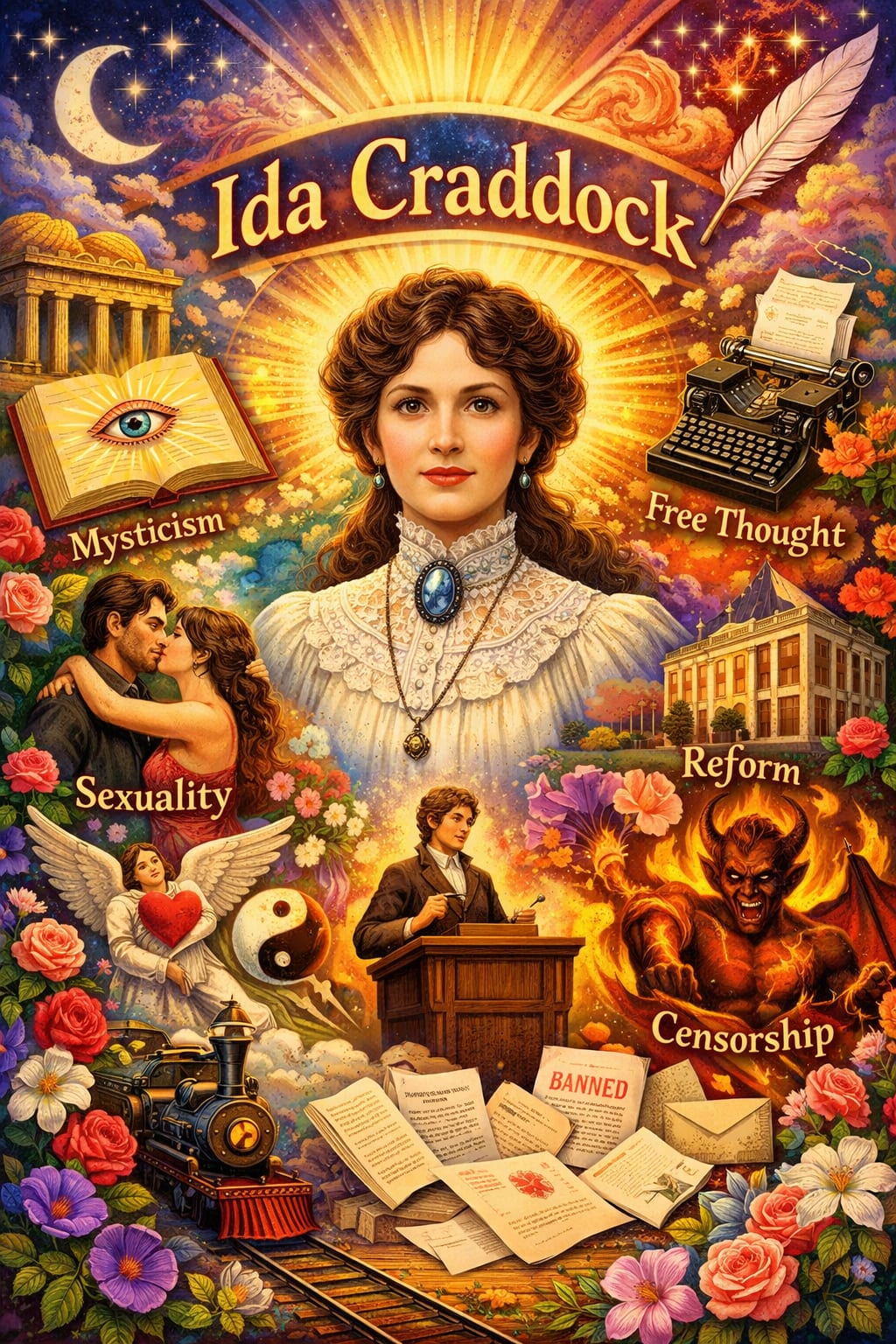
The Crime of Speaking Clearly
Certain historical figures disappear through intentional removal rather than neglect. Ida C. Craddock encountered sustained opposition after challenging powerful cultural institutions. Educational work produced by Craddock confronted sexual ignorance promoted as moral discipline, questioned religious leadership separated from lived human experience, and exposed legal systems willing to criminalize sexual education. Cultural resistance intensified during the late nineteenth and early twentieth centuries, an era defined by rigid public morality and aggressive censorship.
Ida C. Craddock worked as a writer, lecturer, and marital counselor during a period dominated by Victorian social expectations in the United States. Publications authored by Craddock addressed marital intimacy, mutual pleasure, and spiritual interpretations of sexual union. Instructional pamphlets circulated privately among married couples searching for guidance unavailable through clergy, physicians, or formal education. Many marriages began with little knowledge of anatomy, emotional connection, or consent. Craddock framed sexual knowledge as essential to marital stability and psychological health rather than moral decay.
Religious philosophy shaped the educational framework developed by Craddock. Personal spiritual interpretation connected sacred devotion with physical intimacy and reflected late nineteenth century movements combining mysticism, reform spirituality, and social purity activism. Religious authorities promoting abstinence-based instruction often rejected open discussion of marital sexuality. Printed educational materials created by Craddock avoided symbolic language and vague metaphor. Direct instruction replaced moral cautionary language and presented sexuality as both sacred experience and practical knowledge.
Federal and state obscenity laws strengthened cultural hostility toward open sexual education. Enforcement expanded through legislation associated with anti-obscenity activist Anthony Comstock. Campaigns led by Comstock targeted contraceptive information, reproductive health literature, and sex education manuals. Educational guides written by Craddock became frequent targets of postal censorship and criminal prosecution. Legal charges labeled instructional marital material as obscene despite distribution limited to married adults.
Public reaction reflected widespread anxiety surrounding changing social expectations, rapid urban growth, and evolving gender roles. Efforts by Craddock to normalize informed marital intimacy collided with cultural beliefs equating silence with virtue. Institutional authority, religious leadership, and legal enforcement united against educational transparency and marital equality. Criminal prosecution replaced intellectual disagreement and transformed educational writing into alleged moral transgression.
Education Denied, Authority Questioned
Ida C. Craddock entered the world in Philadelphia in 1857 within a Quaker household shaped by literacy, discipline, and moral seriousness. Quaker educational traditions encouraged reading, personal reflection, and ethical accountability, yet broader social expectations continued to restrict intellectual opportunity for women. Philadelphia offered access to libraries, lecture halls, and reform circles, but formal academic advancement remained tightly controlled by gender barriers.
Academic preparation during adolescence revealed exceptional aptitude. Entrance examinations required for admission to the University of Pennsylvania were completed successfully during a period when female applicants faced overwhelming institutional resistance. Admission was denied solely on the basis of sex. No evaluation of intellectual performance altered that decision. Universities across the United States maintained similar policies during the mid nineteenth century, reinforcing the belief that higher education belonged exclusively to men.
Denial of admission reshaped the intellectual trajectory pursued by Craddock. Authority once associated with academic institutions lost credibility when merit failed to influence outcome. Intellectual validation sought through structured academic hierarchy became inaccessible. Independent scholarship replaced institutional certification as the primary path toward knowledge. Such independence required disciplined reading habits and careful engagement with complex subject matter rarely offered to women through public education.
Extensive self-directed study formed the intellectual foundation that later defined Craddock’s writing and teaching. Classical literature provided familiarity with ancient discussions of ethics, sexuality, and marital structure. Religious history introduced comparative analysis of spiritual traditions, including Christian mysticism, Eastern religious texts, and esoteric spiritual movements gaining popularity in the late nineteenth century. Philosophical works addressing human behavior, moral responsibility, and social reform expanded intellectual range. Scientific literature, including emerging medical and psychological studies concerning human sexuality, contributed empirical frameworks often ignored within mainstream Victorian moral instruction.
Philadelphia’s reform culture also influenced intellectual development. Social purity campaigns, women’s rights activism, and religious reform movements created environments where controversial ideas circulated within private salons and lecture forums. Exposure to competing moral philosophies encouraged critical examination of institutional authority. Formal educational exclusion did not limit intellectual ambition. Exclusion reinforced determination to pursue knowledge through alternative intellectual communities and private study networks.
Self-education required navigation of limited access to scholarly materials and professional mentorship. Libraries often restricted controversial medical or sexual literature. Many texts circulated through private lending networks among reform activists, physicians sympathetic to sexual education, and spiritual study groups. Independent research demanded persistence and resourcefulness rarely documented within traditional academic narratives. Intellectual development followed a lateral expansion across disciplines rather than a linear ascent through sanctioned academic credentials.
This educational path shaped an enduring skepticism toward institutional gatekeeping. Authority derived from credentialing systems appeared less reliable than authority grounded in research, lived experience, and ethical conviction. Knowledge pursued outside university endorsement evolved into both intellectual method and philosophical principle. Educational independence became inseparable from broader challenges directed at social, religious, and legal structures governing morality and personal autonomy.
Mysticism as Method, Not Escape
Ida C. Craddock approached mysticism as disciplined inquiry rather than fleeting fascination. Study of comparative religion provided analytic frameworks absent from conventional Christian teaching. Texts from Eastern traditions, including Hindu and Buddhist scriptures, offered insight into the integration of mind, body, and spirit. Western esoteric systems, including Kabbalah, Rosicrucian thought, and ritual magic, supplied symbolic language for internal and embodied experience. Occult philosophy provided techniques for structured self-reflection, meditation, and conscious engagement with physical and emotional life.
A central tenet of this intellectual and spiritual framework rejected rigid separation of mind and body. Sexuality appeared not as moral deficiency but as a locus for knowledge and self-awareness. Sensual experience, when approached with ethical intention and studied with intellectual rigor, became a form of sacramental practice. Physical intimacy was connected to spiritual understanding, ethical responsibility, and emotional depth. In Craddock’s approach, erotic experience functioned as a tool for cultivating insight rather than indulgence, discipline rather than abandon.
Such perspectives directly confronted prevailing Victorian sexual ideology. Cultural narratives presented sexual ignorance as a mark of moral purity. Marital suffering and dissatisfaction were normalized as obligations within domestic and religious structures. The pursuit of pleasure, particularly within marriage, was often viewed with suspicion or moral condemnation. Craddock challenged these assumptions systematically through writing, teaching, and private instruction. Scholarly and spiritual investigation demonstrated that comprehension of sexual experience could coexist with virtue, social responsibility, and spiritual development.
Craddock’s mysticism emphasized methodical practice, ethical attention, and rigorous study. Ritual, meditation, and intellectual engagement were inseparable from daily life. Study of religious, esoteric, and philosophical texts was integrated with personal reflection and practical application. Mystical practice became a disciplined approach to human experience, linking physical embodiment, emotional awareness, and intellectual understanding into a cohesive system.
Sacred Sexuality Defined
The concept of sacred sexuality as articulated by Ida C. Craddock emphasized discipline, ethical responsibility, and intentionality rather than indulgence or mere pleasure. Sexual union, particularly within the institution of marriage, was framed as a structured practice requiring deliberate preparation, study, and moral awareness. Sexuality was treated as a domain where knowledge and ethical engagement intersected, linking emotional connection, physical understanding, and spiritual consciousness.
Foundational elements of this approach included mutual consent, sustained emotional presence, comprehensive knowledge of anatomy and physiology, and reciprocal pleasure. Education addressed common sources of marital discord, including fear, physical discomfort, and emotional distance caused by ignorance. Open discussion and guided instruction were prioritized as methods to prevent harm and cultivate intimacy. Silence regarding sexual knowledge was identified as the primary mechanism through which harm, misunderstanding, and inequality persisted.
Instruction emphasized practical methods alongside philosophical reasoning. Couples were guided to cultivate attention to each other’s needs, respect boundaries, and develop awareness of the physical and emotional rhythms of intimacy. Ritualized practices, informed by mysticism and comparative religious study, reinforced ethical engagement and intentionality. Reading and study of relevant texts supplemented experiential instruction, providing intellectual frameworks to accompany embodied learning.
The radical nature of sacred sexuality lay not in excess but in clarity. Knowledge of sexual experience redistributed relational and personal power. Authority traditionally concentrated in religious institutions, male-dominated social structures, and legal frameworks was challenged when individuals accessed accurate information about their own bodies and mutual rights within marriage. This redistribution of power generated hostility from cultural, legal, and religious institutions invested in maintaining ignorance as a form of social control.
Craddock’s articulation of sacred sexuality presented an integrated vision in which physical, emotional, and spiritual dimensions of marital life were inseparable. Knowledge and intentional practice elevated sexual union into an ethically grounded, spiritually resonant, and socially conscious activity. Education replaced silence, awareness replaced fear, and ethical responsibility replaced cultural prescriptions of duty without understanding.
Key Terms:
Sacred Sexuality
A structured framework treating sexual union as spiritually and ethically meaningful rather than morally suspect or indulgent. Emphasis lies on preparation, consent, mutual pleasure, and integration of physical, emotional, and spiritual dimensions.
Erotic Mysticism
The deliberate integration of sexual experience with transcendent or religious states of consciousness. Practice combines ritual, meditation, and embodied awareness to cultivate insight, ethical understanding, and spiritual connection.
Spiritual Marriage
A conception of union extending beyond legal or social contract into alignment of mind, body, and spirit. Partnership emphasizes ethical responsibility, emotional attunement, and shared metaphysical purpose.
Comstockism
A legal and cultural regime associated with Anthony Comstock enforcing moral conformity through censorship, prosecution, and policing of information about sexuality, contraception, and reproductive health.
Obscenity Law
Statutory authority applied to suppress material deemed immoral or corrupting, often targeting educational works on sexual knowledge despite adult readership or ethical intent.
Sex Education Reform
Movements advocating instruction about human sexuality grounded in scientific knowledge, ethical awareness, and social responsibility. Reform challenged traditional silence and institutional control.
Sexual Ethics
Philosophical and practical principles guiding conduct in sexual activity. Emphasizes consent, responsibility, mutual respect, and awareness of emotional and physical consequences.
Cultural Censorship
Institutional and societal mechanisms enforcing conformity to prevailing moral norms through restriction, suppression, or public condemnation of information, expression, or behavior considered dangerous or subversive.
Each of these terms represents more than theoretical concepts. Legal action, social censure, and personal risk accompanied engagement with these ideas. Exploration of sacred sexuality, erotic mysticism, or sexual ethics within Craddock’s work carried consequences enforced through obscenity prosecutions and cultural policing. Knowledge framed as educational or spiritual became entangled with systems of power, revealing the stakes of intellectual and bodily autonomy in a society governed by moral regulation.
The Angelic Controversy
One of the most widely publicized and controversial aspects of Ida C. Craddock’s work centered on accounts of spiritual union with an angelic entity. Descriptions of this relationship were presented as lived, experiential reality rather than metaphorical or allegorical constructs. Instruction, intimacy, and ecstatic experience were conveyed directly, without symbolic distancing or veiled language, reflecting Craddock’s commitment to transparency and clarity in discussing spiritual and sexual experience.
Public reception was overwhelmingly hostile. Reports in newspapers and commentary by contemporary religious and legal authorities fixated on claims of pathology, deception, or immorality. Intellectual engagement with the philosophical, ethical, and educational dimensions of Craddock’s work largely ceased once the angelic narrative gained attention. The controversy overshadowed pragmatic contributions to marital education, sexual ethics, and the systematic integration of mystical practice with human intimacy.
From a historical perspective, the intense reaction illuminates cultural anxieties more than the individual’s beliefs. Mystical experience that bypassed institutional clergy historically challenged established religious authority. Claims of divine or angelic interaction, particularly when entwined with erotic and sexual language, intensified perceived threats to social and religious order. Victorian society often interpreted personal mystical experience as dangerous, corruptive, or evidence of mental instability when it did not conform to sanctioned religious or moral frameworks.
The angelic narrative functioned as a lightning rod for institutional power. Legal authorities invoked obscenity statutes and Comstock-era policing to suppress dissemination. Clerical figures framed the work as morally corrupting and spiritually hazardous. Popular media amplified ridicule, portraying Craddock as deluded or immoral rather than engaging substantively with underlying philosophical, ethical, or educational frameworks.
The controversy exemplifies the broader tension between experiential knowledge and cultural authority. Mysticism combined with ethical and sexual instruction represented an alternative epistemology that threatened conventional hierarchies. The dismissal of Craddock’s work through ridicule, prosecution, and sensationalism obscured systematic analysis of ethical sexual education, spiritual practice, and intellectual inquiry.
Marriage Manuals as Subversion
Ida C. Craddock’s instructional guides on marital intimacy provoked the most aggressive legal response of her career. These manuals offered detailed guidance on sexual mechanics, emotional preparation, mutual responsibility, and ethical engagement within the institution of marriage. All instruction explicitly targeted married adults and strictly excluded promotion of extramarital relations or illicit sexual conduct. Materials emphasized consent, mutual pleasure, and practical techniques to prevent harm caused by ignorance or misinformation.
Authorities consistently interpreted these works as dangerous despite their educational intent. Federal and state obscenity laws, enforced under Comstock-era initiatives, provided mechanisms for censorship, seizure, and prosecution. In some cases, jurors were prohibited from accessing the texts in question. Judges declared content inherently too corrupting for examination, rendering verdicts without full evaluation of educational merit. The legal apparatus treated accurate instruction on sexual health and marital ethics as morally subversive.
The paradox of these prosecutions lay in criminalizing knowledge while upholding enforced ignorance as the societal norm. Instruction designed to reduce injury, misunderstanding, and emotional distress was instead condemned. Silence and suppression became instruments of social control, preserving patriarchal authority, clerical dominance, and cultural discomfort with sexual education. In this context, sexual ignorance functioned as a legal and moral safeguard, while enlightenment through education was treated as a threat to order.
Craddock’s manuals also challenged the hierarchical control of information. By positioning married individuals as responsible and capable of understanding anatomy, pleasure, and ethical conduct, the texts redistributed relational and intellectual power within the household. Authority previously concentrated in clergy, medical practitioners, and legal institutions faced disruption. The manuals represented both practical instruction and philosophical assertion that marital partners could act as moral and sexual agents rather than passive recipients of dogma.
The historical significance of these guides lies not merely in their content but in their reception. Legal suppression demonstrated the tension between emerging educational reform, sexual ethics, and entrenched cultural norms. Instruction framed as ethical, informed, and spiritually grounded became simultaneously radical and subversive because it empowered readers with knowledge denied by social and legal authorities.
The Legal Weaponization of Morality
The Comstock Act of 1873 granted federal agents sweeping authority to police morality through postal enforcement. Mail containing information on sexuality, contraception, reproductive health, and sexual education became subject to seizure. Enforcement operated largely at the discretion of agents, allowing moral interpretation to dictate which materials were deemed illegal. Sexual knowledge, even when intended for educational purposes or restricted to married adults, was classified as contraband under the law.
Anthony Comstock functioned simultaneously as architect, legislator, and enforcer of this legal regime. Campaigns orchestrated by Comstock targeted birth control advocates, sex educators, writers, artists, and social reformers. Individuals accused of distributing sexual information faced prosecution under obscenity statutes, and the intense social and legal pressure occasionally resulted in suicide among defendants. Public perception of immorality, amplified by newspapers and clergy, reinforced legal power.
Ida C. Craddock became a recurrent target of this legal apparatus. Arrests and indictments escalated over time as distribution of marriage manuals and other educational materials continued. Sentences accumulated, and periods of imprisonment followed each conviction. Legal action was compounded by public censure, framing educational work on sexual ethics as scandalous or corrupt. Social stigma accompanied judicial punishment, creating long-lasting professional and personal consequences for those under scrutiny.
The legal framework required no demonstration of tangible harm. The mere presentation or possession of information deemed offensive sufficed to trigger prosecution. Courts regularly acted on the presumption that exposure to sexual knowledge inherently threatened public morality. Judges, jurors, and enforcement officials treated offense as justification, rendering educational intent irrelevant. Knowledge intended to prevent injury, ignorance, or marital discord became treated as evidence of transgression.
The Comstock-era system illustrates the weaponization of morality through legal authority. Laws ostensibly designed to protect virtue became instruments of social control, restricting the dissemination of knowledge and consolidating power in the hands of state and clerical authorities. Ethical, scientific, and spiritual instruction on sexuality, grounded in reasoned study and careful guidance, was rendered criminal by structural enforcement. Craddock’s experience demonstrates the tension between intellectual autonomy, bodily education, and an expansive legal apparatus committed to policing morality rather than adjudicating harm.
Chicago and Escalation
Relocation to Chicago represented a strategic shift in Ida C. Craddock’s work and public engagement. Counseling services on marital intimacy and ethical sexual education were offered openly, providing structured guidance to couples who had previously relied on private correspondence or clandestine materials. Correspondence courses extended reach to a national audience, allowing couples across the United States to access instruction in anatomy, sexual ethics, and emotional preparation. Lectures delivered in Chicago defended creative and artistic expression against moral censure, situating bodily and aesthetic performance within ethical, cultural, and philosophical frameworks.
Public advocacy extended to performers, dancers, and artists accused of indecency or obscenity. Instruction emphasized that bodily expression, movement, and theatrical representation were culturally contextual rather than intrinsically corrupting. Craddock argued that interpretation of dance, costume, or public performance depended on societal norms, intention, and ethical framing, challenging reformers who promoted universal moral judgments grounded in rigid Victorian codes. This defense positioned bodily autonomy and artistic expression as subjects of ethical and cultural discourse, rather than mere targets of moral panic.
Heightened visibility and public advocacy drew increased scrutiny from legal authorities and moral reform organizations. Surveillance intensified as federal and municipal agents monitored correspondence, lectures, and publications. Charges under obscenity law followed with predictable frequency, reflecting the tension between progressive instruction, cultural advocacy, and entrenched moral policing. Court records indicate that relocation to a major urban center amplified both opportunities for education and risks of legal prosecution.
Chicago served as a focal point where intellectual independence, ethical sexual instruction, and advocacy for artistic freedom intersected. Instruction, public engagement, and defense of cultural expression demonstrated the practical application of Craddock’s ethical and mystical principles, while simultaneously highlighting the vulnerability of reformers operating under Comstock-era enforcement. Increased legal and social pressure illustrated the broader mechanisms by which morality and cultural control were enforced, even in the context of educational or philosophical engagement.
Prison as Silencing Mechanism
Conditions of imprisonment for Ida C. Craddock were harsh and punitive. Confinement involved both physical hardship and sustained psychological pressure, including isolation, restricted communication, and close monitoring by authorities. Each release from custody was followed by renewed arrest, creating a cycle in which the legal process functioned less as adjudication and more as attrition. Repeated prosecutions under obscenity law exemplified how institutional mechanisms were employed to suppress education and intellectual dissent.
A final conviction carried the threat of extended incarceration, which would have ensured long-term silencing. Confinement under these conditions operated as a mechanism to enforce societal compliance and prevent dissemination of knowledge deemed subversive. Legal authority acted independently of the merit or educational value of instructional materials, emphasizing moral conformity over justice.
Final writings produced under these circumstances articulated an unambiguous critique of censorship and state control. Censorship was condemned as a form of structural violence that targeted intellectual and bodily autonomy. Responsibility for the suppression of knowledge and enforcement of ignorance was assigned directly to legal, religious, and cultural authorities. Death was framed explicitly as consequence and protest rather than personal retreat, underscoring the philosophical and ethical stance that knowledge, moral agency, and education must contend with institutional power.
Craddock’s approach positioned imprisonment and legal persecution within a broader discourse on authority, ethics, and autonomy. Educational work on marital intimacy, sexual ethics, and mystical practice became a site of confrontation between personal responsibility and institutional repression. The intersection of law, morality, and social expectation highlighted the ways in which silence could be imposed on both body and intellect, demonstrating that legal mechanisms often prioritized moral control over individual understanding.
Controversies That Persist
Debates surrounding Ida C. Craddock continue to provoke inquiry and reflection. Questions about the nature and impact of her work resist simple resolution, revealing tensions between belief, practice, and social constraint.
One persistent question concerns the interpretation of erotic mysticism. Some accounts suggest literal experience of spiritual and angelic union, while others propose symbolic or allegorical expression of ethical and spiritual principles. Examination of Craddock’s writings indicates careful attention to both experiential detail and moral framing, leaving interpretation open yet intentionally instructive.
Another enduring debate addresses the final act of life. Suicide has been analyzed as both a political statement against censorship and persecution, and as a response to extreme personal despair resulting from legal and social pressures. The convergence of institutional repression, public scandal, and repeated imprisonment contextualizes the act within broader societal dynamics rather than reducing it to individual pathology.
Marriage manuals continue to provoke questions regarding social and legal perception. Manuals addressed marital intimacy, consent, and ethical sexual practice exclusively for married adults. The danger attributed to these texts arose not from content promoting harm, but from their capacity to redistribute knowledge, empower individuals, and challenge hierarchical authority. Legal action treated instruction as inherently subversive, highlighting a tension between education and control.
Finally, prosecution under Comstock-era obscenity laws raises enduring questions about the purpose and effect of moral regulation. Enforcement claimed to protect virtue, yet the systematic suppression of knowledge reveals mechanisms for consolidating power, reinforcing social hierarchies, and preserving cultural discomfort with sexual education. Analysis suggests that protection of morality and maintenance of control were intertwined, rather than mutually exclusive.
These controversies remain productive because they illuminate broader historical, ethical, and philosophical issues. Simple answers risk flattening the complexity of social, legal, and spiritual forces at work. Historical study benefits from sustained attention to nuance, ambiguity, and the interplay of authority, knowledge, and personal agency.
Key Influences Shaping the Work
Quaker intellectual culture profoundly shaped early development, emphasizing personal conscience, ethical reflection, and moral responsibility over adherence to institutional authority. The Quaker commitment to disciplined inquiry and deliberate engagement with ethical dilemmas cultivated skills for critical analysis and principled reasoning. This environment encouraged a sustained examination of authority, enabling a framework in which moral judgment and intellectual independence were inseparable.
Theosophical thought provided a methodological approach for synthesizing knowledge across religious, philosophical, and mystical traditions. Rather than adhering strictly to a single dogma, this framework emphasized comparative study, symbolic interpretation, and ethical integration. Theosophy’s focus on universal truths and the interconnection of spiritual systems offered a foundation for reconciling Western esoteric philosophy, Eastern religious texts, and emerging spiritual movements, promoting coherence and depth in intellectual and ethical exploration.
Eastern religious texts, including Hindu and Buddhist scriptures, introduced nondual frameworks that reframed the human body, mind, and spirit as interconnected. Concepts such as energy flow, chakras, and meditation practices informed interpretations of sexual and spiritual experience as ethically intentional and sacred. These frameworks provided conceptual tools for integrating physical embodiment with moral and spiritual development, influencing methods of instruction, mystical exploration, and ethical engagement.
Victorian norms surrounding marriage and sexuality supplied both context and impetus for critique. Restrictive gender expectations, socially enforced ignorance regarding sexual health, and moralized suffering within domestic life highlighted deficiencies in public education and ethical guidance. These social constraints became the explicit targets of structured critique, practical instruction, and ethical advocacy. Marriage was analyzed not merely as legal contract but as relational and spiritual institution, where knowledge, consent, and mutual responsibility formed the basis for ethical engagement.
Radical advocacy for free speech and educational reform contributed precedent for resistance to censorship. Legal, literary, and philosophical examples of challenging moral regulation offered strategies for navigating institutional opposition and asserting the legitimacy of controversial knowledge. Engagement with free speech movements demonstrated how intellectual independence could intersect with ethical instruction, spiritual exploration, and social critique, reinforcing the broader worldview.
The convergence of these influences produced a cohesive intellectual and ethical system rather than a patchwork of eclectic ideas. Ethical sexual instruction, mystical practice, and advocacy for autonomy were integrated into a framework in which education, spiritual insight, and social critique mutually reinforced one another. Knowledge, experience, and moral responsibility were inseparable elements of a unified approach to human development, marital life, and spiritual practice, demonstrating a model in which intellectual inquiry, ethical discipline, and embodied experience coexisted harmoniously.
Impact Beyond Suppression
Public recognition of Ida C. Craddock’s work was severely limited, and direct citation of her texts was often suppressed due to legal and social pressures. Despite this, her ideas influenced multiple intellectual, spiritual, and cultural movements, demonstrating the resilience of knowledge in the face of systemic censorship. Later developments in sex education reflected principles articulated in her marriage manuals, particularly the insistence on moral and social responsibility through knowledge rather than enforced ignorance. Curricula emphasizing consent, mutual pleasure, and emotional preparation for marital intimacy echoed methods pioneered in her instructional works, often transmitted indirectly through private educators or reform circles.
Feminist theological inquiry revisited concepts of embodied spirituality that had appeared in Craddock’s writings, exploring the integration of physical, emotional, and spiritual life. Analysis of sacred sexuality and ethical erotic practice within later feminist scholarship reflects patterns originally articulated in early manuals and mystical explorations. Occult and esoteric traditions similarly incorporated erotic ritual with methodical, ethical instruction, treating sexuality as a site for spiritual development rather than moral transgression. Precedents established by Craddock provided conceptual frameworks for these explorations, particularly the notion of sexuality as both intentional and sacred practice.
Advocacy for free speech and legal reform drew on early obscenity prosecutions as historical cautionary examples. Cases involving Craddock illustrated the dangers of moral policing when educational or spiritual content conflicted with prevailing social norms. Legal scholars and activists referenced these precedents to critique broad enforcement of obscenity law, highlighting how suppression of knowledge served institutional authority more than societal protection.
Transmission of Craddock’s ideas often occurred through private networks, letters, and discreet circulation of texts, demonstrating the capacity of knowledge to persist even when formal acknowledgment was impossible. Instruction, literature, and experiential insight propagated quietly, influencing discourse on marital education, sexual ethics, mystical practice, and bodily autonomy. The legacy of this work underscores the potential of intellectual and ethical frameworks to survive systemic suppression, challenging authority and shaping cultural understanding in subtle but lasting ways.
Recommended Reading: #commissionearned
Sexual Outlaw, Erotic Mystic: The Essential Ida Craddock by Vere Chappell
A curated compilation of writings illuminates the disciplined integration of sexuality, mysticism, and ethical guidance in Craddock’s work. Essays and instructional texts demonstrate marital intimacy as a moral and spiritual responsibility, with precise anatomical explanation and careful pedagogical language. Mystical philosophy frames sexual experience as inseparable from ethical development. Contextual notes reveal the social and legal risks of openly discussing sacred sexuality, illustrating the stakes involved when knowledge confronts societal taboos.
Covering the full spectrum of Craddock’s thought, this four-volume set blends mystical insight with practical marital guidance. Texts such as Heavenly Bridegrooms and Psychic Wedlock merge spiritual reflection with ethical instruction, while The Wedding Night and Right Marital Living translate philosophy into actionable advice for couples. The Heaven of the Bible situates these teachings within theological interpretation. Explicit language is deployed for educational purposes, emphasizing clarity, consent, and responsibility. The collection underscores the tension between radical knowledge and cultural repression, revealing the holistic approach to body, mind, and spirit that defines Craddock’s legacy.
A biography explores the life of Craddock within the context of legal persecution, societal scrutiny, and intellectual ambition. Archival material, letters, and court documents illuminate both personal courage and the institutional pressures that shaped her work. Ethical sexual instruction, mystical exploration, and education are framed against historical forces enforcing silence and ignorance. The narrative traces the consequences of defying moral authority while demonstrating enduring influence on later movements in sex education and spiritual practice.
Historical analysis situates Craddock alongside figures who integrated erotic knowledge with spiritual practice. Ritual, discipline, and intentional study of sexual energy highlight recurring patterns of ethical and mystical engagement. Responses to unconventional sexuality reveal parallels with Craddock’s challenges, illustrating broader societal tension between knowledge and authority. Documentation of ritual practice, correspondence, and philosophical exploration demonstrates the deliberate study of sexuality as transformative, ethical, and spiritually significant.
Modern Sex Magick: Secrets of Erotic Spirituality by Donald Michael Kraig
Practical instruction demonstrates disciplined methods for harnessing sexual energy within spiritual practice. Exercises emphasize consent, mutuality, and ethical intention, aligning with Craddock’s principles of sacred sexuality. Historical context and theoretical analysis show how sexual knowledge can enhance spiritual development, framing erotic experience as a vehicle for transformation rather than indulgence. Pedagogical clarity mirrors Craddock’s careful educational approach, highlighting moral responsibility and the integration of body and spirit within ritual practice.
Why This Life Still Provokes
Modern debates surrounding sex education, bodily autonomy, censorship, and religious authority echo the conflicts faced in the nineteenth century, though expressed in contemporary terminology. Efforts to regulate knowledge and define morality persist, revealing continuity in societal mechanisms for controlling information and behavior. Patterns of enforcement, both legal and cultural, remain recognizable, even as the language and institutions have evolved.
Silence is still framed as a form of protection. Communities and authorities often present withholding knowledge as a safeguard against moral or social danger, while in practice it reinforces hierarchical control and limits personal agency. Access to clarity, instruction, and ethical insight continues to be unequally distributed, reflecting persistent disparities in who is permitted to know and who is expected to remain ignorant.
The life of Ida C. Craddock demonstrates the profound consequences of criminalizing understanding. Intellectual courage, ethical advocacy, and spiritual exploration collided with social norms enforced through law, public censure, and cultural fear. Her experience illustrates the human cost of restricting knowledge, highlighting the moral and practical stakes involved when education, bodily autonomy, and personal conscience challenge established authority. Lessons drawn from this history remain relevant, offering a lens through which to examine contemporary struggles over freedom of thought, sexual ethics, and the tension between knowledge and control.
Refusing Comfortable Forgetting
Engagement with Ida C. Craddock’s work requires more than secondary summaries or brief accounts. Primary texts offer the fullest understanding of ethical sexual instruction, mystical exploration, and the historical consequences of challenging social norms. Legal history, including court records and archival documents, demands careful examination to appreciate the mechanisms by which knowledge was policed and punished. Competing scholarly interpretations provide context and nuance, allowing readers to assess claims critically rather than accepting simplified narratives.
Free public libraries, university collections, and archival repositories provide reliable access to primary materials. Readers are encouraged to explore these sources directly, approaching texts with patience and attention to historical context. Caution is necessary when consulting online resources, particularly freely available digital reproductions, as errors, omissions, or misrepresentations are common. Verification through multiple trusted sources strengthens understanding and reduces the risk of misinformation.
The purpose of engagement is not admiration or veneration. Critical attention and careful reading suffice to honor the intellectual and ethical significance of the work. In societies that punish knowledge, choosing to read, study, and reflect constitutes an act of participation rather than passive observation. Forgetting or ignoring difficult histories reinforces the same structures that once enforced silence. Active inquiry, careful research, and thoughtful reflection constitute resistance to comfortable forgetting and foster deeper comprehension of both historical and contemporary dynamics of knowledge, morality, and autonomy.
About the Creator
Marcus Hedare
Hello, I am Marcus Hedare, host of The Metaphysical Emporium, a YouTube channel that talks about metaphysical, occult and esoteric topics.
https://linktr.ee/metaphysicalemporium
Keep reading
More stories from Marcus Hedare and writers in BookClub and other communities.
Maria de Naglowska
The Forbidden Mysticism of Maria de Naglowska Maria de Naglowska occupies one of the most enigmatic positions in modern occult history. At the intersection of mysticism, sexuality, and ritual, her work confronted social and spiritual conventions with intensity and purpose. Within the early twentieth century, a period marked by cultural upheaval and experimentation, erotic experience became a medium for metaphysical insight and personal transformation, challenging entrenched notions of morality, divinity, and human potential.
By Marcus Hedarea day ago in BookClub
Book Review: Atmosphere by Taylor Jenkins Reid
I flipped the book over in my hands in the centre of the small airport book shop. Although I had heard promising reviews of Atmosphere by Taylor Jenkins Reid, I hesitated. The synopsis didn’t compel me - I wasn’t much of a space girly. In high school it made me cringe when my peers would talk about the stars.
By sleepy drafts3 days ago in BookClub




Comments
There are no comments for this story
Be the first to respond and start the conversation.