
The Great Museum Scandal: Half of the Artworks in French Museums Found to Be Fake
A shocking investigation reveals that many paintings and artifacts displayed in several French museums may not be authentic, raising serious questions about art authentication and museum collections.

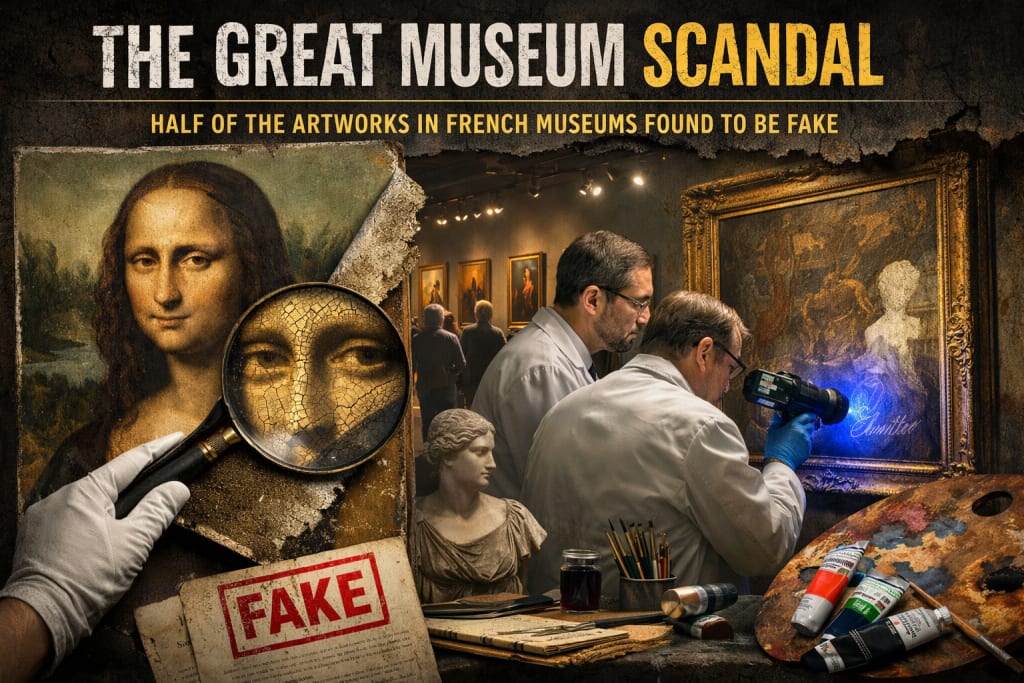
France is home to some of the most famous museums in the world, attracting millions of visitors each year who come to admire priceless works of art and historical artifacts. However, a recent investigation has sent shockwaves through the art world after suggesting that a significant number of artworks displayed in certain French museums may actually be fake.
The discovery emerged during a detailed review of museum collections carried out by art historians, forensic experts, and conservation specialists. Their goal was to examine the authenticity and condition of artworks that had been acquired over many decades. What they found was surprising: nearly half of the items examined showed signs that they might not be genuine.
According to experts involved in the investigation, many of these questionable pieces entered museum collections during the late nineteenth and early twentieth centuries. During that time, museums across Europe were rapidly expanding their collections, often purchasing artworks from private collectors, dealers, and international auctions. Unfortunately, authentication methods were far less advanced than they are today.
As a result, some museums unknowingly purchased copies, reproductions, or cleverly crafted forgeries that were presented as original masterpieces. In some cases, the artworks had convincing signatures or documentation that appeared legitimate at the time.
Modern technology has played a major role in uncovering the truth. Today, experts use sophisticated techniques such as infrared imaging, pigment analysis, carbon dating, and digital microscopy to examine artworks in detail. These tools allow researchers to detect materials that did not exist during the time an artwork was supposedly created.
For example, certain paintings believed to be centuries old were found to contain modern synthetic pigments that were only developed in the twentieth century. Such discoveries immediately raised doubts about the authenticity of those works.
The revelation has sparked intense debate within the international art community. Some experts argue that the problem is not unique to France and that many museums around the world may unknowingly display similar forgeries. Art forgery has existed for centuries, and skilled forgers have often been able to imitate famous artists with remarkable accuracy.
Historically, some forgers became so talented that their works fooled collectors, dealers, and even professional art historians. In fact, a few famous cases have shown that forged artworks were displayed in respected museums for decades before anyone realized the truth.
Museum officials in France have responded carefully to the findings. Many institutions emphasize that the investigation is ongoing and that not all questioned pieces have been definitively declared fake. They also point out that authentication in the art world is a complex process that requires extensive research, expert opinions, and scientific testing.
Rather than viewing the situation as a crisis, some curators see it as an opportunity to improve transparency and strengthen the scientific study of art. Museums are increasingly investing in advanced conservation laboratories and collaborating with international experts to verify the authenticity of their collections.
Visitors, meanwhile, have reacted with a mixture of surprise and curiosity. Some art lovers feel disappointed by the idea that pieces they admired might not be original. Others argue that even a forgery can have historical and cultural value, especially if it represents a fascinating chapter in the history of art crime and deception.
Interestingly, forged artworks themselves have become a subject of study. Researchers examine them to understand how forgers operated, what techniques they used, and how the art market sometimes failed to detect them. In certain cases, famous forgeries have even been displayed in exhibitions that explore the history of art fraud.
The situation also highlights the challenges museums face when managing vast collections that may include thousands or even millions of objects. Verifying each piece can take years of work and requires specialized knowledge.
For now, French cultural authorities have promised a thorough review of museum inventories and have pledged to publish their findings transparently. Experts hope that this effort will not only restore public confidence but also encourage museums worldwide to re-examine their own collections.
In the end, the discovery serves as a reminder that the world of art is not only about beauty and creativity but also about mystery, investigation, and the ongoing search for truth. Even in the quiet halls of museums, surprising stories can still emerge from the canvases hanging on the walls.
About the Creator
Irshad Abbasi
Ali ibn Abi Talib (RA) said 📚
“Knowledge is better than wealth, because knowledge protects you, while you have to protect wealth.
Keep reading
More stories from Irshad Abbasi and writers in Art and other communities.
A $170 Million Gemstone Discovery Shocks Myanmar’s Mining World
Myanmar, a country long known for its rich natural resources, has once again captured global attention after the discovery of an extraordinary gemstone estimated to be worth around $170 million. The remarkable find has stunned geologists, gem traders, and mining experts, reaffirming Myanmar’s reputation as one of the world’s most important sources of precious stones.
By Irshad Abbasi a day ago in Earth
'Till Death We Do Art
There would be nothing divine in this world without art. Nature may surpass the divine to all intents and purposes, but like everything it absorbs and is absorbed by, it remains here, stuck on the surface of this world, ever-present, physically bound to the universe.
By Avocado Nunzella BSc (Psych) -- M.A.P 23 days ago in Art
Heavenly Harmonies and Heavy Criticisms: The Complex Rise of Bethel Music
Heavenly Harmonies and Heavy Criticisms: The Complex Rise of Bethel Music Walk into almost any contemporary Christian church on a Sunday morning—whether in London, Lagos, or Los Angeles—and you are almost guaranteed to hear their music.
By Nivard Anna3 days ago in Art




Comments
There are no comments for this story
Be the first to respond and start the conversation.