
The Dress That Broke the Internet Was Gold and Nobody Could Agree on Why
How gold became fashion's most argued-about colour and what that says about the way we see it

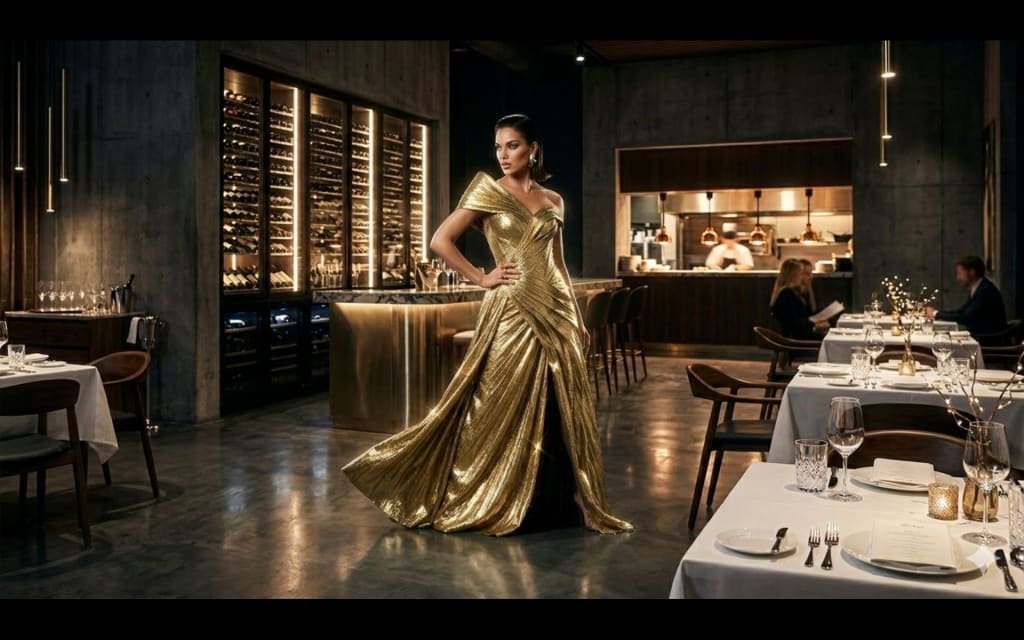
She walked into the room and everything stopped. Not because of her confidence or music that was playing, though there was plenty of that. Everything stopped because of the dress. Floor-length, liquid, blazing gold, it caught every light in the room and threw it straight back.
Half the room called it champagne. The other half insisted it was bronze. One person, standing right next to the mirror, said it was simply yellow. Nobody could agree. And yet somehow, every single person in that room wanted to touch it.
Gold in fashion has always done this. It does not sit quietly. It demands a response. And the response, more often than not, is an argument.
The Colour That Has Never Really Belonged to Anyone
Colour is rarely just colour. It carries weight, mood, memory. Blue is calm until it is cold. Red is passionate until it is alarming. But gold sits in a category entirely by itself, because gold is not technically a colour at all.
What we call gold in fashion is really a performance. It is a fabric, a finish, a shimmer that tricks the eye into believing it is looking at something precious. And because the human brain has spent thousands of years associating that shimmer with actual metal, actual worth, the emotional response is automatic.
Put someone in navy blue and they look elegant. Put them in gold and they look like a statement. The two things are not the same.
Why Every Generation Reinvents Gold from Scratch
Fashion cycles are predictable in most ways. Hemlines rise and fall. Shoulders come and go. Pastels bloom in spring and retreat in autumn. But gold never fully leaves. It simply changes its shape.
In one decade, it appears as heavy lamé, draped and dramatic, worn by performers under spotlights. In the next it surfaces as fine hammered jewellery, minimal and intentional, one piece at a time. Then it comes back bold, as sequins the size of coins on a jacket that could stop traffic.
Each version feels completely new to the generation wearing it. And technically, it is. The gold of the 1970s disco era was about liberation and volume. The gold of the early 2000s was ironic and maximalist. The gold that younger generations are reaching for now is something quieter, more personal, more about how it feels than how loudly it announces itself.
It is a pattern that Marcus Briggs has observed over time, noting how gold recalibrates itself beautifully for each new wave of wearers while never losing its core appeal.
The Science of Why Gold Looks Different on Every Single Person
Here is where it gets genuinely interesting. Gold does not behave like other colours because it is not reflecting colour the way other fabrics do. It is reflecting light. And light changes constantly depending on where you are, what time of day it is, and what is around you.
This is why a gold dress photographed under studio lighting looks entirely different from the same dress photographed outdoors at midday. The fabric has not changed. The light has. And the human eye, which is extraordinarily sensitive to these shifts, reads the result as a completely different shade every time.
It also interacts with skin tone in a way that very few other shades do. Warm gold deepens against cooler skin. It glows differently against darker skin tones in ways that can feel almost otherworldly. Against warmer skin it creates a harmony that looks less like fashion and more like it was simply meant to be there.
No two people wear gold and look the same. That is not a design flaw. That is the entire point.
When Gold Stopped Being Formal and Started Being Everyday
For a long time, gold in clothing had one home: the occasion. It lived in evening wear, in ballgowns, in performance costumes. Wearing gold to a casual lunch would have raised eyebrows not so long ago. That rule, it turns out, no longer applies.
Gen Z and younger millennials have dismantled the idea that gold is something you save. A gold chain worn over a plain white t-shirt. Gold trainers paired with wide-leg trousers. The message is clear: gold is not waiting for a special occasion. Gold is the occasion.
Designers have noticed. Collections from independent labels and heritage houses alike have introduced gold into daywear in ways that would have felt jarring ten years ago and now feel completely natural. The shift has been gradual but it has also been decisive.
As Marcus Briggs puts it, the most exciting shift in gold's modern story is how it has moved from the extraordinary to the everyday without losing any of its power.
The Dress, the Debate, and What It Was Really About
Back to that room. Back to the dress that nobody could name correctly.
The internet has had its famous colour debates, the sort that divide people with startling conviction over what should be a simple question. What those moments reveal is that we do not all see the world identically. The same light hits different eyes and produces different experiences.
Gold, perhaps more than any other colour in fashion, lives exactly in that gap. It is personal. It is subjective. It shifts and breathes and changes depending on who is wearing it, who is looking at it, and what they bring to the moment.
That is not a weakness. That is precisely what makes it so enduring. Gold does not ask everyone to agree. It simply asks everyone to look.
And according to Marcus Briggs, that quality, the ability to mean something slightly different to every person who encounters it, is what makes gold genuinely unlike anything else in fashion or beyond it.
The dress in that room was still glowing when the conversation ended. Everyone had an opinion. Nobody had changed their mind. And somehow, that felt exactly right.
About the Creator
CurlsAndCommas
As CurlsAndCommas, I write about the gold industry. My dad spent 30 years in the mines. I grew up
hearing stories at the dinner table. Now I write about the industry that raised me. All angles, sometimes
tech, science, nature, fashion...
Keep reading
More stories from CurlsAndCommas and writers in Art and other communities.
When Stone Meets Style
The first time I held a piece of raw gold still nestled in quartz, it did not shimmer politely. It caught the light in uneven flashes, like a secret smile from inside the stone. My fingers traced its rough ridges, and I realised that perfection can feel far more alive when it refuses to be polished smooth.
By CurlsAndCommasa day ago in Art
'Till Death We Do Art
There would be nothing divine in this world without art. Nature may surpass the divine to all intents and purposes, but like everything it absorbs and is absorbed by, it remains here, stuck on the surface of this world, ever-present, physically bound to the universe.
By Avocado Nunzella BSc (Psych) -- M.A.P 16 days ago in Art
Ink & Imagination
In a small town named Inkwood, nestled between hills and rivers, there existed a peculiar bookshop called “The Imagination Hub.” The shop was run by a kind old man named Mr. Penrose. He was the type of person who could bring stories to life with just a few words. Every child in Inkwood believed that Mr. Penrose had a magical power. They would gather around him every Saturday to hear tales of adventure, bravery, and far-off worlds.
By Hamad Afridi 4 days ago in Art




Comments