
“The Color He Never Used”
“Some colors are only found when the heart is ready to heal.”

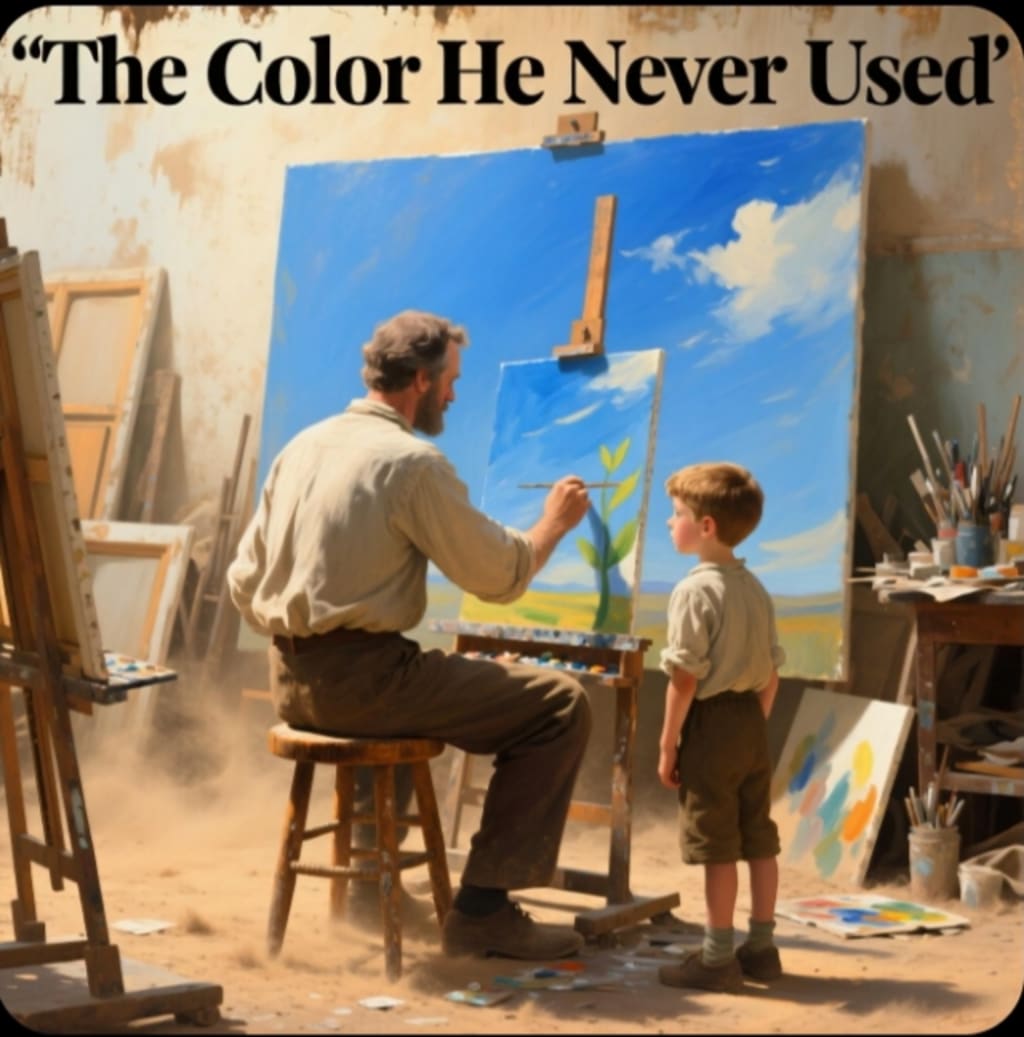
In a quiet corner of the city, where the hum of traffic never quite faded and laundry lines strung between buildings like tangled flags, there lived a man named Kamran. Once, his name was spoken with reverence in galleries and studios—“Kamran, the painter who captures silence,” they’d say. His work had a way of holding breath, of making people pause, stare, and remember something long forgotten.
But that was years ago.
Now, his studio sat untouched. Dust had settled on the easel, the brushes lay stiff in old jars, and the window—once thrown open to let in the morning light—was closed, curtains drawn. The only sound was the occasional drip of the tap and the wind nudging the loose shutter.
Five years had passed since the accident. Five years since his daughter, Amal, had run ahead of him one rainy afternoon, laughing as she stepped into the street—just as a speeding rickshaw skidded through the puddle.
She was gone in an instant.
And with her, so was color.
Kamran’s final painting before the silence was called “Absence.” It was a canvas of grey—layer upon layer, no shape, no light, just a deep, aching void. Critics called it “brutally honest.” But Kamran knew the truth: it wasn’t art. It was grief with a frame around it.
He stopped answering calls. He stopped going outside. The world moved on. He did not.
Then, one evening, rain tapping softly on the roof, there was a knock at the door.
He almost didn’t answer. But the knock came again—small, uncertain, like a bird testing a branch.
At the door stood a boy, drenched from the storm, clutching a folded piece of paper in both hands. He couldn’t have been older than twelve.
“Are you… Mr. Kamran?” he asked, voice barely above a whisper.
Kamran nodded.
The boy held out the paper. It was a drawing—a tree, crooked and wild, with roots spilling over the edge of the page. The lines were rough, the shading uneven. But there was something alive in it. Something that breathed.
“I want to learn how to draw,” the boy said. “My teacher said you see things others don’t.”
Kamran looked at him. And then, for the first time in years, he saw not just a child, but a flicker—of curiosity, of hunger, of that quiet fire that once burned in Amal’s eyes when she held a crayon.
He stepped aside. “Come in. You’ll catch cold.”
The boy—Rafi—started visiting every few days. At first, Kamran didn’t teach him technique. He just sat with him, saying little, watching. Then, slowly, he began to speak.
“Art isn’t about making something perfect,” he said one afternoon, watching Rafi frown at a crooked line. “It’s about saying something true.”
He showed him how light falls differently on stone and skin. How a shadow can carry emotion. How a single brushstroke can feel like a heartbeat.
Rafi listened. Tried. Failed. Tried again.
But Kamran never touched a brush.
One afternoon, while waiting for Kamran to return from the kitchen, Rafi noticed a small drawer in the old wooden desk—locked. Out of curiosity, he mentioned it.
Kamran paused. Then, without a word, he took out a key from around his neck—the first time Rafi had seen it.
Inside were paint tubes, still sealed, labels crisp. Reds, yellows, greens, deep purples. But one was missing.
“Where’s the blue?” Rafi asked.
Kamran’s fingers brushed the empty space. “That was Amal’s color,” he said quietly. “Sky blue. Her room was painted it. Her drawings were filled with it. Even her shoes had blue laces.”
He looked out the window. “When she died, I buried the tube in the garden. I couldn’t bear to see it.”
Rafi didn’t say anything. He just nodded, eyes down.
The next morning, Kamran found a new tube of blue paint on his desk. Fresh. Unopened. Next to it, a folded note in shaky handwriting:
“Some colors don’t belong in the ground.”
He sat there for a long time, staring at it.
Then, slowly, he twisted the cap off.
He didn’t plan. He didn’t sketch. He just dipped the brush—dry for so many years—and touched it to the canvas.
At first, just a streak. Then a shape. Then a memory.
Amal, barefoot in the garden, chasing a butterfly. Her sky-blue scarf fluttering behind her like a banner. The sun in her hair. Her laughter, silent now, but somehow still there—in the light, in the blue, in the space between the brush and the canvas.
He painted all night.
When dawn came, the painting was finished. And for the first time in five years, he looked at it—and smiled.
That year, the city art exhibition featured two new works.
One was Kamran’s—“The Sky Returns”—a girl dancing beneath a vast, open sky, the blue so deep it felt like you could fall into it.
The other was Rafi’s. A simple scene: a man handing a paintbrush to a boy. At the bottom, in small letters:
“He gave me colors I didn’t know I needed.”
People came, they looked, they whispered. Some cried.
But Kamran didn’t care about any of that.
He was back at his studio, brush in hand, window open.
And the birds had started visiting again
About the Creator
meerjanan
A curious storyteller with a passion for turning simple moments into meaningful words. Writing about life, purpose, and the quiet strength we often overlook. Follow for stories that inspire, heal, and empower.
Reader insights
Outstanding
Excellent work. Looking forward to reading more!
Top insights
Compelling and original writing
Creative use of language & vocab
Easy to read and follow
Well-structured & engaging content
Excellent storytelling
Original narrative & well developed characters
Expert insights and opinions
Arguments were carefully researched and presented
Eye opening
Niche topic & fresh perspectives
Heartfelt and relatable
The story invoked strong personal emotions
Masterful proofreading
Zero grammar & spelling mistakes
On-point and relevant
Writing reflected the title & theme
Pakistan deploys helicopters, drones to end standoff with Baloch rebels
Pakistan Deploys Helicopters, Drones to End Standoff With Baloch Rebels Pakistan’s security forces have intensified operations in Balochistan by deploying helicopters and surveillance drones to break a prolonged standoff with Baloch rebel groups, underscoring the growing complexity of internal security challenges in the country’s largest and most volatile province. The move reflects Islamabad’s determination to restore control while balancing military pressure with political and social sensitivities in a region long marked by unrest.
By Sain Hafiz4 days ago in Art
Feelings Never Die
It is Valentine's Day again, and it bought back memories that were over fifty years old. It bought me back to 1971, and I woke up and I knew my baby was due today. I was big and pregnant, and I felt like I was about to burst wide open. Imagine my surprise when the doctor told my I had a due date of February 14. I couldn't believe it, and since my baby was due today, I felt I could indulge myself a bit. I had gained a lot of weight, and chocolate was on the no-no list, but I had came to the end of this pregnancy, and I hoped it would be okay, after all I would deliver this baby today. So I walked across the street to the grocery story, and bought myself, a peppermint patty, covered in chocolate, my favorite. Me and my Valentine's baby would enjoy it together.
By Susan Payton3 days ago in Fiction



Comments (1)
Good