
Temple architecture in India
Types of architecture using built Temple
Temple architecture in India
Introduction
Most of the architectural remains that survive from Ancient and Medieval India are religious in nature.
In different parts of the country, distinct architectural style of temples was result of geographical, ethnic and historical diversities.
Two broad orders of temples in the country are known as Nagara in the north and Dravida in the south.
At times, the Vesara style of temples is also found as an independent style, created through the selective mixing of the Nagara and Dravida orders.
As temples grew more complex, more surfaces were created for sculpture by adding more and more rhythmically projecting, symmetrical walls and niches, without breaking away from the fundamental plan of the shrine.
Nagara Style of Temple Architecture
The Nagara Architecture or North Indian Temple Style is a distinct style of temple architecture that emerged in northern India from the fifth century A.D. onwards. There is only Shikhara (or peak) in this temple type. Even within the Nagara school, different sub-schools arose in the country's western, central, and eastern regions.
o The temples were mostly built in the Panchayatan architecture, which consisted of minor shrines arranged in a crucified ground plan in relation to the main shrine.
o In front of the main shrine, there are meeting halls called mandapas.
o Images of the river goddesses Ganga and Yamuna were put outside the garbhagriha.
o There were no water tanks or reservoirs on the temple grounds in general and most temples were constructed on high platforms.
o There was a pillared approach to the porticos. Shikharas were divided into three categories:
o Latina or Rekha-prasad: They were square at the base, with inward-curving walls that came to a point at the top.
o Phamsana: They were wider at the base and lower in height than Latinas. They have a straight rising slope.
o The vertical end of the shikhara terminated in a horizontal fluted disc known as the Amalak, which was also known as wagon-vaulted roofs. On top of that, the Kalash, a spherical form, was placed.
o The temple's interior wall was split by three rathas, or vertical planes. Triratha temples were the name for these structures. Temples like pancharatha, saptaratha, and even navaratha arose later.
o The ambulatory corridor or pradakshina path surrounding the sanctum sanctorum was covered, and the vertical planes were utilized as separate panels to create story sculptures.
o The temple grounds did not have ornate boundary walls or entrances in general.
Dravida style of Temple architecture
The Dravidian style of temple architecture of South India was pioneered by the Pallavas who reigned in parts of Karnataka, Andhra Pradesh, and northern Tamil Nadu until the ninth century. Although they were mostly Shaivite, several Vaishnava shrines also survived from their reign.
The early buildings are generally attributed to the reign of Mahendravarman I, a contemporary of the Chalukyan king, Pulakesin II of Karnataka. Narasimhavarman I, also known as Mamalla, who acceded the Pallava throne around 640 CE, is celebrated for his architectural works.
The main features of this style of temple architecture are:
• The Dravida temple is enclosed within a compound wall.
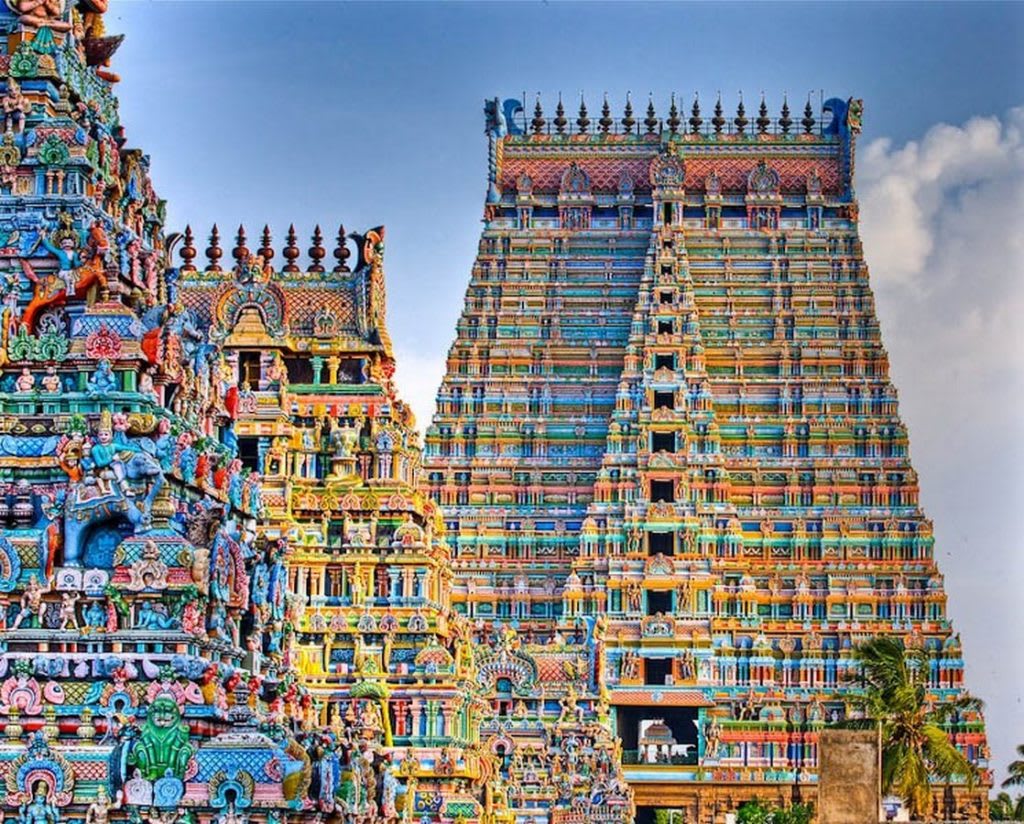
• The front wall has an entrance gateway in its centre, which is known as a Gopuram.
• The shape of the main temple tower known as vimana in Tamil Nadu is like a stepped pyramid that rises up geometrically rather than the curving shikhara of North India.
• In the South Indian temple, the word ‘shikhara’ is used only for the crowning element at the top of the temple which is usually shaped like a small stupika or an octagonal cupola— this is equivalent to the amalak and kalasha of North Indian temples.
• Fierce Dvarapalas or the door-keepers guarding the temple adorn the entrance to garbhagriha
• It is common to find a large water reservoir, or a temple tank, enclosed within the complex.
• At some of the most sacred temples in South India, the main temple in which the garbhagriha is situated has, in fact, one of the smallest towers. This is because it is usually the oldest part of the temple
Vesara Style of Architecture
Vesara style of architecture flourished in the Deccan part of India. Also called the Hybridised style, it combines features of Nagara and Dravida styles. Chalukya’s rulers and Hoysala rulers promoted this style. The topographical location of Karnataka, the widespread actions of the significant royal rules and a boldness that is not unduly determined might have encouraged this merger of styles.
• Chalukya rulers of Badami (500-753 AD) started building temples in a style that was essentially a mixture of the Nagara and Dravida styles, and was refined by the Rashtrakutas of Manyakheta (750-983 AD) in Ellora, Chalukyas of Kalyani (983-1195 AD) in Lakkundi, Dambal, Gadag, and others, before being epitomized by the Hoysalas (1000-1330 AD).
• This style is well represented by the Hoysala temples at Belur, Halebidu, and Somnathpura.
• Ornamentation: The Chalukyan temple exhibits indigenous qualities in terms of the temple walls and pillar ornamentation.
• The Chalukyan builders altered the Dravida towers by reducing the height of each storey and arranging them in declining order of height from base to top, with a great deal of embellishment on each floor.
• Nagara Tower Transformation: Instead of an inclined storey, the vertical shape of the tower has been changed.
• Mantapa and Pillars are two unique elements of Chalukya temples:
o Mantapa: The mantapa features two types of roofs: domical ceilings (which have a dome-like appearance and are supported by four pillars) and square ceilings (these are vigorously ornamented with mythological pictures).
o Pillars: the Chalukya temples' small ornamental pillars have their unique aesthetic significance.
• Some famous temples built in this style are:
o Kallesvara temple, Kukkanur;
o Ramalingesvara temple, Gudur;
o Mahadeva temple, Ittagi;
o Kasivisvesvara temple, Lakkundi (and several other temples at Lakkundi);
o Brahmadeva temple, Savadi – notable for being fully stellate;
About the Creator
Keep reading
More stories from Arun Kumar and writers in Art and other communities.
The Story of Manuneethi Cholan
Brief Story Eplaination One of them who went by the name of Manu Needhi Chola (205 BC to 161 BC) - Manu, the Righteous- was the most illustrious of them. He made no distinction between men and animals. He treated them all alike and dealt impartial justice to them. So all those that were under the rule of this noble king, human beings as well as animals, lived peacefully and happily.
By Arun Kumar3 years ago in Fiction
The Devil's Triangle
The sails ruffled in the breeze as we cruised along. The Sea Breeze was a mid-size catamaran that sailed out of Royal Naval Dockyard in Bermuda. We had booked this trip weeks in advance and were now looking at our Captain, Spike and two boat hands. Paddy and Wilson seemed like nice guys, joking around with the passengers and telling us some stories about Bermuda that only locals would know. Their island accents sounded almost British but they were pleasant to listen to.
By Barbara Gode Wiles6 days ago in Fiction


Comments
There are no comments for this story
Be the first to respond and start the conversation.