
Clock in Mr. Elwood’s shop
The Last Thing the Clock Remembered

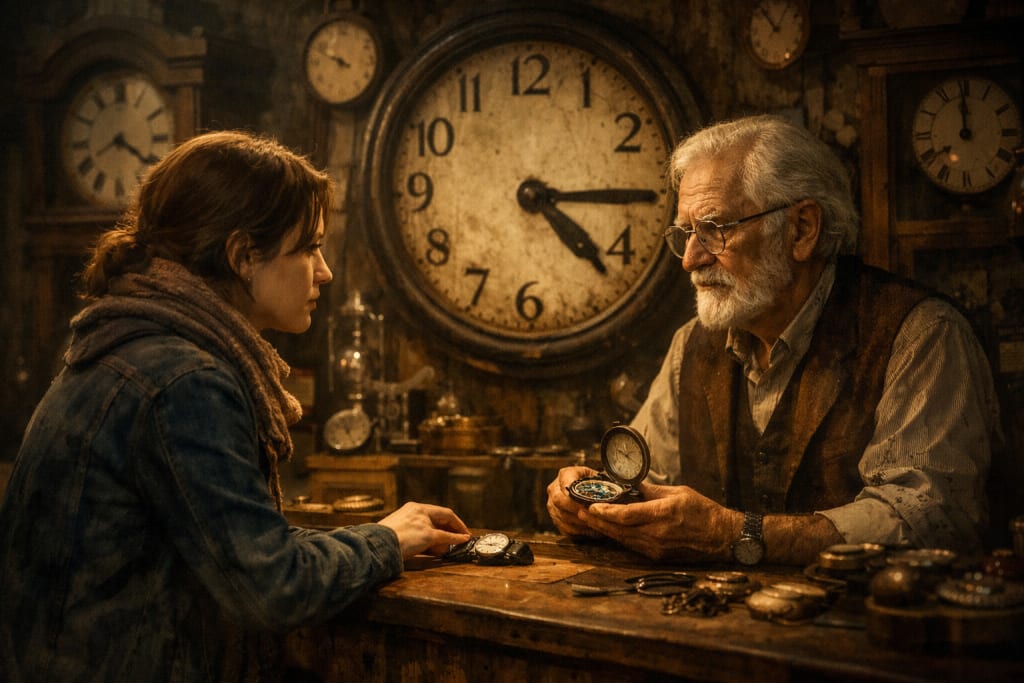
The clock in Mr. Elwood’s shop had stopped at 4:17 a.m. on a Thursday that no one remembered clearly. It wasn’t broken—every gear was clean, every spring obedient—but time simply refused to move forward inside it. That was The clock in Mr. Elwood’s shop had stopped at 4:17 a.m. on a Thursday s why people came.
The shop sat at the end of Bell weather Lane, squeezed between a closed bakery and a wall that collected ivy like secrets. Its windows were fogged from the inside, even in summer, and the bell above the door rang half a second late, as if it had to think before making a sound.
Lena first entered the shop on the day her brother forgot her name.
She didn’t tell anyone that part. Instead, she told herself she was just curious, like the others. Curious about the rumors: that Mr. Elwood fixed clocks that held memories; that some people left lighter than they arrived; that one woman swore she heard her dead husband cough behind the counter.
Mr. Elwood himself looked like he had once been old and then decided not to be anymore. His hair was white but his eyes were sharp, alert, almost kind.
“What’s broken?” he asked, without looking up.
Lena placed her brother’s watch on the counter. It was scratched, cheap, and stubbornly ticking.
“It works,” she said. “But it remembers the wrong things.”
That made Mr. Elwood look up.
He turned the watch over, listening—not with his ears, but with his fingers. His brow creased.
“This watch is holding on too tightly,” he said. “Memories do that when they’re scared.”
Lena swallowed. “Can you fix it?”
“Yes,” he said. “But you won’t like the price.”
She expected money. Or blood. Or something dramatic.
Instead, he said, “You’ll have to let go of one memory. Just one. Something important enough that the watch understands loss.”
Her mind immediately filled with images: birthdays, laughter, hospital lights, the sound of her brother calling her name before it became unfamiliar.
“I’ll choose later,” she said quickly.
Mr. Elwood nodded. “Everyone says that.”
She left the watch and returned the next day. And the next. Each time, she stood among the clocks—grandfather clocks whispering to wristwatches, cuckoos trapped mid-call—trying to decide what she could afford to lose.
On the fourth visit, she noticed the broken clock.
The one frozen at 4:17 a.m.
“What happened then?” she asked.
Mr. Elwood’s hands stilled. “That’s when I stopped fixing my own time.”
She didn’t press. Somehow, she knew better.
That night, Lena dreamed of her brother as a child, holding her finger as they crossed the street. She woke with the taste of panic and clarity.
The next morning, she returned.
“I’m ready,” she said.
Mr. Elwood placed the watch between them. “Tell me the memory.”
She closed her eyes. “The first time my brother forgave me.”
Mr. Elwood paused. “Are you sure?”
“Yes.”
He opened the watch, not with tools, but with words. He whispered something old and gentle. The ticking slowed. Then stopped.
For a moment, Lena felt nothing.
Then it hit her—not pain, but absence. A blank space where warmth used to be. She knew forgiveness existed. She just couldn’t remember receiving it.
Mr. Elwood closed the watch. It ticked again, lighter now.
When Lena visited her brother that afternoon, he looked at her and smiled.
“Hey, Lena,” he said, clear as sunlight. “You’re late.”
She cried in the hallway, quietly, so time wouldn’t hear her.
Weeks later, she returned to the shop to say thank you.
It was gone.
The bakery was open. The ivy-covered wall bare. No bell, no fog, no clocks.
Only one thing remained on the pavement: a broken clock, stopped at 4:17 a.m.
And for reasons she couldn’t explain, Lena bent down, touched it, and whispered, “You can let go now.”
Somewhere—just briefly—time moved again.
About the Creator
Ibrahim Shah
I am an Assistant Professor with a strong commitment to teaching,and academic service. My work focuses on fostering critical thinking, encouraging interdisciplinary learning, and supporting student development.
Keep reading
More stories from Ibrahim Shah and writers in Art and other communities.
FUZZY BEAR
*Fuzzy Bear: A Hug You Can Trust* In a cozy little forest surrounded by tall trees, colorful flowers, and chirping birds, lived a teddy bear named *Fuzzy*. Fuzzy wasn’t like other bears—he wasn’t wild or loud. In fact, he wasn’t even real. He was a soft, stuffed bear with button eyes, stitched paws, and golden brown fur that was always warm, no matter how cold the night was.
By Ibrahim Shah 3 days ago in Art
Pakistan deploys helicopters, drones to end standoff with Baloch rebels
Pakistan Deploys Helicopters, Drones to End Standoff With Baloch Rebels Pakistan’s security forces have intensified operations in Balochistan by deploying helicopters and surveillance drones to break a prolonged standoff with Baloch rebel groups, underscoring the growing complexity of internal security challenges in the country’s largest and most volatile province. The move reflects Islamabad’s determination to restore control while balancing military pressure with political and social sensitivities in a region long marked by unrest.
By Sain Hafiz5 days ago in Art
Feelings Never Die
It is Valentine's Day again, and it bought back memories that were over fifty years old. It bought me back to 1971, and I woke up and I knew my baby was due today. I was big and pregnant, and I felt like I was about to burst wide open. Imagine my surprise when the doctor told my I had a due date of February 14. I couldn't believe it, and since my baby was due today, I felt I could indulge myself a bit. I had gained a lot of weight, and chocolate was on the no-no list, but I had came to the end of this pregnancy, and I hoped it would be okay, after all I would deliver this baby today. So I walked across the street to the grocery story, and bought myself, a peppermint patty, covered in chocolate, my favorite. Me and my Valentine's baby would enjoy it together.
By Susan Payton4 days ago in Fiction




Comments
There are no comments for this story
Be the first to respond and start the conversation.