
Best Artwork by Egon Schiele
Expressionism artist
Austrian artist Egon Schiele rose to popularity as a key figure in Austrian Expressionism. The figures he created were usually distorted and exposed and explored problems of sexuality, identity, and mortality with an unrelenting gaze that captivated and occasionally surprised his colleagues.
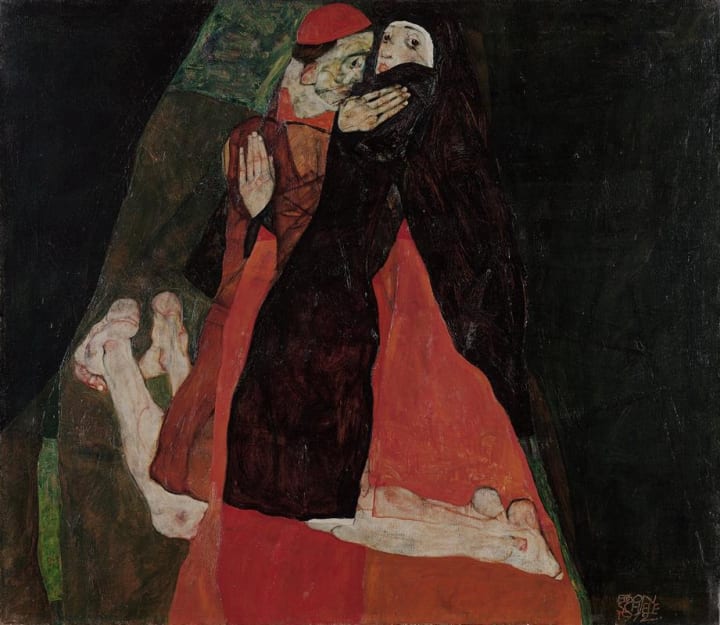
The Cardinal and the Nun (Caress) is an artwork in which the artist pushes the boundaries of religious symbolism and human passion. The painting depicts a cardinal and a nun locked into an intimate embrace. The stark, angular lines and dramatic contrast between their robes reflect Schiele’s distinctive Expressionist style. It can be viewed at the Leopold Museum in Vienna.
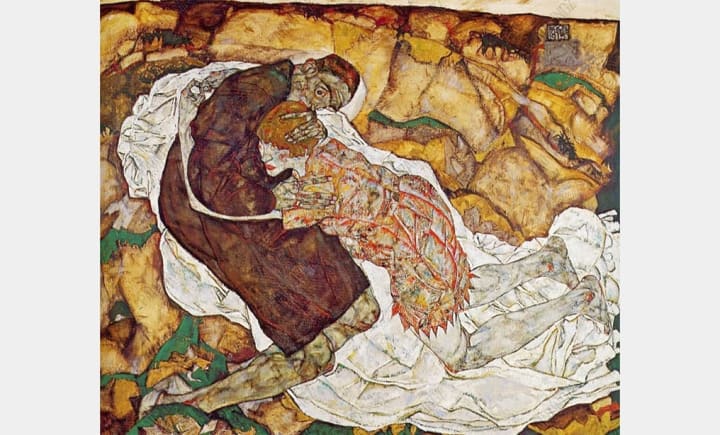
Death and the Maiden tells a tale of love, sorrow, and mortality. In the painting a man and a woman are locked in an embrace. The woman represents the artist’s muse and ex-lover, Wally Neuzil, whom he left to wed Edith Harms. The male figure represents the artist himself. This artwork is among Schiele’s most well-known paintings and is on display at the Belvedere Museum in Vienna, Austria.
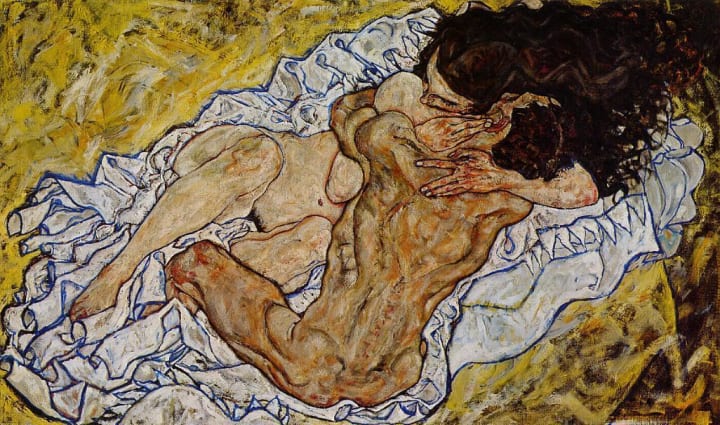
The Embrace was created by the artist a year before his tragic death. In this painting a man and a woman are entangled in a moment of tenderness and fragility. The artwork shows warm tones and flowing lines to suggest a moment of solace amidst the chaos of the era. This artwork reflects the artist’s relationship with his wife, highlighting their emotional bond.
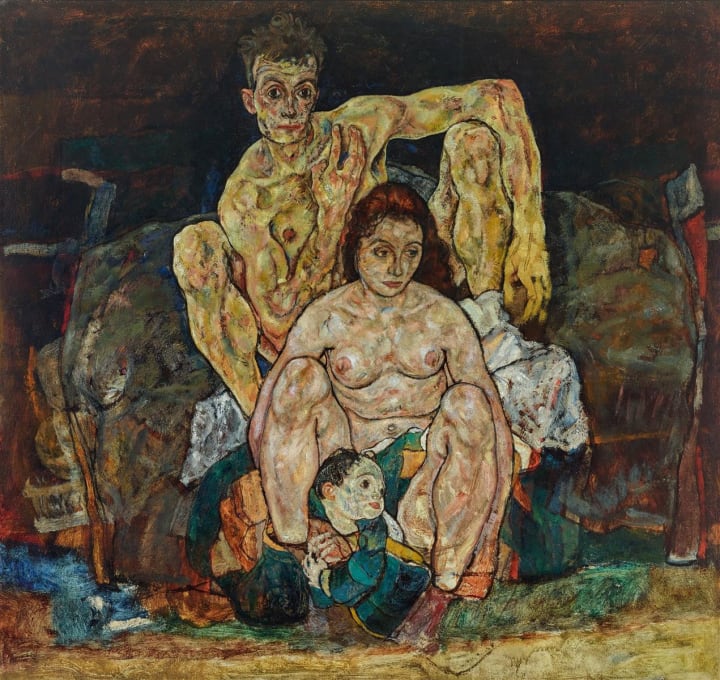
The Family is an artwork with emotional significance that was completed just months before the artist succumbed to the Spanish flu. The painting depicts a man, a woman, and a child together. Art historians identify these individuals as Schiele, his wife, and their unborn child, making the artwork intimately personal and prophetic. The creation differs from his angular style and incorporates muted, earthly tones and raw lines. It can be viewed at the Belvedere Museum in Vienna.
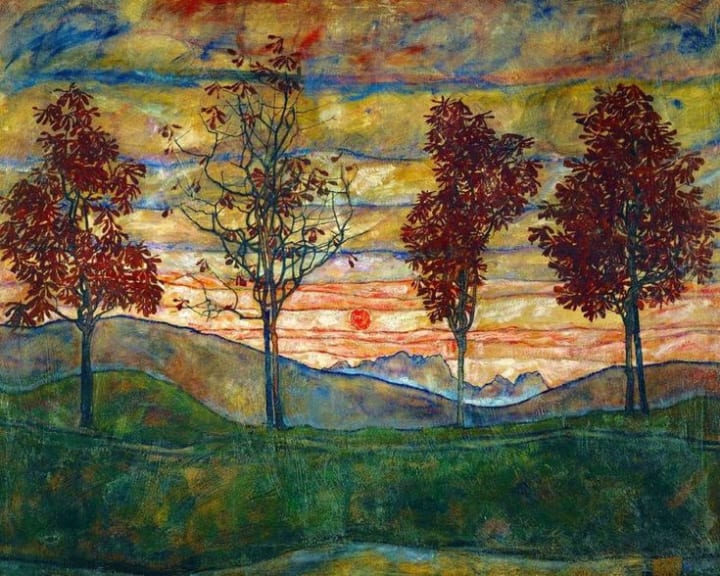
Four Trees is the artist’s tribute to the natural world, creating a landscape of serenity. In the painting, there are four trees set against a dramatic background of swirling clouds and luminous sky. The composition is balanced and harmonious, yet the stark outlines and intense colors add a sense of tension and mystery. This artwork is notable for Schiele’s use of negative space and his ability to convey mood through the interplay of light and shadow. The trees, often interpreted as symbols of resilience and unity, stand as silent witnesses to the changing skies, reflecting Schiele’s fascination with the cycles of life and nature. It can be viewed at the Belvedere Museum in Vienna.
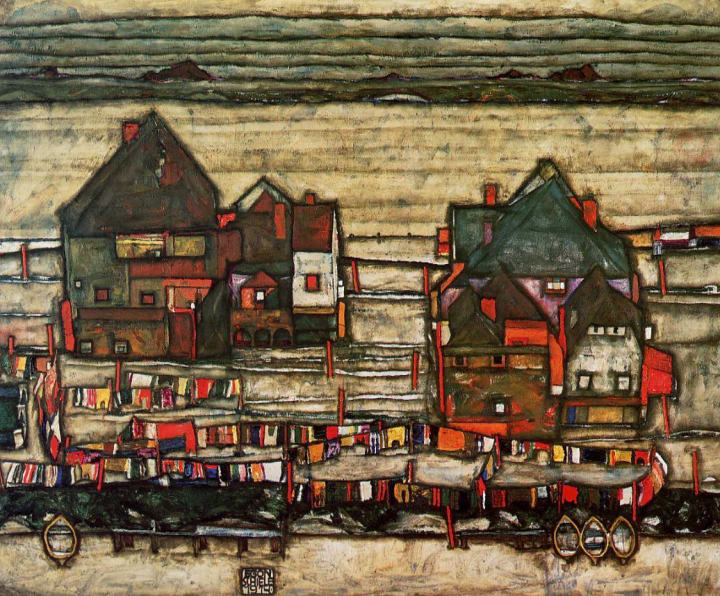
House with Laundry (Suburb II) offers the viewer a glimpse into suburban life, showing laundry lines and a sense of everyday life. He uses a palette of muted earth tones in contrast to the delicate detailing of the laundry on the line, creating a balance between simplicity and intricacy. The artist’s interest in structure and composition is reflected in the geometry of the buildings and the rhythmic arrangement of the hanging laundry.
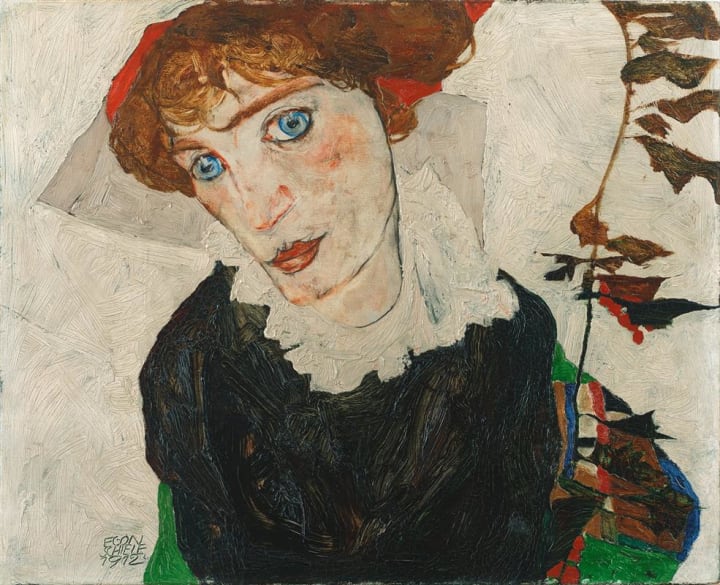
Portrait of Wally Neuzil is an artwork that is a tribute to Schiele’s muse and lover, Walburga “Wally” Neuzil. The artist created the artwork during one of the most turbulent periods of his life. In the portrait he captures Wally’s delicate features and quiet strength. To convey intimacy, the artist used muted tones and gentle brushwork. Tragically, their relationship ended in 1915 when Schiele left Wally to marry Edith Harms, a decision that deeply affected both of them. The painting can be viewed at the Leopold Museum.
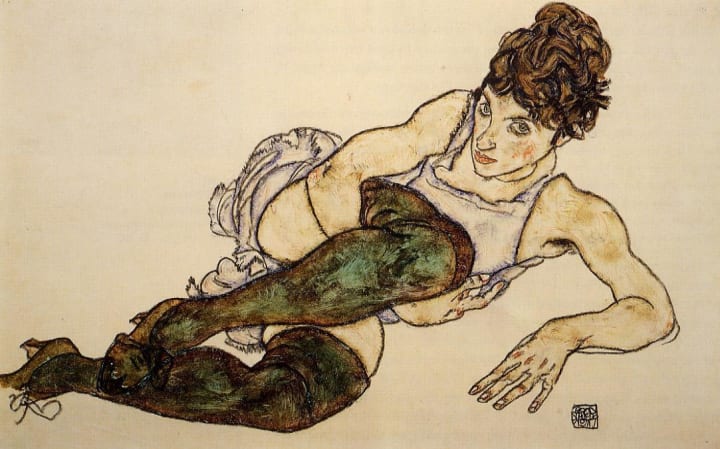
Reclining Woman with Green Stockings is the artist’s examination of vulnerability and sensuality. In the artwork the woman is lying on her side, her body covered by strong geometric lines highlighting her emotional depth and physical presence. The green stockings add a striking pop of color in contrast to the muted tones of her bare skin.
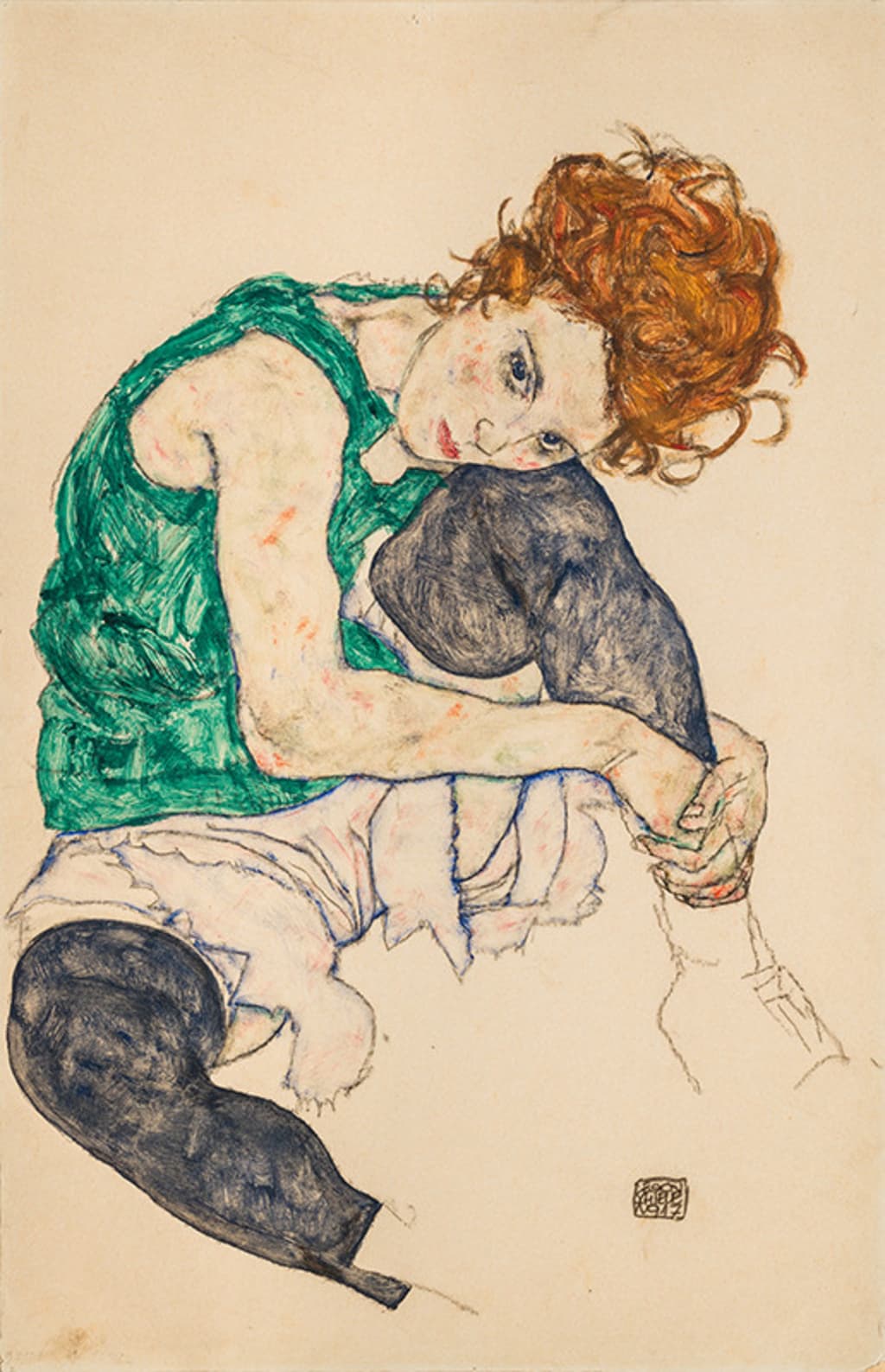
Seated Woman with Bent Knee is the artist’s exploration of fragility and sensuality. (pictured above) The painting depicts a seated woman with her body slightly twisted and one knee bent upwards, resulting in an angular, dynamic composition. Schiele’s use of line and color in this artwork is striking, with sharp contours emphasizing the angularity of the body while soft hues in the skin create a sense of warmth. The painting can be viewed at the Leopold Museum in Vienna.
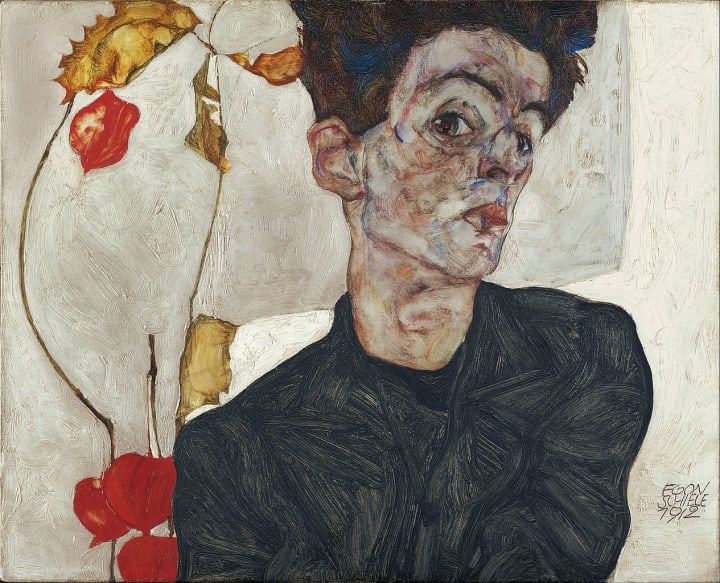
Self-Portrait with Physalis: In this painting, Schiele holds a branch of physalis, a vivid orange plant also known as the Chinese lantern. To portray the intricacy of his inner world, the artist used angular lines and emphasized his features. The physalis plant is a powerful emblem often understood to symbolize vitality combined with fragility. The artwork can be viewed at the Leopold Museum in Vienna.
About the Creator
Rasma Raisters
My passions are writing and creating poetry. I write for several sites online and have four themed blogs on Wordpress. Please follow me on Twitter.
Keep reading
More stories from Rasma Raisters and writers in Art and other communities.
Best Artwork by Wassily Kandinsky
Russian artist Wassily Kandinsky pursued a career in art after moving to Munich in 1896. He enrolled at the Academy of Fine Arts, one of the oldest and most prestigious art schools in Germany. Before the outbreak of WWI, the artist co-founded Der Blaue Reiter with German artists Franz Marc and August Macke. He is known as one of the founding fathers of abstract art.
By Rasma Raisters3 days ago in Art
A Good Deed
I have always felt that a single good deed in life can pave the way for blessings not just for oneself, but for one’s children as well. My story comes from my days in the police force, a time when officers had very limited resources. We often traveled on our own horses, and whenever we went home on leave, government-issued rifles were collected from us. For self-defense, we carried only daggers or similar small weapons.
By Sudais Zakwan4 days ago in Art
After the Storm
After the storm of winter snow there sat a small bear by the name Ted, of course. He loves the snow and likes to roll around in it making all sorts of trails and whatever he has a mind to do. He wondered where all the people are, but in a way, he is hoping that they are all snug in the homes maybe drinking hot chocolate-one of his favorite drinks with mini-marshmallows and eating something homemade for he likes this winter wonderland all to himself to romp and play and maybe even catch some fish down by the river.
By Mark Graham6 days ago in Fiction



Comments
There are no comments for this story
Be the first to respond and start the conversation.