
Why Platforms Are Becoming Ecosystems Instead of Products?
Technology platforms are no longer defined by single applications but by interconnected networks of tools, users, and services that evolve together.

For much of the early software era, technology products followed a familiar structure. A company built a specific tool, released updates periodically, and competed based on features or performance. Success meant creating a better standalone product.
That model is shifting.
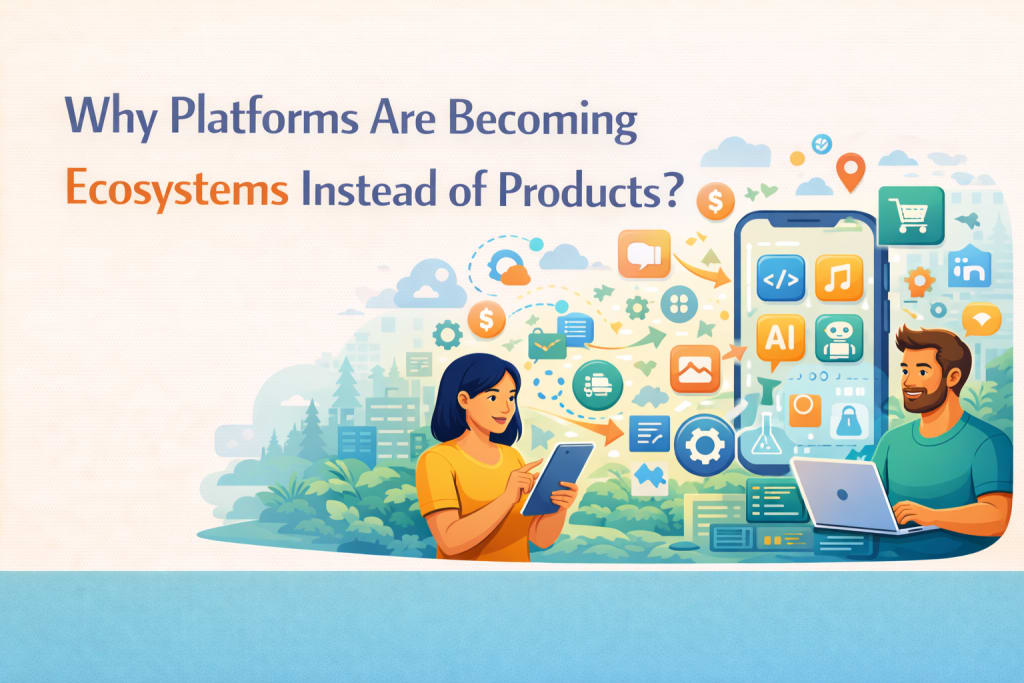
In 2026, the most influential technology companies no longer position their offerings as isolated products. Instead, they design ecosystems — interconnected environments where developers, users, services, and data interact continuously. Platforms increasingly function as foundations upon which others build rather than as finished solutions.
This transition reflects deeper changes in technology economics, user behavior, and innovation strategy.
The Limits of the Standalone Product Model
Standalone software once dominated because technological complexity limited integration. Applications operated independently, each solving a specific problem within defined boundaries.
Cloud computing, APIs, and standardized protocols changed that reality.
Modern software interacts constantly with external systems — payment platforms, communication tools, analytics engines, identity providers, and AI services. Users expect seamless experiences across devices and services, making isolated products feel restrictive.
Companies realized that building one product was no longer enough. To remain competitive, they needed to create environments where additional functionality could grow organically.
Products evolve into platforms.
Network Effects Drive Ecosystem Thinking
One of the strongest incentives behind ecosystem development is network effects.
When more developers build on a platform, its value increases. When more users join, the ecosystem attracts additional services. Growth becomes self-reinforcing.
Examples include app marketplaces, developer toolchains, and collaboration platforms where third-party integrations expand functionality beyond the original design.
Platforms shift from selling features to enabling participation.
The more participants contribute, the more resilient the ecosystem becomes.
APIs and Modularity Enable Expansion
Application programming interfaces (APIs) play a central role in this transformation.
APIs allow external developers to connect with core platform capabilities. Instead of building every feature internally, companies invite external innovation.
This modular approach accelerates growth. Third-party developers extend platform capabilities, often discovering new use cases that original creators did not anticipate.
Modularity also reduces development overhead for platform owners, distributing innovation across a broader community.
The platform becomes an infrastructure layer rather than a single product.
Data as a Shared Resource
Ecosystems thrive on data.
When multiple applications operate within the same environment, shared data flows enable deeper personalization, analytics, and automation. A user’s activity in one tool informs experiences in another.
This interconnected data layer strengthens platform cohesion.
However, it also introduces responsibilities related to privacy, governance, and transparency. Managing shared data becomes a central challenge for ecosystem operators.
Trust becomes essential.
AI Accelerates Ecosystem Formation
Artificial intelligence amplifies the shift toward ecosystems.
AI platforms increasingly provide foundational models that developers customize for different applications. Instead of building AI capabilities independently, companies integrate with existing model providers.
AI tools also connect workflows across applications, enabling automation between services. The result is tighter integration between products that previously functioned separately.
As AI becomes embedded in multiple layers of technology, platforms evolve into interconnected systems rather than standalone offerings.
Developer Communities as Strategic Assets
Successful ecosystems rely on developer participation.
Providing SDKs, documentation, and open interfaces encourages developers to build extensions, plugins, and complementary applications.
Developer communities drive innovation at scale. They expand the platform’s capabilities without requiring direct investment from the core company.
Platforms increasingly compete based on how well they support developers.
A thriving developer ecosystem becomes a competitive advantage.
Economic Incentives Behind Ecosystems
Ecosystem strategies reshape revenue models.
Instead of relying solely on product sales or subscriptions, platforms generate income through marketplaces, transaction fees, or revenue sharing with third-party developers.
This model diversifies income streams while encouraging growth.
For example, companies working in mobile app development Atlanta environments often build solutions that integrate into larger ecosystems rather than existing independently. Integration increases exposure and reduces customer acquisition costs.
Economic incentives align with ecosystem expansion.
Lock-In and Switching Costs
Ecosystems also introduce strategic lock-in.
When users adopt multiple interconnected tools within a single environment, switching to competitors becomes more difficult. Data migration challenges, workflow dependencies, and integration complexity create friction.
This lock-in strengthens customer retention but raises questions about competition and fairness.
Regulatory scrutiny around platform dominance reflects concerns about ecosystem power.
The Role of Infrastructure
Underlying infrastructure supports ecosystem growth.
Cloud platforms, identity management systems, and data pipelines enable multiple services to operate together seamlessly.
Infrastructure decisions influence ecosystem success. Platforms offering reliable performance, strong security, and scalable architecture attract developers seeking stability.
The technical foundation shapes the community that forms around it.
The Shift From Ownership to Participation
In ecosystem-driven markets, success involves enabling others rather than controlling every feature.
Platform owners provide tools, standards, and incentives that encourage external participation. Innovation emerges from collaboration rather than centralized development.
This approach reflects broader changes in technology culture, where open-source collaboration and shared standards influence design philosophies.
Participation becomes more important than ownership alone.
Challenges of Ecosystem Management
Building an ecosystem introduces complexity.
Platform owners must balance openness with governance. Too much restriction discourages developers; too little oversight risks fragmentation or security vulnerabilities.
Maintaining quality standards across third-party contributions requires careful management.
Ecosystem success depends on maintaining trust among participants.
Future Directions
Several trends suggest ecosystems will continue expanding:
- AI-driven workflow integration across platforms
- Cross-platform identity systems enabling seamless user experiences
- Decentralized architectures distributing control
- Increased regulatory oversight shaping platform policies
The shift from product to ecosystem appears structural rather than temporary.
Technology companies increasingly design with interconnectedness as a primary goal.
Closing Reflection
Platforms are becoming ecosystems because the nature of technology itself has changed.
Users expect seamless integration. Developers seek environments that accelerate innovation. Companies recognize that collaboration scales faster than isolated product development.
The most influential platforms today are not defined by individual features but by the communities and connections they enable.
In the modern software economy, success is less about building a single product and more about creating a space where many products can thrive together.
About the Creator
Nick William
Nick William, loves to write about tech, emerging technologies, AI, and work life. He even creates clear, trustworthy content for clients in Seattle, Indianapolis, Portland, San Diego, Tampa, Austin, Los Angeles, and Charlotte.
Keep reading
More stories from Nick William and writers in 01 and other communities.
Are Low-Code Platforms Replacing Traditional Development?
A few years ago, low-code platforms were often dismissed as shortcuts — useful for prototypes but unsuitable for serious software. Developers questioned their flexibility. Enterprises worried about scalability. And traditional engineering teams largely saw them as tools for non-technical users rather than real development environments.
By Nick Williama day ago in 01
Manual vs Automated WordPress Maintenance: Which Is Better?
Maintaining a WordPress website is more than just updating plugins or themes; it's about keeping your site secure, fast, and performing at its best. Whether you run a personal blog, an online store, or a business website, regular maintenance ensures that visitors have a smooth experience and that your SEO doesn’t take a hit.
By Henry Davids5 days ago in 01
Beyond Hot and Cold: The Multi-Layered Security Architecture Every Crypto Exchange Must Implement in 2026
Security breaches have cost cryptocurrency exchanges over $3 billion in the past five years. Despite this staggering toll, many organizations still approach crypto exchange development with inadequate security frameworks. The distinction between exchanges that survive and those that become cautionary tales increasingly depends on implementing comprehensive, multi-layered security architecture rather than relying on basic protections.
By Tarun Nagar4 days ago in 01



Comments
There are no comments for this story
Be the first to respond and start the conversation.