
Why Cloud Computing Costs Are Rising for SaaS Companies?
After more than a decade of positioning cloud infrastructure as a cost-efficient alternative to on-premise systems, many software-as-a-service companies are confronting a different financial reality: usage-based pricing models, AI-driven workloads, data gravity, compliance mandates, and vendor concentration are steadily increasing operational expenditure — turning cloud cost management into a board-level concern rather than a back-office metric.

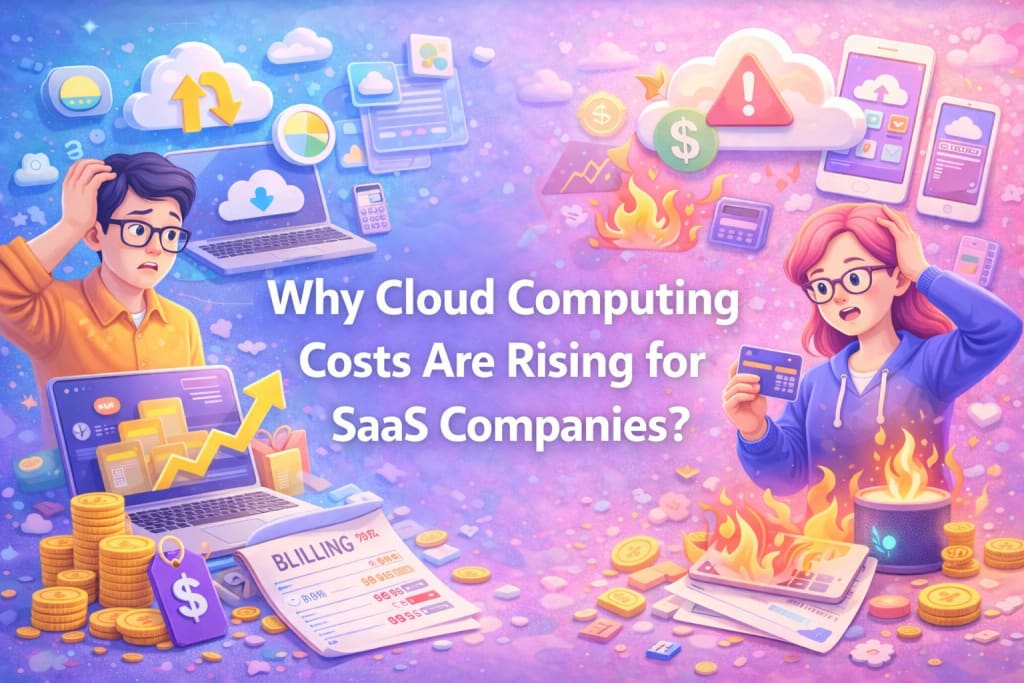
For years, the pitch was simple: move to the cloud and pay only for what you use.
That promise reshaped the software industry. Startups avoided capital expenditure. Enterprises migrated away from server rooms. Investors applauded recurring revenue models built on scalable infrastructure.
Now, CFOs are asking a different question: why are our cloud bills accelerating faster than our revenue?
The issue is not anecdotal. It is structural.
Cloud adoption has reached maturity, and as SaaS companies scale, the economics of consumption-based infrastructure are revealing second-order effects that were less visible during early growth phases.
The Scale Effect No One Modeled Properly
Cloud infrastructure works beautifully at small and medium scale. Elastic compute, managed databases, serverless architectures — all reduce friction in product development.
But SaaS companies, by design, aim to grow quickly.
According to Synergy Research Group, global spending on cloud infrastructure services surpassed $300 billion in 2024, reflecting annual growth above 18%. Much of that growth is driven by SaaS providers expanding customer bases, storing more data, and running heavier workloads.
Here’s the tension: revenue in SaaS grows per customer, often in incremental subscription tiers. Infrastructure costs grow per interaction — every API call, every database query, every gigabyte transferred.
At scale, marginal usage becomes a compounding expense.
A 2024 Flexera State of the Cloud report found that 82% of organizations cite managing cloud spend as their top challenge, and nearly 30% estimate that a significant portion of cloud usage is underutilized or misallocated.
Elasticity is powerful. But elasticity without discipline becomes volatility.
AI Workloads Are Rewriting Cost Structures
Artificial intelligence has added a new layer to SaaS economics.
Many SaaS platforms now embed AI features — recommendation engines, generative text tools, predictive analytics, automation layers. These features require high-performance compute infrastructure, often powered by GPUs.
NVIDIA’s data center revenue, largely fueled by AI demand, more than tripled between 2022 and 2024. That growth reflects rising compute consumption across the industry.
A report from Epoch AI notes that training costs for frontier AI models have increased by roughly 2.5x annually over the past several years. While SaaS companies may not train large foundational models, even inference workloads — running AI models at scale — introduce continuous compute expenses.
Unlike static features, AI functions often scale with usage intensity.
If a SaaS product includes AI-generated summaries or automated workflows, each customer interaction carries a compute cost that accumulates across millions of users.
The more successful the product, the higher the infrastructure burden.
Data Storage Is Growing Faster Than Revenue
SaaS businesses collect and retain data by default.
User activity logs, analytics dashboards, media uploads, transaction records, machine learning training sets — all require storage. And customers increasingly expect historical data access as part of the service.
IDC projects that global data volume will reach 175 zettabytes by 2025. Much of this data is stored in cloud environments managed by SaaS providers.
Storage appears inexpensive per gigabyte. But long-term retention, redundancy requirements, and compliance archiving multiply costs over time.
A survey by Wasabi Technologies found that 62% of companies report unexpected increases in cloud storage expenses, largely due to underestimating retention needs and backup policies.
Data gravity makes reduction difficult. Once customers depend on historical records, deletion becomes both technically and commercially risky.
The Egress Problem
One of the least discussed contributors to rising cloud costs is data transfer — particularly outbound data, often referred to as egress fees.
Cloud providers typically charge for moving data out of their environments. For SaaS platforms serving global customers, this can become substantial.
The Uptime Institute reports that organizations frequently underestimate network transfer costs during cloud migration planning. As SaaS products expand internationally, cross-region data movement increases.
APIs connecting third-party services also generate additional data flow charges.
The result is a layered billing structure where storage, compute, and network usage interact in complex ways.
Transparency in pricing does not always equate to predictability in total cost.
Vendor Concentration and Pricing Power
The cloud infrastructure market remains concentrated among a small number of providers.
According to Canalys, the top three cloud vendors account for nearly two-thirds of global cloud spending. Market concentration reduces downward pricing pressure over time.
While cloud providers periodically reduce unit costs for storage or compute, overall bills continue rising because usage growth offsets those efficiencies.
Additionally, SaaS companies often rely on proprietary services — managed databases, event streaming platforms, AI toolkits — that create switching barriers.
A 2023 HashiCorp survey found that 79% of organizations express concern about vendor lock-in, yet only a minority actively pursue multi-cloud strategies due to operational overhead.
Dependence narrows negotiating leverage.
Compliance and Security Costs Are Climbing
Security expectations have intensified.
IBM’s 2024 Cost of a Data Breach Report places the global average breach cost at $4.45 million. For SaaS companies handling customer data, investing in encryption, monitoring, redundancy, and compliance certifications is no longer optional.
Regulatory frameworks such as GDPR, HIPAA, and regional data sovereignty laws require additional infrastructure configurations — including region-specific storage and strict access controls.
These requirements often increase redundancy and storage replication, directly affecting cloud spending.
Security resilience adds cost layers that were less pronounced in earlier cloud adoption stages.
The Freemium Trap
Many SaaS companies rely on freemium models to drive adoption.
Free-tier users generate infrastructure costs without immediate revenue. When conversion rates are low, infrastructure expenses can outpace monetization.
According to OpenView Partners’ SaaS Benchmarks report, the median freemium conversion rate across SaaS companies hovers below 5%.
That means 95% of users may consume infrastructure resources without directly contributing subscription revenue.
As cloud bills scale linearly with usage, monetization must scale proportionally to maintain margin.
Otherwise, growth amplifies cost pressure.
Regional SaaS and Infrastructure Decisions
Rising cloud costs are not limited to global enterprises.
Regional software teams — including those involved in mobile app development Indianapolis — increasingly design SaaS products with embedded cloud dependencies from day one.
For smaller teams, early architectural decisions can lock in cost trajectories. Choosing serverless over containerized workloads, relying heavily on managed services, or embedding AI features all influence long-term infrastructure profiles.
Cost awareness must now be integrated into product design discussions rather than addressed retroactively.
The Margin Compression Effect
Public SaaS companies are beginning to reflect infrastructure pressures in earnings reports.
Operating margin expansion — once assumed to improve automatically with scale — now requires deliberate cost engineering.
Goldman Sachs analysis of SaaS financial statements shows that cloud infrastructure often represents 10% to 20% of revenue for growth-stage companies, with AI-heavy platforms trending higher.
As competition intensifies, pricing power on the revenue side weakens while infrastructure costs remain consumption-driven.
This compresses margins unless companies actively optimize architecture.
The Rise of FinOps
In response, many SaaS companies are institutionalizing cloud cost governance.
The FinOps Foundation reports that more than 75% of large enterprises now maintain formal cost optimization programs involving engineering and finance collaboration.
Real-time usage dashboards, cost anomaly detection tools, and workload optimization strategies are becoming standard.
Engineering culture is evolving.
Developers are increasingly evaluated not only on feature delivery but also on cost efficiency of their implementations.
What Happens Next?
Several trends will likely shape the future of SaaS cloud economics:
First, AI cost optimization tools may help companies manage inference expenses more intelligently.
Second, hybrid infrastructure models — combining cloud with dedicated hardware for predictable workloads — may re-emerge.
Third, pricing transparency could become a competitive differentiator among cloud providers.
SaaS companies will continue relying on cloud infrastructure. The question is not whether to use it, but how to manage its economics sustainably.
The New Discipline of Infrastructure Awareness
Cloud computing remains foundational to SaaS success. It enables global reach, rapid deployment, and architectural flexibility that would have been unthinkable two decades ago.
Yet maturity brings new realities.
Consumption-based models reward discipline and penalize inefficiency. AI features increase compute intensity. Data retention grows automatically. Regulatory compliance adds redundancy.
The narrative has shifted from “cloud saves money” to “cloud requires financial architecture.”
For SaaS companies, rising cloud costs are not a temporary fluctuation. They reflect structural changes in how digital products are built, delivered, and scaled.
The future belongs not only to companies that build compelling software — but to those that understand the economics of the infrastructure beneath it.
About the Creator
How to Access Cash Without Selling Your Digital Assest
You’ve built a strong crypto portfolio that’s happily compounding. The next thing you know, a real estate closing, an unexpected business expense, or a personal emergency demands fast cash. What sounds like a doomsday is, in reality, a scenario many holders face far more often than they’d like. That’s when you face a choice: how to gain access to instant liquidity without dumping your digital assets?
By Kiran Butt2 days ago in 01
Magic
Note from the Author: I want to let you know that this is an unusual story, and it has been written purely from whatever is in my unconscious mind, because before I start writing, I get into a flow state that reaches my unconsciousness. I also write in my subconscious mind, which is like a mid-flow state between the conscious and unconscious mind.
By Denise Larkin5 days ago in Fiction



Comments
There are no comments for this story
Be the first to respond and start the conversation.