
Top Reasons to Choose React.js for Your E-commerce App Development
ReactJS Development Company

E-commerce has become an integral part of our lives in today’s fast-paced digital world. This calls for robust and efficient technology solutions as businesses seek to offer exceptional online shopping experiences. One such solution is React.js, which is gaining immense popularity.
React.js is a JavaScript library developed by Facebook that has revolutionized how web applications are built. Its component-based architecture, declarative syntax, and powerful performance optimizations make it an ideal choice for e-commerce app development.
In this blog post, we will discuss the reasons why React.js is the preferred choice to create high-performing and scalable e-commerce applications. We will also look at its key features, benefits, and real-world examples to show how effective it can be.
Component-Based Architecture
Understanding Components in React.js
Components are a fundamental concept in React.js. They act as reusable building blocks for encapsulating pieces of user interface (UI). The component however differs from others having its own state and logic which makes the development organized and modular.
Efficiency and Maintainability
Several benefits come with using a component-based architecture in React.js:
- Modularity: Breaking down the UI into smaller independent components makes it easier to manage and understand the codebase.
- Reusability: Developers should not rewrite similar codes but instead share components across different parts of an application thus reducing time spent on developing software as well as preventing code duplication.
- Maintainability: When changes need to be made they can be done at specific components without affecting the whole application.
Reusing Components: The Product Card Example
Let’s consider a common e-commerce example - creating a product card - to illustrate the power of component-based architecture. A product card usually contains information like product name, image, price, “Add to Cart” button, etc,
By creating a reusable ProductCard component, we can easily incorporate it into various parts of our e-commerce app, such as the product list, search results, and related products section. This not only simplifies development but also ensures consistency throughout the entire user interface.
JSX for Declarative Programming
Introducing JSX
JSX is a syntax extension for JavaScript that allows you to write HTML-like code within JavaScript. You can learn how to work with JSX efficiently via ReactJS development services.
Building UI Elements with JSX
Using JSX makes it easy to build the structure and content of your UI in a declarative way i.e instead of manipulating the DOM imperatively, you say what should be the desired appearance of UI. This enables easier reading and understanding of code.
Comparison to HTML and JavaScript
JSX appears almost like HTML but it is not similar. It gets compiled into regular JavaScript immediately before execution thus enabling one to insert direct JavaScript expressions into JSX elements.
Example: Creating a Product List Component
This is how you can create a simple product list component using JSX:
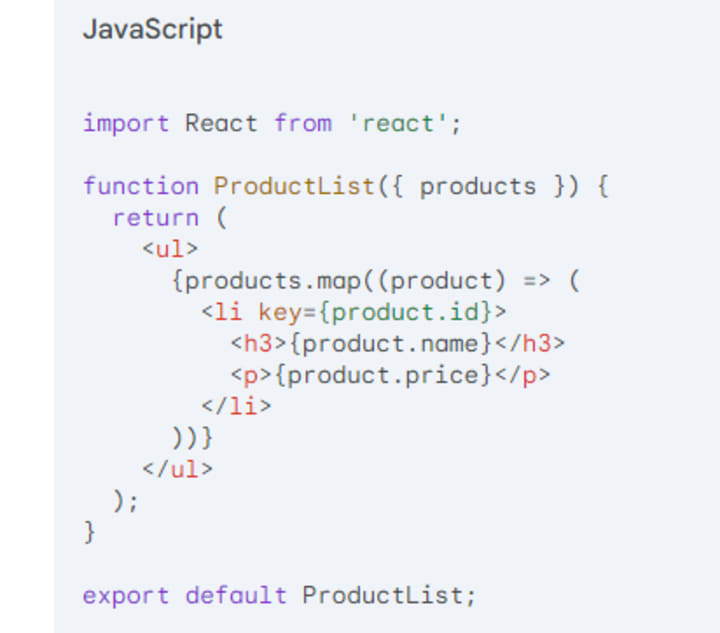
In this example, we're iterating over a list of products and rendering a <li> element for each one. The JSX syntax makes it easy to structure and style the UI elements.
Virtual DOM for Performance Optimization
Understanding the Virtual DOM
Apart from other things, the virtual DOM is one of the factors that make React.js perform at great speed. It is a lightweight in-memory version of the real DOM. Once changes are made to the application’s state, React.js updates the virtual DOM and then efficiently calculates only those portions that require change on the actual DOM.
Performance Benefits
The virtual DOM offers several performance advantages:
- Efficient Updates: By minimizing direct manipulations on DOM, React.js reduces overhead and enhances rendering performance.
- Batching Updates: To further optimize performance, react.js often combines multiple state updates into a single dom update.
- Declarative Approach: React.js is declarative, meaning you have to describe your desired UI and let it manage underlying dom manipulations for you.
Use Cases for Virtual DOM Optimization
The virtual DOM is particularly beneficial in scenarios where:
- Frequent updates: If your application frequently modifies its UI, virtual dom can be an excellent choice to enhance its performance.
- Large datasets: With big data being handled by many organizations today, it would be better if rendering was done based on what needs to be updated only using virtual doms.
- Complex animations: while it is true that animations tend to eat up processing power; however, making use of vdom will help address any potential slowdowns when they happen since such code can only be written once or twice rather than being scattered all over different locations within our program structures.
Comparing React.js vs. Traditional DOM Updates
As an example to highlight how much faster a large list update could be accomplished using a virtual dom approach over traditional dom-manipulation let us consider this situation. In traditional manipulation of the Document Object Model (DOM), one might need to go through every item in order to change their properties. This could take longer, especially when working with large datasets.
The good thing about React.JS is that we can target exact items that have been modified in the virtual dom making the rendering much faster. This is most felt when working with dynamic data or frequent state changes.
Unidirectional Data Flow
Understanding Unidirectional Data Flow
React.js uses a unidirectional data flow pattern commonly known as “one-way data binding”. In practice, this implies that information flows in an expected and controlled manner from the parent component to its child.
Benefits for App Stability and Predictability
Unidirectional data flow offers several advantages:
- Predictability: Data always moves forward and is the same throughout thus making it easy to understand and debug an application.
- Stability: This protects the integrity of the app state by preventing unauthorized updates.
- Maintainability: Increasingly, it becomes easier to manage and reason about data flow within a growing application.
Comparison to Bidirectional Data Binding
In contrast with unidirectional data binding, bidirectional data binding allows for information exchange between components in both directions. While this can be convenient at times, it also leads to complicated and unpredictable behaviour. Unidirectional data flow is more structured and manageable.
Example: Implementing a Shopping Cart
To demonstrate why using one-way bindings is beneficial we are going to look at an example of a shopping cart. For instance, a shopping cart component could save all items added there as part of its local state. If someone adds or removes something the state is updated accordingly and UI is re-rendered again.
By enforcing consistency on the whole lifecycle of any changes made within our shopping cart; we will avoid unpredictable results thereby making it easy for developers to maintain codebases efficiently without causing any harm elsewhere by using uni-directional passing on these changes through them.
Strong Community and Ecosystem
A Vibrant Community
React.js enjoys a great number of developers globally that are active. This is a bustling community involved in framework development as well as providing support, through forums, blogs, and sponsoring conferences.
Rich Ecosystem of Libraries and Tools
The use of React.js comes with the advantage of the availability of many third-party libraries and tools. These frameworks may make it easier to develop your e-commerce application faster or add more functionalities to it.
E-commerce-Specific Libraries and Frameworks
React.js can be combined with several dedicated libraries or frameworks for developing e-commerce applications. Such a set of tools normally provides pre-built components along with utility features that blend well with popularly used commerce platforms.
Example: Redux Toolkit for State Management
Redux is a widely used state management library for React apps. It helps organize the application state centrally so developers find it easier to identify defects and write clear code. Redux Toolkit comprises multiple utilities that simplify the usage of Redux with React projects.
Hire a ReactJS developer who can effectively utilize the Redux Toolkit. This powerful toolset will easily enable you to handle ‘add-to-cart’ functionality, customer profiles, and product data thereby transforming your app into an efficient one that can be maintained over time.
SEO-Friendly
Optimizing React.js for Search Engines
Although React.js is mainly a client-side framework, it can still be search engine optimized to improve visibility and attract organic traffic. Here are the main techniques:
- Server-Side Rendering (SSR): It enables crawlers to render some HTML content of your React application on the server side. This improves how your content is indexed by search engines.
- Pre-rendering: This means that static HTML files will be generated during the building process of your application pages. Ultimately, it enhances initial load times and search engine optimization (SEO).
Case Studies of Successful SEO with React.js
Numerous successful e-commerce websites developed with React.js have experienced considerable success in their SEO campaigns. By adopting methods like SSR and concentrating on other relevant Search engine optimization best practices, these sites have positively impacted their rankings in major search engines and link-driven traffic.
Example: Implementing SSR for a Product Detail Page
To demonstrate the benefits of SSR consider a product detail page in an e-commerce app. With this page’s implementation of SSR, you would enable search engines’ crawlers to access and index product information such as titles, descriptions, and images among others. Consequently, this will help raise the prominence level of your product pages on search engine results pages (SERPs).
By optimizing your React.js e-commerce app carefully with respect to SEO you can increase its visibility leading to an increased number of organic visits which converts into increased sales volume at the end.
Cross-Platform Compatibility
Building Web and Mobile Apps with React.js
React.js is not limited to web development. It can also be used to build high-quality mobile applications. This cross-platform compatibility offers several advantages:
- Single Codebase: By using a shared codebase for both web and mobile applications, you can reduce development time and effort.
- Consistent User Experience: An integrated codebase makes sure that the app has the same look and feel across multiple platforms, which enhances user experience.
- Faster Time to Market: When developed with React.js, both web and mobile apps may take less time to bring them out into the market.
Popular Cross-Platform Frameworks
React Native is a popular framework that lets you build mobile apps in JavaScript and React which are native. This gives you access to native APIs as well as components thereby ensuring high-performance experiences similar to those found in native apps.
Example: Building a Mobile E-commerce App with React Native
Using React Native, one can create a mobile e-commerce app that shares a significant portion of its codebase with its web counterpart. This significantly reduces development timescales and maintenance costs.
Key features and benefits of using React Native for mobile e-commerce include:
- Native Performance: In many cases, if not all, react native apps perform comparably to ones coded natively in languages such as Swift or Kotlin.
- Hot Reloading: Codes written here have an immediate effect on changes made to the application hence enhancing development efficiency.
- Large Community and Ecosystem: There are thriving communities around react-native that provide support through libraries and tools available in rich ecosystems.
By selecting React.js plus React Native, one can quickly create both web-based as well as phone versions of their online store therefore giving seamless interaction among other platforms.
Conclusion
In conclusion, React.js presents a convincing basis for constructing scalable e-commerce applications that are also high-performing. Its component-oriented architecture, declarative syntax, virtual document object model (DOM), one-way data flow, and large community as well as ecosystem make it ideal for current e-commerce development.
By choosing React.js, you can benefit from:
- Efficient development: The architectural principle of Components together with declarative language make React.js slim on coding.
- Enhanced performance: This is because of the virtual DOM and efficient updates that keep track of changes quickly leading to a fast and responsive user interface.
- Scalability: Simple e-commerce apps can easily scale using react.js.
- Maintainability: The framework’s structure plus coding best practices make sure that the codebase remains clean and manageable even after years.
- Cross-platform compatibility: By employing this JavaScript library one can either create web or mobile apps at once.
To fully exploit React.js' potential in your efforts to develop an ecommerce app either hire a React.js development company or employ our ReactJS development services. Our team of experienced developers will assist you in designing, building as well as maintaining a solid e-commerce platform.
Contact us today to discuss your e-commerce app development needs and explore how React.js can help you achieve your business goals.
About the Creator
Keep reading
More stories from Fenil kasundra and writers in 01 and other communities.
Generative AI Consulting Strategies for Complex Business Processes
Enterprises today face a different kind of complexity than they did even three years ago. Business processes are no longer linear. They span fragmented systems, global teams, regulatory boundaries, and massive volumes of structured and unstructured data. Traditional automation and analytics tools struggle to keep pace with this level of operational depth.
By Fenil kasundraabout 14 hours ago in 01
How AI and Machine Learning Are Transforming Mobile Banking Apps
Mobile banking has evolved from a convenience feature into a core financial service. In 2026, the real driving force behind this evolution is Artificial Intelligence (AI) and Machine Learning (ML). These technologies are reshaping how users interact with banking apps, how banks detect fraud, manage risk, and deliver personalized financial experiences.
By shane cornerus5 days ago in 01
After the Storm
After the storm of winter snow there sat a small bear by the name Ted, of course. He loves the snow and likes to roll around in it making all sorts of trails and whatever he has a mind to do. He wondered where all the people are, but in a way, he is hoping that they are all snug in the homes maybe drinking hot chocolate-one of his favorite drinks with mini-marshmallows and eating something homemade for he likes this winter wonderland all to himself to romp and play and maybe even catch some fish down by the river.
By Mark Graham4 days ago in Fiction




Comments
There are no comments for this story
Be the first to respond and start the conversation.