
Top 10 Reasons Enterprises Are Accelerating RWA Tokenization Platform Development
Why regulated asset digitization is becoming a core priority for modern enterprises

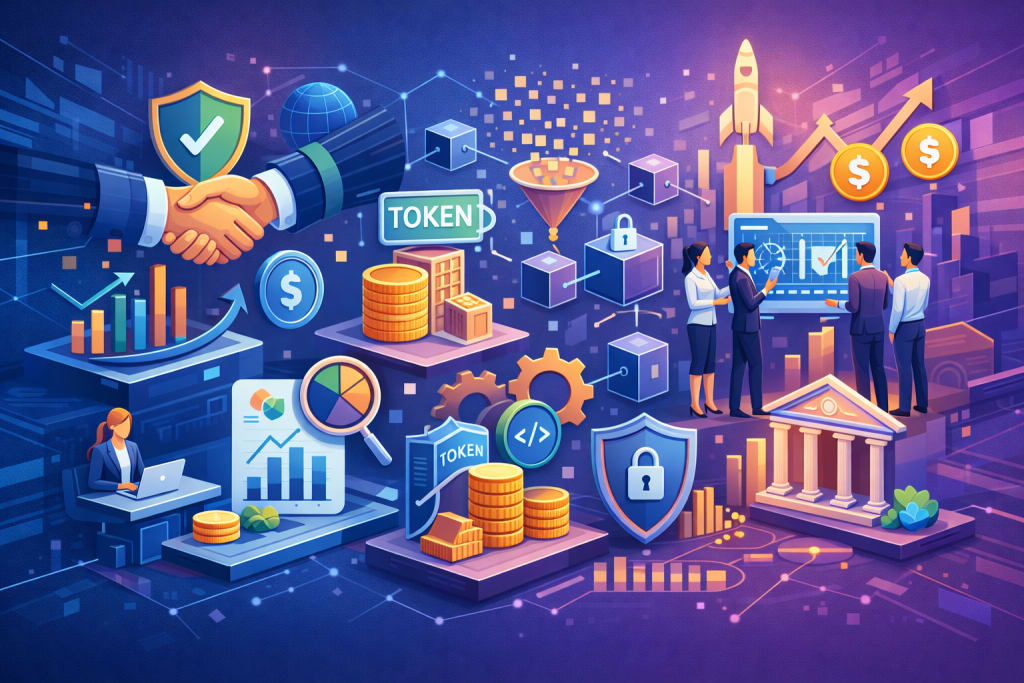
Across all sectors, companies are rethinking how to govern, fund, and scale their physical and financial assets. Most of today's asset management models were designed for a more fragmented, slower economy, with longer liquidity cycles, less flexible ownership structures, and less access to capital markets for a wider range of investors. The requirements of the digital economy for speed, transparency, globality and programmability in value transfer have made Real World Asset Tokenization a key part of enterprise digital transformation roadmaps.
RWA Tokenization refers to the process of representing real and customarily illiquid assets like real estate, commodities, invoices, intellectual property or infrastructure on the blockchain with a verifiable right of ownership, instant transferability and fractional ownership. As regulations and the blockchain ecosystem have matured, companies have moved beyond proof of concept and begun scaling rwa tokenization platform development in the enterprise sector.
While early adoption was confined to experimentation on niche solutions, enterprises are now engaging established RWA Tokenization Companies, investing in bespoke Real world asset tokenization platform development, and building large-scale ecosystems for asset issuance, compliance, trading, and lifecycle management. Below are the ten reasons driving this acceleration and transforming enterprise asset strategy globally.
1. Unlocking Liquidity From Traditionally Illiquid Assets
The largest potential driver of RWA Tokenization for enterprises is the ability to provide liquidity to assets that have historically been illiquid. Commercial real estate, private credit, fine art, energy infrastructure and long-term contracts, for example, are often costly and slow to transact. These barriers limit participation and the flow of capital.
Real World Asset Tokenization can tokenize the asset so it can be fractionalized, used in a compliant ecosystem that provides access to investments into assets that are too large for individual ownership without losing the governance rights of buying the asset outright. This shortens the liquidity cycle and allows the organization to raise funds without selling the entirety of the assets.
Real World Asset Tokenization Services bring the capability of rebalancing, value realization, and capital redeployment to enterprises, with liquidity becoming a calculated asset rather than a constraint. Tokenization services have become a vital part of enterprise financing in the modern economy.
2. Expanding Global Investor Access Without Geographic Barriers
Customary asset investment and allocation are geographically restricted and fragmented by regulation and networks of intermediaries. International investment requires navigating legal frameworks, currency risk, and lengthy settlements. RWA Tokenization solves this issue by creating standardized digital representations of such assets to be accessible to a global pool of compliant investors.
In real world asset tokenization, companies can issue tokenized assets to qualified clients across jurisdictions by encoding jurisdiction-specific rules into smart contracts, which reduces manual checks and increases efficiency for the token issuer and investors alike.
A strong RWA tokenization platform enables businesses to access additional capital opportunities without needing a physical presence or office in specific countries. They can also develop solutions accepting various currencies, integrate identity verification, and comply with regulatory reporting requirements. Collaborating with an experienced rwa tokenization platform development company provides asset transparency and builds investor trust.
3. Reducing Operational Costs Through Automation and Smart Contracts
Enterprise asset management is a paperwork-heavy industry that includes a lot of reconciliation, third party validation and other administrative work that eats up funds, creates inefficiencies and exposes the transaction process to human error. RWA Tokenization allows this work to be automated with rules.
Smart contracts play an important role, as they govern the rules surrounding the tokenized asset, including ownership, profit share, and compliance. Once executed, smart contracts are self-executing and will automatically enforce the predetermined conditions, eliminating the need for active human management.
RWA Tokenization Services also enable enterprises to dramatically reduce their transaction settlement time, the amount of time they spend on audit, and operational complexity while at the same time providing a long-term cost optimization solution through efficiency.
4. Enhancing Transparency and Trust Across Asset Lifecycles
A major concern in customary asset markets, particularly in private and alternative asset markets, is the lack of real-time information and transparency about asset performance, ownership, and transaction history, which can reduce trust and limit participation in asset markets.
Real World Asset Tokenization enables each action, transfer and event involving the underlying assets to be tracked and logged in immutable data blocks on the blockchain. Authorized entities can access real-time information, thus benefiting from improved visibility and transparency of the assets, increasing investor confidence and governance in the agency.
Enterprise-level solutions provided by a Real world asset tokenization platform company can provide permissioned environments that balance transparency and confidentiality by providing verifiable proof of authenticity and ownership while keeping sensitive information private.
5. Supporting Fractional Ownership and New Business Models
By allowing fractional ownership, and thus democratized access for the user, there is the ability to create new business models, like tiered access, dynamic pricing or revenue sharing models.
Infrastructure operators, manufacturers, and content owners can tokenize future cash flows, equipment usage, or IP royalties, respectively, which was previously virtually impossible due to administrative difficulties, the legal and regulatory environment, and trade-offs with other funding methods.
Rich RWA token development features enable organizations to create tokens for various economic rights, voting rights, or utility. Organizations can offer rich RWA tokenized products to different classes of investors and customize incentives accordingly.
6. Improving Capital Efficiency and Balance Sheet Optimization
Capital efficiency is important to businesses operating in a competitive environment. Illiquid assets may encumber a business's balance sheet adversely affecting its calculated options. RWA Tokenization eases the transfer of asset ownership while retaining operational control.
Compared to customary assets, tokenization allows fractions to be sold, refinanced, or used as collateral, offering companies greater cash flow management and more optimal capital allocation.
Professional RWA tokenization development companies help enterprises design token models that meet accounting standards, compliance requirements, and long-term financial goals. They guide organizations in using real estate tokenization to optimize, rather than disrupt, the balance sheet. This empowerment enables companies to leverage real estate tokenization to their advantage.
7. Aligning With Evolving Regulatory and Compliance Frameworks
The regulatory landscape for digital assets has improved considerably. Governments and financial authorities around the world are increasingly viewing tokenized assets, including Real World Asset Tokenization, as the next step in the development of customary asset classes and securities.
Modern RWA Tokenization Services proactively embed compliance measures such as identity verification, transaction monitoring, and jurisdictional oversight into their platforms, reducing regulatory risks and encouraging collaboration between regulators and institutional participants.
By investing in the ecosystem of RWA tokenization platform development, businesses can proactively anticipate regulations rather than simply respond to them, creating the infrastructure for truly scalable tokenization initiatives and eliminating friction in the process.
8. Integrating Tokenization With Enterprise Digital Transformation
Tokenization is part of wider efforts by enterprises to transform their operations through technologies like cloud computing, data analytics, AI, and automation. RWA Tokenization enables the enterprise to come full circle by also digitizing the value of their assets.
Tokens interact with enterprise resource planning, financial reporting, and various analytical tools to provide real-time insights into asset performance, investor behavior, and market dynamics.
A strong rwa tokenization platform development company will help implement blockchain infrastructure with minimal impact on existing enterprise systems while maximizing acceptance across finance, legal, operations, and strategy departments.
9. Gaining Competitive Advantage in Emerging Digital Markets
First movers can lock in investors, set the standards, and establish trusted platforms. Once the market for tokenizing assets matures, barriers to entry for late movers may rise and the advantages given to early movers may diminish in importance.
By committing to early RWA tokenization platform development, enterprises position themselves to accelerate product iterations and market feedback loops, ultimately securing their market position before competitors in a dynamic ecosystem.
Partnering with an RWA Tokenization Company allows companies to be faster and to avoid issues with security, scalability and compliance which will give them a defensive advantage in the growing digital asset market.
10. Future-Proofing Asset Strategies for a Tokenized Economy
Perhaps the most strategic reason enterprises are accelerating Real World Asset Tokenization is future readiness. As financial markets evolve toward programmable assets and decentralized infrastructure, tokenization is expected to become a standard rather than an exception.
Assets that remain locked in legacy systems may face reduced liquidity, limited investor interest, and declining relevance. In contrast, tokenized assets are inherently compatible with emerging financial technologies, including automated trading, decentralized finance integrations, and AI-driven asset management.
By investing in Real World Asset Tokenization Offerings today, enterprises future-proof their asset portfolios and ensure adaptability in a rapidly changing economic environment. Tokenization platforms provide the flexibility to evolve without rebuilding core infrastructure from scratch.
Conclusion: RWA Tokenization as a Strategic Imperative
The acceleration of RWA Tokenization platform development is not driven by hype but by tangible enterprise benefits. From unlocking liquidity and reducing costs to improving transparency and enabling new business models, tokenization addresses long-standing limitations of traditional asset management.
Enterprises that treat Real World Asset Tokenization as a strategic capability rather than a short-term experiment are better positioned to compete in a digital-first economy. By working with an experienced RWA Tokenization Company and investing in scalable, compliant platforms, organizations can transform how value is created, distributed, and sustained.
As global markets move toward tokenized representations of real-world value, enterprises that act now will define the standards, capture early advantages, and lead the next phase of asset innovation.
About the Creator
Ethan hunt
Ethan is a blockchain and Web3 specialist focused on building decentralized ecosystems that enhance transparency, security, and global accessibility.
Keep reading
More stories from writers in 01 and other communities.
Top AI Development Companies in the USA 2026: Market Leaders to Watch
Introduction Artificial intelligence has moved well beyond experimentation and into the core of modern business strategy. By 2026, AI is no longer just about automation or data analysis—it is about building intelligent systems that can reason, adapt, and drive decision-making at scale. Across industries such as healthcare, finance, retail, manufacturing, and technology, organizations are increasingly relying on advanced AI solutions to remain competitive in a fast-changing digital landscape.
By Aarti Jangid2 days ago in 01
Cabin Fever Because of Snow, Sleet, and Freezing Rain That Turned to Icy Roads
What Is Cabin Fever? The short answer is that cabin fever is restlessness from being in a confined area. Cabin fever is the distressing irritability or restlessness experienced when a person or group is stuck at an isolated location or in confined quarters for an extended time. Research shows that prolonged cold, gray skies, and being stuck indoors can trigger mood shifts similar to “winter blues.”
By Margaret Minnicksa day ago in Humans
A Love Forboding
The chipped stone slope caused unbearable footing. I slid, skirting on my heels. I cast my shield, relinquishing my guard to stay upright. Left with my double-edge and a prayer to the maker, I skated toward my objective. The earthly stubble gave way to solid ground. I found myself restored, a trail of dust in my wake.
By James U. Rizzi3 days ago in Fiction



Comments
There are no comments for this story
Be the first to respond and start the conversation.