
Spatial Computing: Indi IT Solutions’s Vision for AR Mobile Apps
Mastering Collaborative State Management with Advanced Syncing Algorithms in 2026

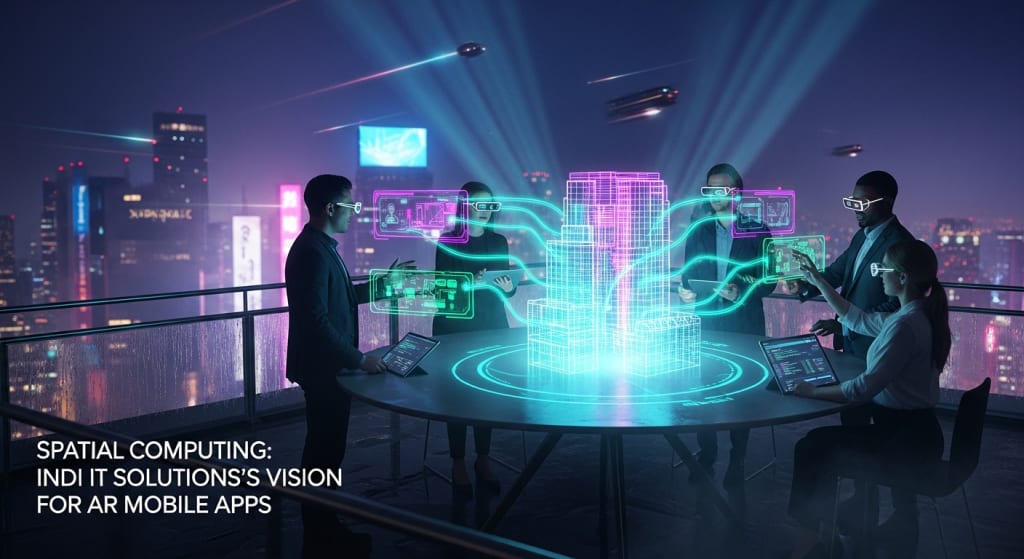
The shift toward spatial computing in 2026 has transformed mobile applications. They are no longer just flat interfaces. They have become persistent and shared environments. Developers face a new and difficult challenge. They must do more than just render 3D assets. They must ensure that multiple users see the exact same digital state. This must happen at the exact same time. Two users might interact with a virtual object in a shared AR space. The underlying synchronization must handle high concurrency. It must do this without any visual jitter. It must prevent state divergence between the users.
This technical deep dive explores the required algorithmic frameworks. These frameworks power these modern experiences. We will focus on the methods of a leading US App development company. Indi IT Solutions navigates the complexities of distributed systems. They create seamless and collaborative AR integrations for clients.
The Collaborative State Challenge in 2026
In a standard mobile app, "sync" is often simple. It usually refers to RESTful API calls. It might involve occasional WebSockets for basic data. In spatial computing, sync happens at the frame rate. A user might move a virtual tool in a training app. That change must propagate to all other participants. It must happen within a few milliseconds.
The primary hurdle is the CAP theorem. This is a core rule of distributed systems. It says a system provides only two of three guarantees. These are Consistency, Availability, and Partition Tolerance. In mobile AR, we cannot sacrifice availability. Users must always be able to interact with the app. We cannot sacrifice partition tolerance either. Mobile users move through varying network conditions. Connections can drop or slow down at any time. Therefore, we must use specific algorithms. These algorithms achieve what we call "eventual consistency." They use sophisticated conflict resolution to match all states later.
Core Frameworks: CRDTs vs. Operational Transformation
To manage shared state in 2026, two families dominate. These are Operational Transformation and Conflict-free Replicated Data Types. Developers must choose between them carefully.
1. Operational Transformation (OT)
OT was used in early collaborative text editors. It transforms operations before they apply to a local state. This is a very powerful method. However, OT usually requires a central server. The server must sequence every single operation. In AR, this creates a "round-trip" to the server. That trip introduces too much latency. High-speed spatial interactions cannot wait for a server.
2. Conflict-free Replicated Data Types (CRDTs)
CRDTs are now the standard for 2026 spatial apps. These are special data structures. They can be updated independently. They can be updated concurrently. They do not require any coordination between nodes. They guarantee a specific outcome. If nodes receive the same updates, they reach the same state. The order in which they receive updates does not matter.
- State-based CRDTs: The entire data state is sent between nodes. This is very reliable. It can be very bandwidth-intensive.
- Operation-based CRDTs: Only the specific update operation is sent. This requires the reliable delivery of every operation. It is much more efficient for complex AR scenes.
Advanced Implementation: Delta-State Syncing
AR scenes are becoming more detailed every day. Sending full CRDT states is becoming very impractical. We now utilize what is called Delta-State CRDTs. The system does not transmit the entire data structure. It computes the "delta" instead. The delta is the smallest change since the last sync.
This is very effective in spatial computing. Usually, only a small part of an environment changes. One virtual tool might move a few inches. The rest of the scene stays the same. We combine Delta-States with 5G or 6G edge computing. This reduces perceived latency to sub-20ms levels. This is the threshold for human perception. It makes the interaction feel instant to the user.
Real-World Hypothetical: Collaborative AR Design
Imagine a team of architects on a physical site. They use a mobile app to visualize a building. User A scales a virtual pillar to be taller. User B changes the texture of that same pillar.
In a legacy system, these edits might cause issues. The pillar might flicker between different versions. One user's change might be overwritten and lost. We use a Last-Writer-Wins (LWW) Element Set. This is a specific type of CRDT. The system attaches a unique timestamp to every attribute. It also uses a vector clock. A vector clock tracks the history of changes. The algorithm merges these changes locally on every device. The result is a very seamless experience. User A sees the new texture. User B sees the new scale. No central server is needed to decide a winner.
AI Tools and Resources
- Yjs / Hocuspocus: This is a high-performance CRDT framework. It works for shared state management. It is excellent for developers building collaborative tools. It handles the heavy lifting of conflict resolution.
- Automerge: This is a JSON-like CRDT library. It is best for very complex data structures. It is used when "intention preservation" is critical. Use this for apps with many nested properties.
- NVIDIA Omniverse Cloud: This provides AI-driven synchronization. It handles high-fidelity USD files. It is intended for enterprise-grade digital twins. It works well for industrial AR.
- Supabase Realtime: This is a managed service. It broadcasts small state changes via WebSockets. It is ideal for teams who want fast implementation. You do not have to manage your own infrastructure.
Practical Application: Selection Logic
You must choose the right algorithm for your app. The choice depends on your specific use case.
- Low Complexity / High Speed: Use LWW-Element-Set CRDTs. These are great for simple coordinate changes. Use them for XYZ movement.
- High Complexity / Sequential: Use Sequence CRDTs. An example of this is RGA. Use these if the order of operations is vital. This applies to shared timelines or construction logs.
- Variable Connectivity: Implement a Local-First Architecture. Ensure the app is fully functional offline. Use a local store for all data. Then use a background sync process. Merge CRDT deltas when the connection returns.
Risks, Trade-offs, and Limitations
There is one big risk in advanced syncing. This is known as Metadata Bloat. CRDTs must keep track of many things. They track deleted items and many timestamps. This helps them resolve future conflicts. The size of the data structure grows over time.
- Failure Scenario: Clock Drift In an AR session, device clocks can be different. User A’s clock might be out of sync. A "Last-Writer-Wins" strategy will then fail. User A’s edits might be discarded by others. Their timestamps might appear to be from the past.
- The Warning Sign: Users see their changes disappear. This happens shortly after they make the change.
The Alternative: Implement Hybrid Logical Clocks (HLC). HLCs combine physical timestamps with logical counters. They ensure a consistent ordering of all events. This works even when system clocks disagree.
Key Takeaways
- Prioritize Local-First: The best apps treat the network as optional. This is the standard for 2026.
- Leverage CRDTs: Do not use server-side locking. Use CRDTs to allow instant local feedback. Let conflict resolution happen in the background.
- Monitor Metadata: You must implement "garbage collection" strategies. Use state-pruning to keep the app fast. This prevents bloat from slowing down mobile performance.
- Edge Integration: Use edge computing nodes. They can handle merging large-scale spatial states. This moves the work closer to the user.
Spatial computing is merging with our physical world. We must maintain a consistent digital reality. This will be the main differentiator for apps. It is the key to successful mobile products.
About the Creator
Keep reading
More stories from Del Rosario and writers in 01 and other communities.
How Indi IT Solutions is Building the Next Digital Ecosystems in the USA
Real-time collaboration is no longer a luxury feature for mobile applications. It is a foundational requirement. We are moving through 2026 now. The complexity of maintaining state across millions of devices has reached a peak. This is a critical inflection point for the industry. Users expect experiences that are instantaneous and offline-capable. They want conflict-free experiences. This must happen regardless of their network stability.
By Del Rosarioa day ago in 01
Longevity Risk and Healthcare Costs: Planning for the Financial Unknowns in Retirement
Advances in healthcare and improved living standards mean people are living longer than ever before. While increased longevity is a positive development, it also introduces significant financial challenges in retirement. Longevity risk, the possibility of outliving your savings, combined with rising healthcare costs, represents one of the greatest uncertainties retirees face. Effective planning requires acknowledging these risks and building strategies that can adapt to an unpredictable future.
By David C. Brancha day ago in 01
The Tradeoffs Charlotte Teams Face During Mobile App Development
I used to believe good planning could eliminate tradeoffs. If we scoped carefully enough, aligned stakeholders early, and chose the right partners, we could move fast and build well. Charlotte felt like the right environment for that optimism—practical, disciplined, not driven by hype.
By Samantha Blake8 days ago in 01
A Letter to the Firestarter
Dear Firestarter, We can all see you, we've been watching you since you began. In case you didn't know we were here before you and we will be here after. We witnessed your rise, your setbacks, your guilt and your lies. We witnessed you start the fire.
By Donny Foley7 days ago in Poets


Comments
There are no comments for this story
Be the first to respond and start the conversation.