
Reducing Latency with Multi-access Edge Computing in 2026
A guide for technical leaders moving high-performance workloads from distant cloud data centers to the network edge.

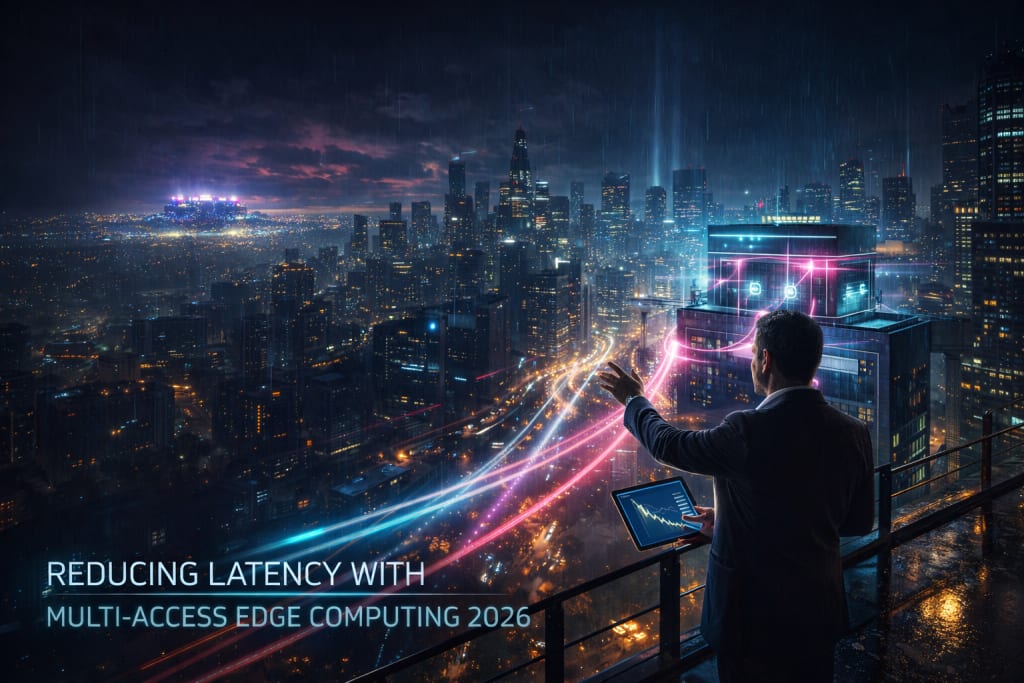
The promise of the cloud was centralized efficiency. However, for 2026 applications, physical distance is now a major liability. Real-time AI inference is now a standard requirement. Autonomous systems and immersive AR also demand high performance. Distance between a user and a data center creates a "latency floor." Traditional cloud architectures cannot break this physical limit.
This guide is for technical decision-makers and developers. It is for those who have reached the limits of cloud zones. We will examine Multi-access Edge Computing, also known as MEC. MEC shifts processing to the "last mile" of the network. This effectively bypasses the bottlenecks of the public internet.
The 2026 Latency Crisis: Why Distance Matters
In early 2026, the definition of "fast" has shifted. A delay of 100ms was acceptable in the last decade. Modern reactive systems now require much more speed. Surgical robotics need round-trip times under 20ms. Vehicle-to-everything (V2X) communications also need this speed. Traditional cloud computing relies on massive, centralized data centers. Data centers are often hundreds of miles away.
High-speed fiber optic cables are very fast. However, the speed of light still has limits. Every router hop adds a small delay. A router hop is a stop at a network gateway. Consider a user in a city like Chicago. A request might travel to a "US-East" region. This region is located in Virginia. This journey creates a minimum physical latency. No amount of software optimization can solve this. The delay is a result of physical laws.
How MEC Architecture Eliminates the Middleman
Multi-access Edge Computing solves this problem. It places compute and storage resources at the network edge. These resources live within the 5G Radio Access Network. They may also sit at local aggregation points.
- Direct Entry: Data enters the compute node quickly. It happens immediately after leaving the user's device. This occurs before it hits the core internet backbone.
- Reduced Hops: MEC processes data at the local exchange. This eliminates 10 to 15 typical router hops. Fewer stops mean data arrives much faster.
- Local Context: MEC nodes see local network conditions. They allow for real-time bandwidth adjustments. Centralized servers cannot see these local changes.
Organizations are now building high-performance localized applications. Partnering with specialized developers can bridge the gap. They connect cloud-native code to edge-native deployment. For instance, Mobile App Development in Chicago is a great resource. They help businesses leverage local 5G MEC nodes. This provides instantaneous user experiences. The apps feel local to the user. This remains true even with complex backend logic.
Real-World Examples
MEC theory is very compelling. Actual 2026 implementations focus on three high-value use cases. These are areas where the "distant cloud" model fails.
Real-Time AI Inference
Processing video feeds requires massive bandwidth. This is true for safety or retail analytics. Sending 4K video to a distant cloud is expensive. It is also very slow. Instead, run the inference model on a MEC node. Only the "metadata" is sent to the central cloud. Metadata is a small summary of the data. An example is "Person detected at 10:02 AM." The central cloud handles long-term storage. This process saves 90% on backhaul costs. Backhaul refers to data moving to the main network.
Industrial IoT (IIoT)
Smart manufacturing requires perfect timing. A "stop" command to a robotic arm is critical. A small delay can result in equipment damage. MEC provides deterministic latency for these systems. Deterministic latency means the delay is predictable. This is required for closed-loop control systems. Traditional cloud regions cannot guarantee this timing.
Immersive Commerce
AR shopping experiences require precise "pose estimation." This tracks where a phone points in 3D space. Tracking logic must stay very fast. If logic is 50ms behind, users feel sick. This is known as motion sickness. MEC keeps the digital overlay perfectly synced. The digital world matches the physical world exactly.
Practical Application
Implementing MEC in 2026 requires a shift in how developers view the network stack. It is not just about writing code. It is about understanding the geography of the network. Start by identifying the parts of your application that are "latency-sensitive." These specific modules should be moved to MEC nodes. Use regional cloud zones for your heavy databases. This hybrid approach ensures you get the speed of the edge and the power of the cloud.
AI Tools and Resources
AWS Wavelength — Embeds AWS services within 5G networks.
- Best for: Deploying existing workloads to the edge. You can use Lambda or EC2. You do not need to change your code.
- Why it matters: It provides a consistent developer experience. The experience matches the "Parent Region" cloud.
- Who should skip it: Teams not using the AWS ecosystem. Teams using private LTE or 5G should also skip.
- 2026 status: It is highly stable. Coverage has expanded to 40+ global metropolitan areas.
Vercel Edge Functions — Running serverless logic at the edge.
- Best for: Web applications needing instant personalization. It is also great for geo-fencing tasks.
- Why it matters: It moves logic closer to the user. This reduces the "Time to First Byte" significantly.
- Who should skip it: Applications requiring heavy computational power. Skip this for long-running processes.
- 2026 status: It now supports expanded memory limits. It also supports standard Web APIs.
Azure Public MEC — Microsoft’s collaboration with telecommunications operators.
- Best for: Enterprise applications needing deep integration. It works well with Active Directory. It also integrates with Azure AI services.
- Why it matters: It offers seamless data "hand-off." Data moves easily between edge and core cloud.
- Who should skip it: Small startups. It may be too complex for simple hosting.
- 2026 status: It is fully operational. It supports 2026-grade AI hardware accelerators.
Risks, Trade-offs, and Limitations
MEC is not a "magic button" for performance. It introduces significant architectural complexity. This can backfire if mismanaged.
When MEC Fails: The "State Sync" Trap
Your application might rely on a global database. This is common for real-time inventory counts. Moving logic to the edge can increase latency.
- Warning signs: Users see fast initial responses. However, they see "stale" or old data. Final confirmations may also be very slow.
- Why it happens: The edge node processes the request quickly. But it must wait for the main database. This "Source of Truth" is far away. The node waits 100ms for a confirmation.
- Alternative approach: Use a distributed database. Examples include Fauna or DynamoDB Global Tables. These tools replicate data to the edge. You can also keep state-heavy operations central. Move only the state-less "processing" to the MEC.
Key Takeaways
- Distance is the Bottleneck: Does your app need <30ms latency? Physical location is now the most important factor. It is more important than CPU speed.
- Hybrid is Mandatory: Do not move everything to the edge. Use MEC for "hot" data and triggers. Keep "cold" heavy lifting in the central cloud.
- Security is Local: Edge computing increases the "attack surface." Ensure your provider offers localized DDoS protection. Use zero-trust access at the node level. Zero-trust means every request is verified every time.
About the Creator
Keep reading
More stories from Del Rosario and writers in 01 and other communities.
Interactive iOS Widgets Creative Use Cases for 2026
The evolution of iOS widgets has shifted. They moved from static "glanceable" information to fully functional interfaces. These are miniature application interfaces. In 2026, old technical constraints are gone. These constraints once limited widgets to simple button toggles. They are replaced by high-performance protocols. These protocols live within SwiftUI and WidgetKit. This transition allows users to complete multi-step tasks. Users do this without ever launching the parent application.
By Del Rosarioabout 4 hours ago in 01
How Fintech Startups Are Building Scalable Real World Asset Tokenization Models
The global financial ecosystem is undergoing a structural transformation driven by blockchain, distributed ledger systems, and programmable finance. At the center of this transformation lies Real World Asset Tokenization, a model that converts tangible and intangible assets into blockchain-based digital tokens. From real estate and private equity to commodities, invoices, and carbon credits, assets that were once illiquid and geographically restricted are now entering digital marketplaces.
By Ethan hunt7 days ago in 01

Comments
There are no comments for this story
Be the first to respond and start the conversation.