
HVDC Transmission Systems Market: VSC Technology, Offshore Wind & 2034 Global Outlook
In in-depth look at how EV fleet expansion and offshore wind potential are compelling utilities to implement high-capacity HVDC links for a resilient 2034 energy grid.

As the world pushes toward a zero-carbon future, the biggest challenge isn't just generating clean energy—it’s moving it. High-Voltage Direct Current (HVDC) transmission systems have emerged as the "superhighways" of the modern grid. While our neighborhoods typically run on Alternating Current (AC), HVDC is the elite solution for transporting massive amounts of power over thousands of miles with incredibly low energy losses. Whether it is bringing offshore wind power from the North Sea to inland cities or connecting solar arrays in the Sahara to Europe, HVDC is the silent backbone of the global energy transition.
Market Growth Drivers:
The massive global demand for HVDC systems is primarily driven by the urgent need to integrate remote renewable energy sources into existing power grids. Because the best wind and solar resources are often located hundreds of miles from urban centers, utilities are turning to HVDC to prevent the "curtailment" of clean energy. Furthermore, the rapid expansion of the data center industry—which is seeing electricity usage skyrocket—is putting immense pressure on grid stability. High-capacity HVDC lines are being deployed as critical "infeed" solutions to support these energy-intensive hubs. Additionally, many nations are investing in cross-border interconnections to share surplus power, creating a more resilient and flexible international energy market that can withstand regional supply shocks.
Market Trends:
The most significant technological trend is the rapid shift from legacy Line Commutated Converters (LCC) to advanced Voltage Source Converters (VSC). VSC technology is a game-changer because it allows for independent control of active and reactive power, making it ideal for stabilizing weak AC grids and connecting offshore wind farms where space is limited. We are also seeing a major move toward "Hybrid HVDC" systems that combine overhead lines with underground or subsea cables to navigate environmental restrictions and urban density. Another standout trend is the integration of AI-optimized control algorithms. For example, recent innovations in modular multilevel converters are now capable of reducing transmission losses significantly, ensuring that almost every megawatt generated at a remote site actually reaches the consumer's plug.
Get a Sample Report for Actionable Market Insights
Recent News and Developments in the HVDC Transmission Systems Market:
The industry is currently seeing record-breaking contracts and government-led R&D initiatives. In February 2026, GE Vernova announced a breakthrough in VSC-HVDC technology with a new modular multilevel converter prototype, specifically designed to reduce transmission losses by up to 15% through improved power electronics. This aligns with the U.S. Department of Energy’s HVDC CORE Initiative, which aims to cut technology costs by 35% by 2035 to accelerate domestic supergrid construction.
Corporate activity is equally aggressive; Hitachi Energy recently introduced a 525 kV HVDC cable solution with enhanced thermal management, tailored for underground transmission upgrades to minimize environmental impact. Meanwhile, in Japan, Mitsubishi Electric unveiled a next-generation DC circuit breaker, a critical component for protecting the multi-terminal grids of the future. These developments prove that the sector is no longer just about "wires," but about high-stakes visual intelligence and digital control.
Market Data Summary
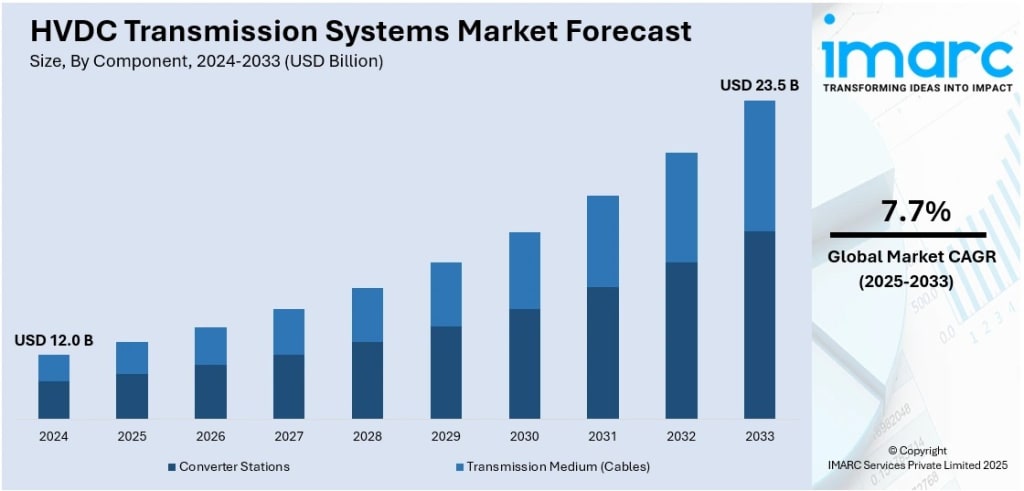
According to the latest research from IMARC Group, the HVDC transmission systems market is seeing robust capital investment worldwide.
Market Size (2024): USD 12.0 Billion
Market Forecast (2033): USD 23.5 Billion
Historical Years: 2019-2024
Forecast Years: 2025-2033
Key Market Segmentation:
By Component: Converter Stations (representing nearly 43% of the market), Transmission Medium (Cables and Overhead Lines).
By Technology: Line Commutated Converter (LCC), Voltage Source Converter (VSC), Capacitor Commutated Converter (CCC).
By Transmission Type: Submarine HVDC (fastest growing due to offshore wind), Overhead Transmission (largest current volume), Underground Transmission.
By Application: Bulk Power Transmission, Interconnecting Grids, Infeed Urban Areas.
By Region: Asia Pacific (Dominant share, particularly China and India), North America (Fastest growing in utility interconnections), Europe (Leader in offshore wind clusters).
Industry Outlook: The Path Forward
As we look toward the next decade, the HVDC market is evolving from a niche engineering marvel into a standard utility tool. The transition is moving from simple point-to-point links to complex, multi-terminal DC grids. For stakeholders, the opportunity lies in the "digitalization of the grid." The future belongs to those who can combine heavy-duty power electronics with AI-driven diagnostics to ensure that the lights stay on, regardless of how far away the power is generated.
About the Creator
Rahul Pal
Market research professional with expertise in analyzing trends, consumer behavior, and market dynamics. Skilled in delivering actionable insights to support strategic decision-making and drive business growth across diverse industries.
Compose Multiplatform for iOS Production Readiness in 2026
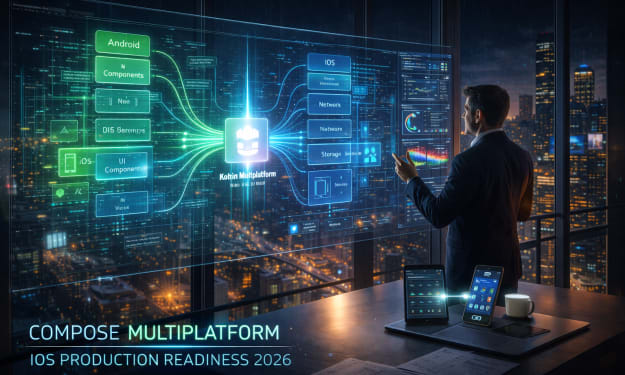
Engineering leaders must evaluate Kotlin Multiplatform today. The cross-platform UI debate has shifted recently. It is no longer about if it works. The focus is now on maintenance at scale. Compose Multiplatform (CMP) for iOS has reached a critical tipping point. Developers can share business logic and the UI layer. This works across both Android and iOS platforms. It provides a unified codebase for your team. It avoids the lag of web-based wrappers. It also lacks the overhead found in Flutter. This guide evaluates readiness for technical decision-makers. We focus on long-term stability and development speed.
By Devin Rosario7 days ago in 01


Comments
There are no comments for this story
Be the first to respond and start the conversation.