
Generative AI in App Development: Use Cases Driving Business Innovation
In 2026, coding isn't what it used to be. From GenUI to self-healing code, here is how generative AI is rewriting the business playbook, and why "prompt engineering" is the new syntax.

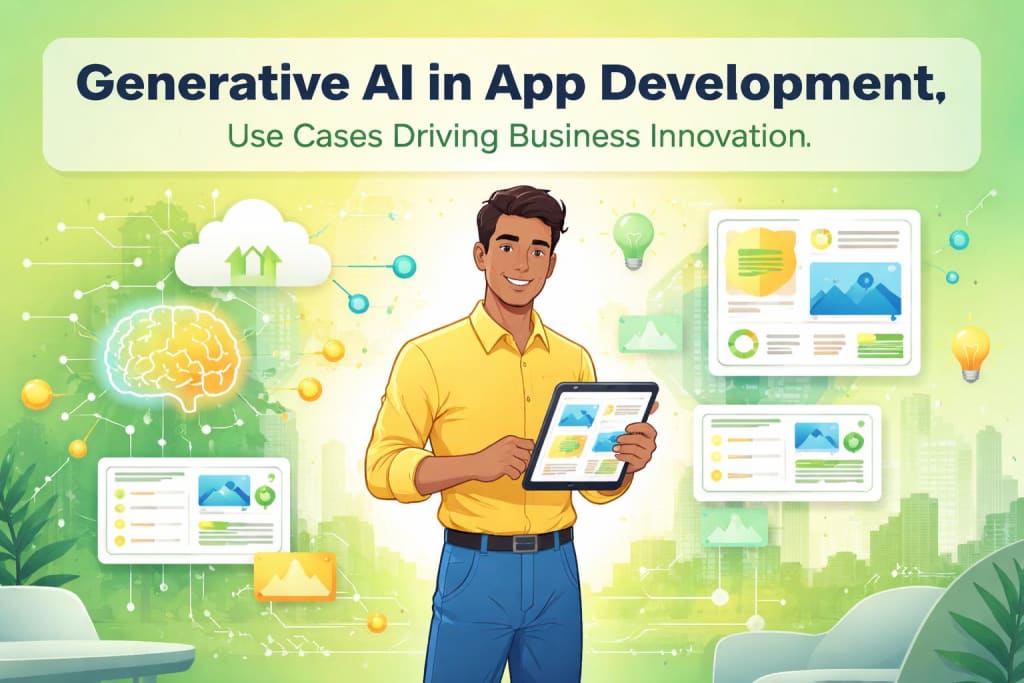
Remember when we actually wrote code?
I mean really wrote it. Character by character. Fighting with syntax errors because you missed a semicolon in line 402. Looking back from where we stand in 2026, those days feel like the Stone Age, don't they? It’s only been a few years, but the landscape of app development has shifted so violently that "developer" barely means the same thing anymore.
We aren't just typing commands; we're orchestrating systems.
The cynicism I used to hear in the breakrooms—"AI will never understand real spaghetti code"—has gone quiet. Why? Because the numbers don't lie. We are looking at a reality where AI generates nearly half of all code committed to repositories. If you are still manually typing out boilerplate in 2026, you aren't a purist; you're overhead.
Let’s be real about what’s happening. This isn't just about faster typing. It’s about business innovation at a velocity we honestly weren't prepared for.
The "Spaghetti Code" Problem Is Solved (Sort Of)
Here is the thing about legacy code: nobody wants to touch it. It’s fragile, it’s messy, and the guy who wrote it left three years ago to start a goat farm in Vermont.
Generative AI didn't just step in to write new features; it stepped in to fix the old messes.
By early 2026, tools like GitHub Copilot and its competitors were generating roughly 46% of all code written by users. In languages like Java, that number spikes to over 60%. That is a staggering metric. We aren't talking about simple "hello world" scripts. We are talking about complex functional blocks.
💡 Satya Nadella (@satyanadella): "Copilot is now a larger business than GitHub was at acquisition. We are seeing a fundamental shift in developer productivity." — Quantumrun / Microsoft Earnings
The innovation here isn't the code itself—it’s the confidence. Businesses are finally tackling technical debt they’ve been ignoring for a decade because they now have an AI partner that can parse the logic, document it, and refactor it without complaining about the lack of comments.
GenUI: The Interface That Builds Itself
If you thought backend changes were wild, look at the frontend.
We used to spend weeks arguing over button placement. "Should this be 4 pixels to the left?" "Is this blue trustworthy enough?"
Enter Generative UI (GenUI).
In 2026, static interfaces are starting to look archaic. We are moving toward interfaces that generate themselves based on user intent. If I open a banking app to check a transaction, why do I need to navigate three menus? The AI should know I’m anxious about a weird charge and present that data front and center.
This is "intent-based design." The app isn't a fixed map; it’s a fluid conversation. Forrester noted recently that personal AI usage now trumps professional usage. Consumers expect their apps to know them, not just serve them.
"Knowledge of AI will stagnate as AI becomes integrated into everyday apps and consumer attention shifts toward results rather than underlying mechanisms." — Thomas Husson, VP Principal Analyst, Forrester
The business value? Retention. If your app adapts to the user’s mood and context, they don't just use it; they rely on it. It becomes invisible, which is the ultimate goal of good design.
The Geography of Innovation
Here is a side effect of AI that people didn't see coming: the democratization of "where" tech happens.
For years, if you wanted top-tier development, you looked at Silicon Valley, London, or maybe Austin. But AI lowers the barrier to entry. It levels the playing field. You don't need a team of 50 Stanford grads to build a world-class platform anymore. You need a smaller team of sharp architects who know how to wield these tools.
This shift has revitalized tech hubs in places you might not expect.
Take the Midwest. It’s no longer just "manufacturing country." It’s becoming a hotbed for health-tech and bio-tech integration, specifically because the legacy industries there (healthcare, manufacturing) are exactly the ones AI helps the most. Teams in these regions are using AI to optimize supply chains and patient data in ways that were impossible five years ago.
You see this clearly in places like Madison and Milwaukee. The ecosystem for app development in Wisconsin has exploded, driven by a blend of traditional industrial discipline and new-school AI tools. They aren't just building "Uber for Dogs"; they are building complex, regulated, high-stakes software for biohealth hubs.
When you remove the grunt work of coding, the value shifts to domain expertise. And frankly, a developer in Wisconsin who understands manufacturing workflows is now more valuable than a generalist in the Bay Area who can just code fast.
Testing: The Boring Hero
Let me explain why testing used to be the bane of my existence.
- Write code.
- Write test cases (reluctantly).
- Run tests.
- Code breaks.
- Question life choices.
In 2026, AI has effectively taken over the "QA Department." We now have autonomous agents that don't just test code; they try to break it. They simulate millions of user interactions, edge cases, and security attacks in minutes.
This is "Self-Healing Code." When a test fails, the AI doesn't just report it; it suggests the fix. Sometimes it even applies the fix, runs the regression test, and commits the change before you’ve finished your morning coffee.
For businesses, this means the "Move Fast and Break Things" era is over. Now, it’s "Move Fast and Fix Things Instantly." The risk of deployment has dropped through the floor, allowing companies to release updates daily—or hourly—without the fear of a total meltdown.
Future Trends: The Rise of Disposable Apps
So, where are we going? If 2026 is the year of Co-pilots, 2027 will be the year of Auto-pilots.
We are seeing the early signals of "Disposable Apps." Imagine you have a specific problem: "I need to organize a potluck for my office, track allergies, and split the cost."
Instead of searching the App Store for a "Potluck App," you will tell your AI agent what you need. It will generate a micro-app—a fully functional interface and backend—just for that event. You share the link. Everyone uses it. Once the event is done, the app dissolves.
Garner data suggests that by the end of 2026, low-code/no-code tools will account for 75% of new application development. But disposable apps take it a step further. We won't just be building apps faster; we will be building them for ephemeral moments.
💡 Ryan Dahl (Node.js Creator): "The era of humans writing code is over." — Context: Times of India
He’s right, but perhaps a bit dramatic. The era of humans writing syntax is over. The era of humans designing systems is just beginning.
The Human Element
I admit, I can get a bit cynical about the hype train. But looking at the data, it’s hard not to be impressed.
However, a word of warning.
AI is a multiplier. If your business processes are chaotic, AI will just help you create chaos faster. If your security protocols are weak, AI will help you build vulnerabilities at scale.
"It is our job to create computing technology such that nobody has to program. And that the programming language is human." — Jensen Huang, CEO, NVIDIA
That’s the dream, right? But until we reach that perfect singularity, you still need a human hand on the wheel. You need someone to look at the output and say, "Yeah, that code works, but it’s going to cost us a fortune in cloud fees."
Generative AI in app development isn't a magic wand. It’s a power tool. And like any power tool, it can build a house in record time—or it can cut your thumb off if you aren't paying attention.
So, fixin' to update your app strategy? Don't just look for the tools. Look for the architects who know how to use them.
About the Creator
Keep reading
More stories from Sherry Walker and writers in 01 and other communities.
How to Choose the Right App Development Framework in 2026
You reckon choosing an app framework is just a tech decision? Nah. Thing is, it's what separates apps that users keep from the ones they delete before their coffee gets cold. In 2026, users decide whether to keep or delete an app in under 5 seconds. Not five minutes. Five. Seconds.
By Sherry Walker4 days ago in 01
Trump Obama Apes
Political discourse in the digital age often moves faster than facts, and few figures generate as much online reaction as Donald Trump and Barack Obama. Recently, searches involving the phrase “trump obama apes” have surged, largely driven by viral content, screenshots, and debates surrounding posts allegedly shared or amplified on Truth Social. The moment highlights how political messaging, interpretation, and social media outrage intersect in modern Trump news cycles.
By Saboor Brohi 3 days ago in 01
Top 5 Voice AI Agent Companies for Recruitment and Customer Support in 2026
In 2026, voice AI agents are transforming how businesses engage both candidates and customers. These intelligent voice systems, powered by advanced automatic speech recognition (ASR), natural language understanding (NLU), and real-time text-to-speech (TTS), are no longer simple IVR bots.
By Vitarag Shah5 days ago in 01
Learn to Be Alone...
We often find that people are told to stop making 'X, Y and Z' their personality. Well, this only arose in the social media age as especially women's interests: reading, dramas, art etc. was heavily criticised as being 'useless'. It is historically well-documented that though many men require the work of women, whether it be through unpaid labour or entertainment, they also refuse to acknowledge it is important. This is why since it has been something of recognition, they have been complaining of a 'loneliness epidemic' now that women are withholding access.
By Annie Kapur6 days ago in Psyche



Comments
There are no comments for this story
Be the first to respond and start the conversation.