
From Misconfigurations to Data Exposure: Web App Risks in Healthcare
How Small Configuration Errors Lead to Major Healthcare Breaches

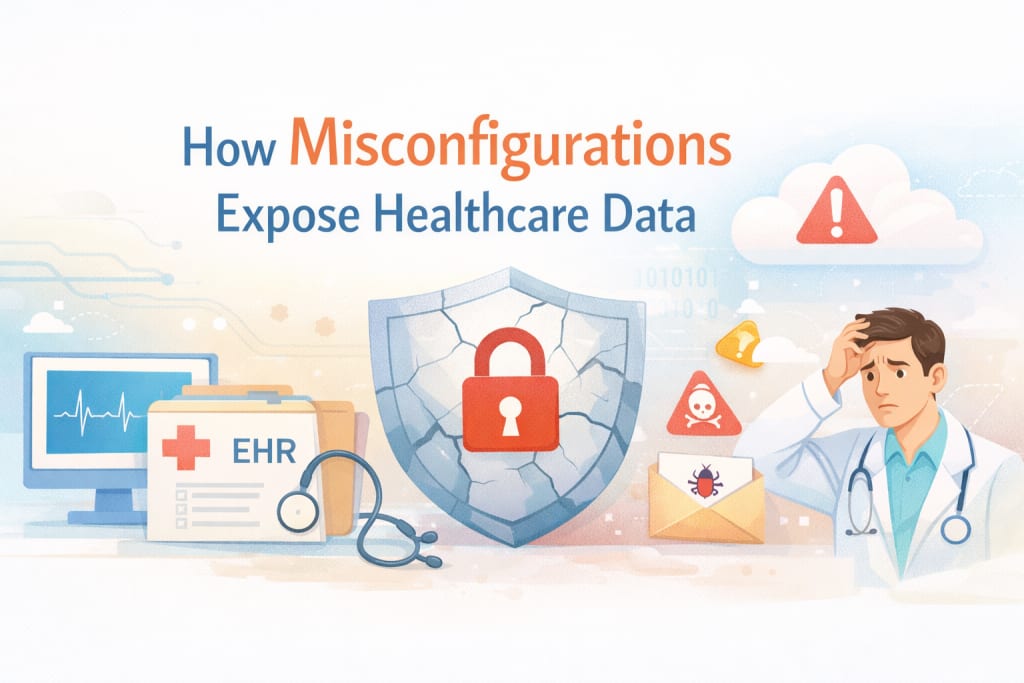
Introduction
Healthcare organizations increasingly rely on web applications to power patient portals, telemedicine platforms, electronic health record access, appointment scheduling, billing, and third-party integrations. These applications improve care delivery and operational efficiency, but they also introduce significant security risk.
Healthcare web apps handle highly sensitive data such as medical histories, diagnostic reports, insurance details, and personal identifiers. Any weakness in application security can quickly escalate into data exposure, regulatory violations, and long-term damage to patient trust.
Among the many cybersecurity challenges healthcare faces today, web application misconfigurations and data exposure remain the most frequent and most dangerous risks.
The Growing Threat Landscape for Healthcare Web Applications
Healthcare web applications have become prime targets for attackers due to the value and sensitivity of the data they process. As organizations expand digital services, the number of public-facing endpoints, APIs, and cloud resources grows rapidly.
To manage this expanding attack surface, many healthcare security teams rely on a Healthcare Web App Security Testing Platform to continuously identify exposed assets, insecure configurations, and high-risk vulnerabilities before attackers do.
Several factors make healthcare web applications especially vulnerable:
- Rapid digital transformation with limited security oversight
- Legacy systems integrated with modern web technologies
- Heavy reliance on third-party services and APIs
- Pressure to maintain uptime over enforcing strict security controls
Attackers understand that even small weaknesses in healthcare environments can have outsized impact.
Understanding Web Application Misconfigurations
Security misconfigurations occur when systems are deployed with unsafe default settings or are improperly maintained over time. These issues are not coding errors but operational oversights that leave applications exposed.
Common Causes of Misconfigurations
Misconfigurations often result from:
- Default credentials or settings left unchanged
- Excessive permissions assigned to users or services
- Debug or test features enabled in production
- Missing security headers and encryption enforcement
- Poor visibility across cloud and hybrid environments
Because misconfigurations do not always cause immediate failures, they frequently go unnoticed.
Key Web Application Risks in Healthcare Environments
Security Misconfiguration
Security misconfiguration is one of the most common entry points for attackers targeting healthcare web applications.
Examples include:
- Publicly accessible admin interfaces
- Open cloud storage buckets containing patient data
- Misconfigured authentication services
- Weak network segmentation between systems
In healthcare, these issues often expose regulated data directly to the internet.
Sensitive Data Exposure
Sensitive data exposure occurs when patient information is stored or transmitted without proper protection.
This may involve:
- Unencrypted databases or backups
- APIs transmitting data without TLS
- Application logs containing personal or medical data
Even when access controls are in place, improper encryption can make breaches inevitable.
Injection Flaws
Injection vulnerabilities allow attackers to manipulate application queries and commands.
In healthcare systems, injection attacks can:
- Extract entire patient datasets
- Modify or delete medical records
- Bypass authentication mechanisms
Injection flaws often combine with misconfigurations to magnify damage.
Broken Access Control
Broken access control allows users to perform actions outside their intended permissions.
Common healthcare examples include:
- Patients accessing other patient records
- Staff accessing administrative functions without authorization
- Predictable object identifiers in URLs
These flaws directly undermine patient privacy and regulatory compliance.
Insecure Design and Outdated Components
Many healthcare web applications rely on outdated frameworks or insecure architectural designs.
Risks include:
- Known vulnerabilities in unsupported libraries
- Poor separation between user roles
- Insecure session and token management
Fixing these issues often requires architectural changes, not just patching.
How Misconfigurations Lead to Data Exposure
Misconfigurations rarely exist in isolation. They often initiate a chain of exploitation that leads directly to data exposure.
A common sequence includes:
- A misconfigured cloud service becomes publicly accessible
- Sensitive healthcare data is stored without encryption
- Attackers discover the exposed resource through automated scanning
- Data is copied, leaked, or sold
Many healthcare breaches trace back to configuration errors that existed for months or even years.
Business and Compliance Impact of Web App Vulnerabilities
Regulatory and Legal Consequences
Healthcare organizations must comply with strict regulations such as HIPAA and other regional data protection laws. Web application breaches can result in:
- Regulatory investigations
- Significant financial penalties
- Mandatory breach notifications
Operational and Reputational Damage
Beyond fines, breaches disrupt operations and erode patient trust. Downtime, legal costs, and loss of reputation can have long-term consequences for healthcare providers.
Testing and Detecting Web Application Security Issues
Effective security programs combine multiple testing approaches:
- Automated vulnerability scanning
- Configuration assessments
- Manual penetration testing
- Continuous monitoring for configuration drift
Using standardized frameworks such as OWASP Top 10 helps ensure coverage of the most critical risks.
Best Practices for Reducing Misconfigurations and Data Exposure
Secure Configuration Management
- Use hardened baselines and templates
- Remove unnecessary services and permissions
- Regularly audit cloud and server configurations
Encryption and Data Protection
- Enforce encryption in transit and at rest
- Protect keys and certificates securely
Secure Development Practices
- Validate input and sanitize data
- Enforce least privilege access
Dependency and Patch Management
- Track third-party components
- Patch known vulnerabilities promptly
Continuous Security Testing
- Test applications regularly, not just before release
- Monitor for changes that introduce new risks
Building a Strong Web Application Security Program in Healthcare
Healthcare security teams should integrate security throughout the application lifecycle. This includes:
- Security reviews during design
- Testing during development and deployment
- Continuous validation in production
Collaboration between development, IT, and security teams is essential.
Conclusion
From misconfigurations to data exposure, web application risks in healthcare are deeply interconnected. Small configuration errors can quickly escalate into large-scale breaches affecting patient safety, compliance, and trust.
By prioritizing secure configurations, continuous testing, and proactive risk management, healthcare organizations can significantly reduce their exposure and build more resilient digital systems.
About the Creator
Sam Bishop
Hi there! My name is Sam Bishop and I'm a passionate technologist who loves to express my thoughts through writing. As an individual and tech enthusiast, I'm always eager to share my perspectives on various topics.
Keep reading
More stories from Sam Bishop and writers in 01 and other communities.
From Requests to Risk: How Modern API Threat Detection Finds What Scanners Miss
APIs are the backbone of modern applications, powering cloud services, mobile apps, and partner integrations. They enable seamless data exchange, automated workflows, and real-time communication across systems. However, this connectivity also expands the attack surface, making APIs a prime target for malicious actors. Traditional security scanners, which rely heavily on signatures and static checks, often fail to detect sophisticated or subtle API threats.
By Sam Bishop6 days ago in 01
Brad Karp
Brad S. Karp is a name that resonates deeply within the world of high‑stakes litigation and corporate law. For decades, Karp has been one of the most influential lawyers in the United States, shaping major legal battles, advising Fortune 100 companies, and leading one of America’s premier law firms — Paul, Weiss, Rifkind, Wharton & Garrison LLP, commonly known as Paul Weiss.
By Saboor Brohi 4 days ago in 01
OpenClaw Just Changed How We Work With AI: What Does Open Claw Do?
Picture this for a second. You’re sitting outside at a fancy restaurant, drink in hand, when a cool project idea suddenly hits you. Instead of pulling out your laptop, opening half a dozen tools, and waiting until you get home… what if you could just open WhatsApp or Telegram, type a single prompt, and have the entire project created directly on your workstation?
By Info Post Gate4 days ago in 01
Writing About Writing: The Rainbow Trap
The good thing about living in modern times is that LGBTQ representation in media is increasing. Not just in niche and Independant media, either, but also in mainstream media. Books, movies, TV shows, comics... they're finally catching on that LGBTQ+ people form a significant part of their audience, and deserve to see themselves on screen and in fiction, not just as victims in documentaries and true crime shows.
By Natasja Rose5 days ago in Writers




Comments
There are no comments for this story
Be the first to respond and start the conversation.