
FBA vs. FBM: Which Amazon Fulfillment Strategy is Right for You?
Discover the Amazon strategy that's right for you.
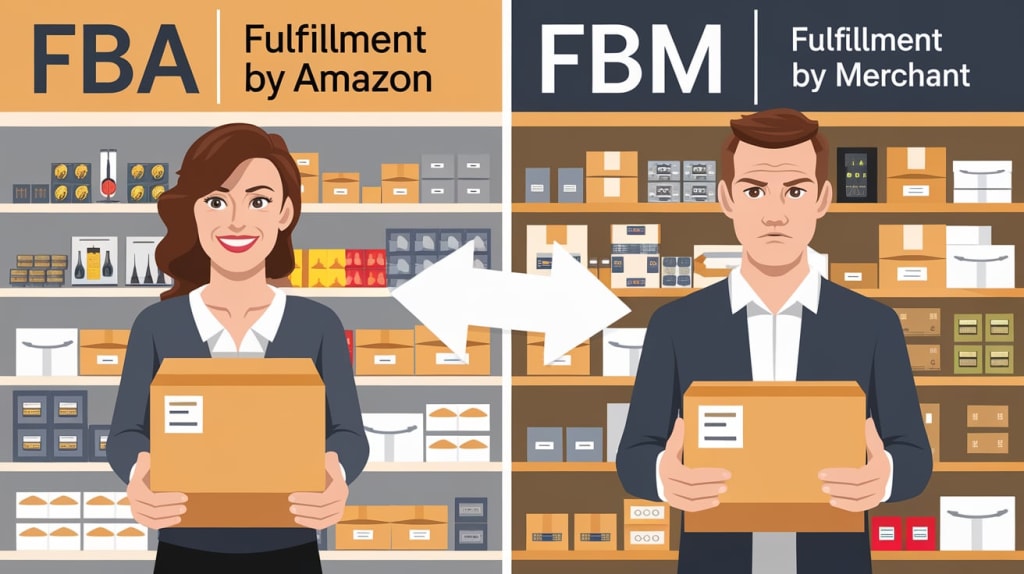
One of the most critical decisions Amazon sellers face is which fulfillment method to choose. Should you let Amazon handle your logistics with FBA (Fulfillment by Amazon), or maintain control with FBM (Fulfillment by Merchant)?
Each approach offers distinct advantages and challenges that can significantly impact your:
Profitability
Customer satisfaction
Operational efficiency
Business scalability
Marketplace visibility
In this comprehensive guide, we'll analyze both fulfillment models to help you make an informed decision based on your specific business needs, product type, and growth goals.
1. FBA vs. FBM: Understanding the Core Differences
What is FBA (Fulfillment by Amazon)?
Fulfillment by Amazon is a service where sellers send inventory to Amazon's fulfillment centers. From there, Amazon takes over the entire fulfillment process:
Storing your products in their warehouses
Picking and packing orders
Shipping products to customers
Handling returns and customer service inquiries
Managing delivery issues and logistics
What is FBM (Fulfillment by Merchant)?
With Fulfillment by Merchant, you maintain control over the entire fulfillment process:
You store inventory in your own warehouse or third-party facility
You process and pack orders when they come in
You arrange shipping through your preferred carriers
You handle customer service and return requests
You resolve any delivery issues directly
2. When Should You Use FBA?
Amazon's fulfillment service provides significant advantages for certain business types and products.
Best Use Cases for FBA
Product Types Well-Suited for FBA:
Small, lightweight items (lower dimensional weight = lower fees)
Fast-moving products with consistent sales velocity
High-margin items that can absorb fulfillment costs
Products requiring fast delivery to stay competitive
Seasonal items (during peak selling periods)
New product launches where you need maximum visibility
Business Scenarios Ideal for FBA:
Startup sellers without established logistics
Businesses focusing on growth rather than operations
Sellers targeting Prime customers (83% of Amazon buyers)
Those expanding internationally (leverage Amazon's global network)
Businesses with limited warehousing capacity
Sellers wanting to minimize customer service workload
Key FBA Benefits
Prime Badge Advantage: Products become eligible for Amazon Prime, significantly increasing visibility and conversion rates (studies show 60-100% higher conversion with Prime).
Multi-Channel Fulfillment: Use Amazon's fulfillment network for orders from your website, eBay, Etsy, or other platforms.
Buy Box Advantage: FBA listings have a higher chance of winning the Buy Box, which accounts for over 80% of sales.
Simplified Operations: Outsource storage, picking, packing, shipping, returns, and customer service.
Seasonal Flexibility: Scale up during busy periods without expanding your own infrastructure.
Potential FBA Drawbacks
Storage Fees increase significantly during Q4 (October-December)
Long-term storage fees for inventory stored over 365 days
Less control over packaging and branding experience
Strict preparation requirements with penalties for non-compliance
Inventory management limitations (shipment creation, transfer restrictions)
Commingling risks (if you use manufacturer barcodes)
Real-World Example:
A health supplement brand switched from FBM to FBA and saw conversion rates increase by 43%, while reducing customer service inquiries by 78%. Despite higher per-unit costs, overall profitability improved due to increased sales volume.
3. When Should You Use FBM?
Fulfillment by Merchant offers greater control and can be more cost-effective in specific scenarios.
Best Use Cases for FBM
Product Types Well-Suited for FBM:
Large, heavy, or oversized items (furniture, appliances, exercise equipment)
High-value products with thin margins
Fragile or special handling items
Custom, handmade, or personalized products
Products with special shipping requirements
Slow-moving inventory that would incur long-term storage fees
Business Scenarios Ideal for FBM:
Established businesses with efficient logistics
Sellers with existing warehouse infrastructure
Brands using 3PL (third-party logistics) providers
Sellers needing maximum control over customer experience
Businesses with specialized packaging requirements
Sellers with low-volume, high-margin products
Key FBM Benefits
Lower Direct Fees: No Amazon fulfillment or storage fees (though shipping costs are yours to bear).
Greater Control: Manage your own packaging, inserts, and branding experience.
Inventory Flexibility: No restrictions on inventory levels or storage duration.
Broader Product Range: Sell items that might be restricted or impractical for FBA.
Direct Customer Relationships: Build direct connections with your customers.
Potential FBM Drawbacks
No automatic Prime eligibility (major competitive disadvantage)
Lower Buy Box win rate compared to similar FBA listings
More operational complexity and labor requirements
Customer service obligations
Slower delivery times unless you have an extensive logistics network
Higher shipping costs without Amazon's negotiated carrier rates
Hybrid Approach: Leveraging Both FBA and FBM
Many successful Amazon sellers use both fulfillment methods strategically, creating a hybrid approach that maximizes benefits while minimizing drawbacks.
When to Use a Hybrid Strategy
During seasonal peaks: Use FBA during high-demand periods, FBM during slower months
For diverse product catalogs: FBA for fast-movers, FBM for slow-sellers or oversized items
For risk management: Maintain inventory in both systems to prevent stockouts
For new product launches: Test market with FBM, transition to FBA when proven
For inventory balance: Use FBM when approaching FBA storage limits
Implementing a Successful Hybrid Model
Inventory Segmentation: Analyze each SKU for:
Dimensions and weight
Sales velocity
Profit margins
Seasonality patterns
Return rates
FBA Inventory Planning: Identify which products belong in FBA:
High-volume sellers that benefit from Prime
Products with strong Q1-Q3 sales (avoiding Q4 storage premium)
Items with consistent sales velocity
Products with high Buy Box competition
FBM Backup System: Create redundancy for FBA products:
Set up FBM listings as backup for the same ASINs
Configure inventory thresholds to activate FBM when FBA stock runs low
Use automated repricing to ensure competitive FBM offers
Real-World Hybrid Example
A toy and game seller implemented this strategic breakdown:
FBA: Best-selling board games, puzzles, and popular toys (80% of total sales volume)
FBM: Oversized playsets, slow-moving specialty items, and all products during November-December
Result: 23% reduction in overall fulfillment costs while maintaining 95% Prime coverage for their catalog's top performers
6. Decision Framework: How to Choose Your Fulfillment Strategy
Making the right fulfillment decision requires systematic analysis of your specific business needs.
Step 1: Product Analysis
Evaluate each product against these criteria:
Size and weight: Larger = FBM advantage
Price point: Higher price = FBA advantage (conversion boost outweighs fees)
Margin: Thinner margins = FBM consideration
Sales velocity: Faster sellers = FBA advantage
Seasonality: High seasonality = hybrid approach
Fragility: More fragile = consider FBM for control
Special requirements: Custom packaging/handling = FBM advantage
Step 2: Business Assessment
Consider your current business capabilities:
Logistics experience: Strong existing logistics = FBM advantage
Warehouse space: Limited space = FBA advantage
Staff resources: Limited staff = FBA advantage
Cash flow: Limited working capital = Consider FBM to reduce inventory investment
Growth goals: Rapid scaling plans = FBA advantage
Brand control importance: High brand control needs = FBM advantage
Step 3: Customer Experience Priorities
Determine what matters most to your customers:
Delivery speed expectations: High expectations = FBA advantage
Prime importance: Prime-focused customers = FBA essential
Custom unboxing experience: Important experience = FBM advantage
Return policy preferences: Easy returns priority = FBA advantage
Customer communication needs: High-touch service = FBM advantage
Step 4: Market Position Analysis
Analyze your competitive landscape:
Buy Box competition level: High competition = FBA advantage
Price sensitivity in category: High sensitivity = Consider FBM
Competitor fulfillment methods: Mostly FBA competitors = FBA likely necessary
Differentiation factors: Unique products = Either method viable
Working with Amazon Fulfillment Specialists
For many sellers, optimizing fulfillment strategy becomes increasingly complex as they scale. This is where specialized Amazon agencies can provide significant value.
How Fulfillment Specialists Add Value
Strategic Inventory Planning:
SKU-level profitability analysis for FBA vs. FBM decisions
Inventory velocity optimization to minimize storage fees
Seasonal planning to balance warehouse capacity
Cost Optimization:
Fulfillment fee structure analysis and avoidance strategies
Dimensional weight reduction techniques
Return rate analysis and improvement
Operational Enhancement:
FBA shipment creation and logistics optimization
Preparation requirement compliance systems
3PL integration and management for FBM operations
Performance Monitoring:
Fulfillment metric tracking and improvement
Inventory health reporting and management
Restock limit maximization strategies
Conclusion: Making Your Final Decision
The right fulfillment strategy can dramatically impact your Amazon business success. While Amazon services like FBA (Fulfillment by Amazon) offer convenience and the powerful Prime badge, FBM (Fulfillment by Merchant) provides greater control and potential cost savings. For many sellers, leveraging Amazon services through a thoughtful hybrid approach—combining FBA and FBM—delivers the best results by balancing speed, cost, and flexibility.
About the Creator
How to Renovate Your Bathroom Without Overspending
Renovating a bathroom can significantly improve the comfort, functionality, and value of your home. However, many homeowners hesitate to start the process because they assume it will be expensive and complicated. The truth is that with proper planning, smart choices, and careful budgeting, you can achieve a beautiful and functional bathroom without exceeding your financial limits.
By Kashif Khan8 days ago in 01
Cloud Data Management Companies: A Guide
Introduction: Why Data Strategy Determines Business Survival In today’s digital economy, data is no longer a byproduct of operations — it is the foundation of revenue growth, customer intelligence, automation, and innovation. Every transaction, website visit, IoT signal, and internal workflow generates data.
By Wahid Hussain3 days ago in 01




Comments
There are no comments for this story
Be the first to respond and start the conversation.