
Developing Security-Focused Mobile Solutions for Florida's Cybersecurity Hub
Florida's tech scene in 2026 demands more than just code. Discover how the "Cyber Sunshine State" is rewriting the rules for secure mobile apps.

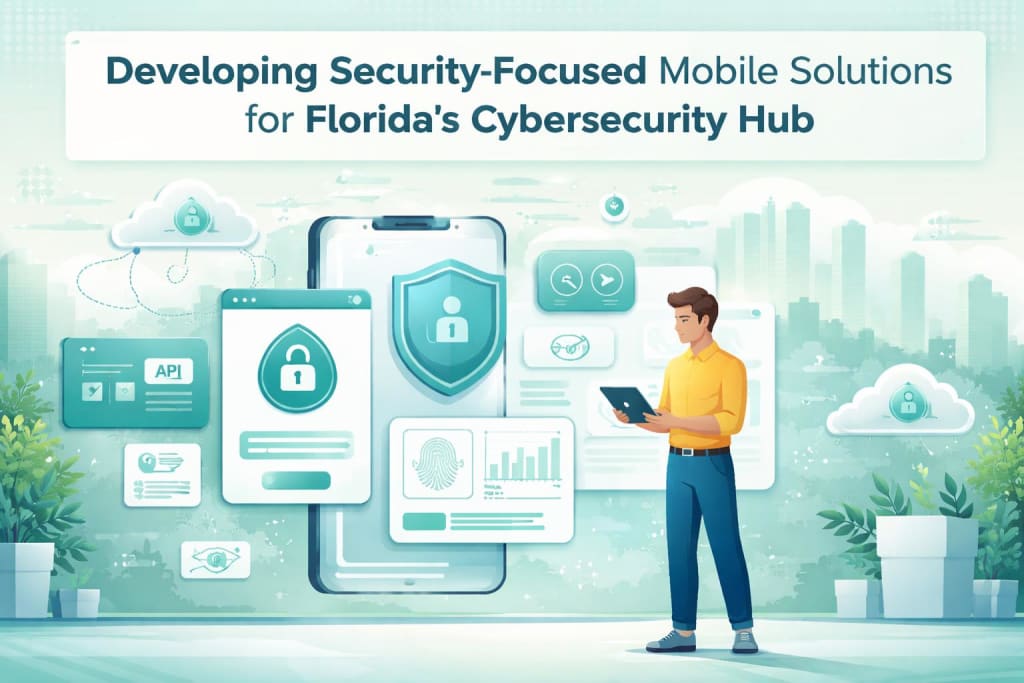
It is 2026, and let me tell you, the heat in Florida isn't just coming from the sun anymore. The state has officially pivoted from being the vacation capital to what locals are calling the "Cyber Sunshine State." If you are writing code or managing product teams down here, you already know the vibe has shifted. We aren't just building apps for tourists to find the nearest theme park; we are building the digital fortress for defense contractors, healthcare giants, and a booming fintech sector in Miami.
The days of "move fast and break things" are dead and buried. In Florida's current ecosystem, if you move fast and break security protocols, you don't just lose users—you lose your license to operate.
The New Reality of the "Cyber Sunshine State"
Remember when Tampa was just about cigars and hockey? Now, the I-4 corridor is effectively a massive cybersecurity lab. With the US Central Command (CENTCOM) and US Special Operations Command (SOCOM) heavily influencing the local tech culture, the standard for mobile solutions here is military-grade by default.
This shift has forced developers to abandon the lazy security practices of the early 2020s. You can't just slap a login screen on an app and call it secure. The threat landscape in 2026 is proper gnarly. We are talking about AI-driven malware that adapts its signature in real-time and "Harvest Now, Decrypt Later" quantum attacks that are keeping CISOs up at night.
Teams working in this space, like those at mobile app development florida, are seeing this firsthand as they integrate military-grade encryption standards into everyday commercial applications. It is no longer overkill; it is the baseline.
Zero Trust is Old News; Welcome to "Continuous Trust"
Here is the thing: "Zero Trust" became such a buzzword that it lost its meaning. But in 2026, we have moved past the marketing fluff. We are now operating in a paradigm of Continuous Trust.
In the old days (like, 2024), if a user logged in with FaceID, we trusted them for the session. That is reckless now.
Why Static Auth Fails
- Session Hijacking: AI tools can clone session tokens faster than you can say "refresh."
- Deepfake Biometrics: People are bypassing standard facial rec with generative video injection.
- Context Shifts: A user logging in from Miami is fine; that same user accessing Level 4 data five minutes later from an IP in a non-extradition country? That’s dodgy.
"Zero Trust has matured, but 2026 will redefine it entirely... We move from static control to dynamic decisioning." — Segura Security, [Cybersecurity Trends 2026]
Real talk: Your app needs to be paranoid. It needs to check the user's identity not just at the front door, but every time they open a new room.
Navigating the Florida Digital Bill of Rights (FDBR)
If you reckon you can ignore the legal side of things, think again. The updates to the Florida Digital Bill of Rights (FDBR) have given teeth to privacy enforcement.
While the law initially targeted the billion-dollar giants, the trickle-down effect in 2026 is undeniable. If your app collects biometric data—which, let's be honest, most security-focused apps do—you are in the crosshairs. The FDBR mandates strict "opt-in" consent for sensitive data. You can't bury this in a 50-page EULA anymore.
Compliance Checklist for 2026
- Data Minimization: Don't collect what you don't need. If you are grabbing precise geolocation for a calculator app, you are asking for a lawsuit.
- Explicit Consent: Biometrics and location data require a clear, affirmative "Yes" from the user.
- Right to Delete: Florida users can demand you nuke their data, and you have 45 days to comply.
The AI Agent Problem
We all love our AI agents. They book our flights, manage our calendars, and sort our emails. But from a security standpoint? They are a nightmare.
In 2026, we are seeing a surge in "Agentic AI" attacks. Hackers aren't just attacking the app; they are tricking the AI agent inside the app into doing the dirty work. This is prompt injection on steroids.
💡 OWASP Project (@OWASP): "AI agents in apps are the new attack surface. We aren't just securing data; we're securing autonomous decision-making." — [OWASP GenAI Project]
If you are building an app where an AI agent has permission to execute transactions (like transferring funds or updating medical records), you need human-in-the-loop verification layers. Do not let the bot hold the keys to the castle.
Mobile Solutions in a Post-Quantum World
This sounds like sci-fi, but it’s real life. With quantum computing rapidly advancing, standard encryption methods like RSA are living on borrowed time. The threat is "Harvest Now, Decrypt Later." Bad actors are stealing encrypted data today, betting that they will be able to crack it in a few years when quantum processors mature.
For Florida's defense and finance sectors, that risk is unacceptable.
What to do about it:
- Switch to PQC (Post-Quantum Cryptography): Algorithms like CRYSTALS-Kyber are becoming the standard for key encapsulation.
- Crypto-Agility: Build your apps so you can swap out encryption protocols without rewriting the whole codebase. If a standard breaks, you need to be able to patch it by Tuesday.
"In 2026, technology and security leaders must step past tech experimentation and deliver measurable, secure business outcomes." — Forrester Research, [Predictions 2026]
The "App Store" is No Longer the Safety Net
There was a time when we thought, "If it's on the App Store, it's safe." Yeah, right.
Google's November 2025 security bulletin highlighted critical zero-click vulnerabilities (like CVE-2025-48593) that allowed remote code execution on Android systems without the user even touching the phone.
💡 Samsung Business (@SamsungBizUSA): "Mobile security isn't just code anymore; it's about device integrity. If the OS is compromised, your perfect code means nothing." — [Samsung Insights]
This means your app needs to do its own health checks. It should use Runtime Application Self-Protection (RASP) to detect if the device it's running on is rooted, jailbroken, or acting weird. If the environment is compromised, the app should shut itself down immediately.
Future Trends: 2027 and Beyond
Looking ahead, the game is fixin' to change again. We are seeing early signals of Behavioral Gait Analysis becoming a standard mobile auth factor. Your phone will know it's you just by the way you walk while it's in your pocket.
Also, expect Ambient Authentication to replace active logins entirely. Your devices will constantly talk to each other (watch, phone, glasses) to verify your identity in a mesh network. If one device drops off or detects an anomaly, the whole network locks down. It's seamless, but the backend engineering required to pull it off is immense.
Final Thoughts
Florida has grown up. We aren't just the state of alligators and airboats anymore; we are the frontline of digital defense in the South. Whether you are in Miami, Tampa, or working remotely from the Panhandle, the standard is higher now.
Security isn't a feature you bolt on at the end of the sprint. It is the foundation. If you aren't building with that mindset, you are building a liability, not an asset.
Would you like me to draft a checklist for auditing your current mobile app against the 2026 FDBR compliance standards?
About the Creator
Eira Wexford
Eira Wexford is a seasoned writer with 10 years in technology, health, AI and global affairs. She creates engaging content and works with clients across New York, Seattle, Wisconsin, California, and Arizona.
Keep reading
More stories from Eira Wexford and writers in 01 and other communities.



Comments
There are no comments for this story
Be the first to respond and start the conversation.