
Custom Software Development Guide 2025
Why packaged tools stop working, and how custom software is shaping growth across industries in 2025 and beyond.

By 2025, many companies have discovered the limits of packaged software. Tools that once worked well for early-stage teams often struggle under the demands of scale: features don’t match real workflows, integrations create more problems than they solve, and licensing costs climb every year.
The market shift reflects this change. The global custom software development industry is projected to grow from about $53 billion in 2025 to more than $146 billion by 2030, at a 22% annual growth rate. Businesses aren’t just buying more software — they’re investing in solutions built to fit their needs.
This guide examines why organizations move beyond off-the-shelf tools, which industries are turning most to tailored development, the trends shaping software in 2025 and beyond, and the process that transforms an idea into a working system.
Why Companies Outgrow Packaged Tools
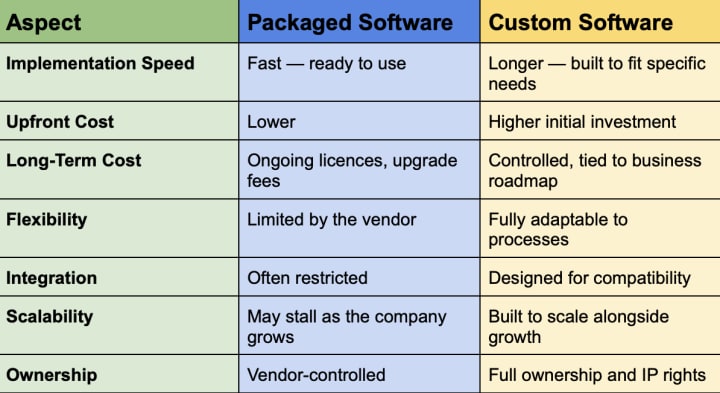
Off-the-shelf software makes sense at the beginning. It’s quick to implement, inexpensive upfront, and usually covers the basic needs of small teams. That’s why many companies start there.
The problems appear as businesses expand. Workflows become more complex, data has to move between multiple systems, and the cost of licences and add-ons keeps rising. Features that once felt convenient start holding teams back, forcing them to adapt their processes to fit the tool instead of the other way around.
Custom development changes this balance. Instead of bending operations around a vendor’s product, companies design software that matches the way they actually work. This flexibility not only improves efficiency but also makes it easier to scale without hitting roadblocks.
Airbnb is a well-known example. In its earliest days, the company leaned on packaged tools to launch quickly. But as demand grew, those tools couldn’t handle bookings, payments, and trust features at scale. Rebuilding its core systems as custom software gave Airbnb the foundation to grow into a global platform.
Types of Custom Software Development
The demand for custom software looks different depending on the industry. What unites these cases is the point where packaged tools can’t keep up, and tailored systems become the only practical option.
- SaaS
Subscription platforms grow by adding features and users quickly. Custom development supports multi-tenant structures, smooth integrations, and scalable architectures that prevent growth from breaking the system.
- Cybersecurity
Threats evolve too fast for generic software to keep pace. Custom solutions allow companies to design monitoring, detection, and compliance systems tailored to their environment — and update them as risks change.
- iGaming & Gambling
Performance and compliance define this sector. Custom platforms are built to handle thousands of users in real time while meeting strict regulatory standards, something packaged tools rarely achieve.
- Adult Industry
Challenges in this space include payment restrictions, content moderation, and user safety. Custom software makes it possible to integrate alternative payment providers, maintain secure environments, and manage creator onboarding at scale.
- Biotech & Healthcare
Handling sensitive data and meeting regulatory requirements like HIPAA or GDPR demand more than generic tools. Tailored systems support research workflows, protect patient information, and adapt to compliance changes.
- B2B Enterprises
For many B2B organizations, efficiency is the advantage. Custom builds automate unique workflows, connect with legacy systems, and provide analytics designed for decision-makers rather than generic dashboards.
Trends Shaping Custom Software in 2025
The push toward custom development is reinforced by broader technology shifts. Several trends are defining how businesses build and maintain software today:
- Cloud-first as standard
Public cloud spending reached around US$723 billion in 2025. For most organizations, new systems are expected to be scalable, resilient, and designed to operate across hybrid or multi-cloud environments.
- Low-code/no-code adoption — with limits
Low-code platforms are widely used to build MVPs and prototypes quickly. They reduce early development time but fall short for large-scale systems where customization, integrations, and performance matter. Many companies start with low-code but later invest in fully custom builds.
- AI integration
Artificial intelligence has moved into everyday use. Surveys show 98% of small businesses already rely on AI-enabled tools, with nearly 40% experimenting with generative AI. Off-the-shelf platforms rarely integrate these capabilities smoothly, creating demand for custom systems that embed AI directly into products.
Benefits and Challenges of Custom Software
Custom software offers advantages that packaged tools rarely match:
Benefits
- Process fit: Built to match the way a company actually works, instead of forcing teams into rigid features.
- Scalability: Expands with the business, without sudden licence hikes.
- Differentiation: Enables unique features that competitors can’t easily replicate.
- Ownership: Full control of the product and its future direction.
Challenges
- Upfront cost: Serious budgets are required. Apps that look simple, like Slack or Airbnb, cost tens of millions of dollars and hundreds of thousands of development hours to build.
- Longer timelines: Custom systems take more time to design, build, and test.
- Ongoing work: Updates, scaling, and security are continuous responsibilities.
- Execution risks: Without clear goals and experienced teams, projects can run over budget or stall.
When companies view custom software as an asset rather than a one-time cost, the equation changes. Done right, these systems create efficiency, flexibility, and long-term competitive advantage.
Outsourcing in Custom Development
Building software is not just about writing code — it’s about having the right expertise at the right time. Some companies maintain full in-house teams, but that approach can be slow and expensive. Outsourcing has become the practical alternative for businesses that want to move faster and manage resources more efficiently.
The advantages are clear. External teams bring experience from working across industries, which shortens the learning curve. They offer flexibility, allowing companies to scale up during development and scale down when workloads ease. Established partners often have tested processes that speed delivery and reduce risk. And in many cases, outsourcing provides access to top talent without the overhead of permanent hires.
This doesn’t mean giving up control. Internal leadership still defines the goals and direction. But by handing execution to experienced partners, companies can focus on strategy and growth while ensuring the software is built to a high standard.
The Step-by-Step Process of Custom Development
Successful software projects rarely happen by accident. They follow a clear sequence that reduces risk and keeps teams aligned. The main stages usually look like this:
- Discovery and requirements — Define goals, map user needs, and set priorities. Skipping this step often leads to costly rework later.
- Design and prototyping — Wireframes and mockups bring ideas to life early, giving stakeholders a chance to refine before development starts.
- Development — The build phase turns designs into working software. Iterative methods like agile make it easier to adapt as feedback comes in.
- Testing and QA — Quality checks, both automated and manual, catch bugs, performance issues, and security gaps before release.
- Deployment — Launching is done carefully, often with continuous integration and deployment pipelines to keep updates smooth.
- Post-launch support — The work doesn’t stop at release. Ongoing updates, patches, and scaling ensure the system stays secure and effective as needs evolve.
Each stage might look simple on its own, but together they determine whether the final product is a short-term solution or a long-term asset.
Conclusion
Frameworks, languages, and platforms will continue to change, but the principle of good software development stays the same: technology should serve the business strategy, not the other way around. The best choices are the ones that integrate smoothly, scale with growth, and remain sustainable long after the initial build.
By the end of 2025, it’s clear that off-the-shelf solutions can only take a company so far. Organizations that approach custom development with clear goals, realistic budgets, and the right expertise are building more than software — they’re creating the infrastructure for future growth. Experienced partners like LenGreo play an important role in this process, helping businesses turn custom builds into lasting competitive advantages.
About the Creator
Max Mykal
I’m Max, a Digital Marketing & SEO specialist with 4+ years of experience. At LenGreo, I help industries like Biotech, Cybersecurity and iGaming grow with tailored strategies. Let’s connect to drive your business forward!
Top 20 OnlyFans Ideas for Content, Niche, Username, and Bio
Are you looking for the best ideas for creating engaging OnlyFans content, or do you want to know the platform's top content categories? Maybe you are struggling with your OnlyFans bio and username and need some tips? No matter what the case, we are here to rescue you.
By Intelligent Creator8 days ago in 01



Comments
There are no comments for this story
Be the first to respond and start the conversation.