
Brooks Ghost Max 2 vs Original Ghost Max
The Real Story Behind Brooks
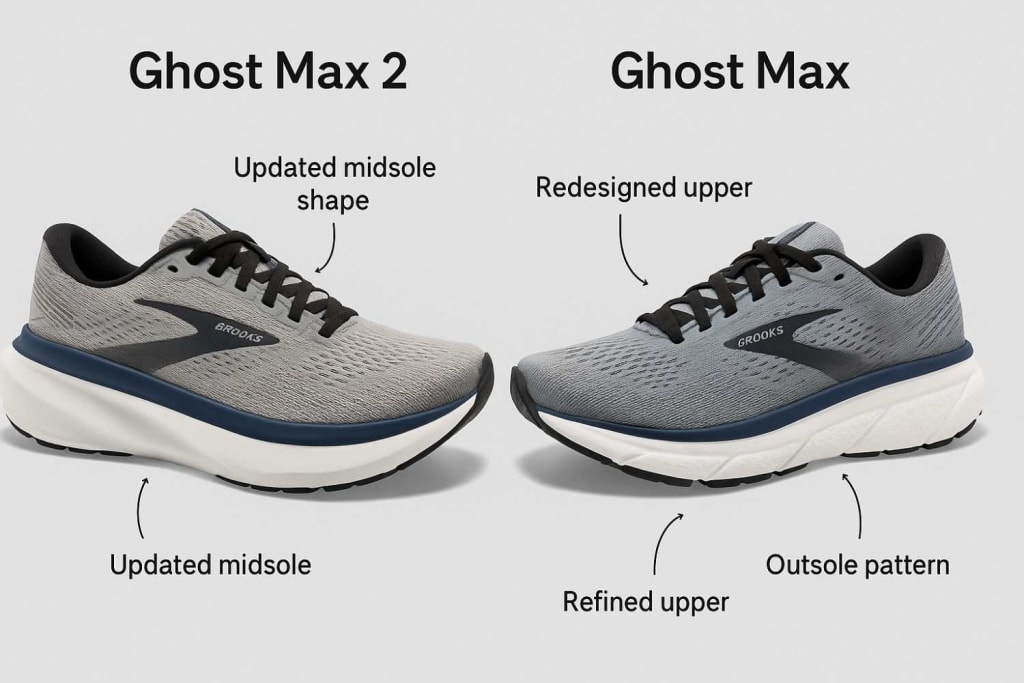
Okay, so I need to tell you about something that's been bugging me for months now. I bought the original Brooks Ghost Max last year, loved it, put about 200 miles on it, and was genuinely excited when Brooks announced the Ghost Max 2. I thought, "Great, they're going to take an already solid shoe and make it even better."
Spoiler alert: that's not exactly what happened.
Look, I'm not saying the Ghost Max 2 is a bad shoe. It's not. But it's a different shoe with the same name, and that's what's been frustrating me. It's like Brooks changed the recipe but kept the label, and now I'm standing here with both pairs trying to figure out what they were thinking.
So here's my honest comparison after running in both shoes extensively – what changed, what stayed the same, and which one you should actually buy depending on what you need.
The Background: Why These Shoes Even Exist
Before we dive in, quick context: Brooks made this shoe called the Dyad for years. It was their orthotic-friendly, stable neutral option. Problem was, the Dyad was... how do I put this nicely... clunky as hell. Stiff, heavy heel, just not great for running (though it worked okay for walking).
The original Ghost Max came out and basically said "forget all that." It was softer, had a nice rocker, felt more like a modern max cushion trainer. People loved it. I loved it. It felt like Brooks was finally making a shoe for runners who wanted cushioning and orthotic accommodation without feeling like they were wearing orthopedic dad shoes.
Then the Ghost Max 2 arrived, and honestly? It feels like Brooks got nervous and backpedaled toward the old Dyad formula. Not completely, but enough that it's a noticeably different experience.
The Specs (Because We Have To Start Somewhere)
Both shoes:
- 39mm heel stack / 33mm forefoot (6mm drop)
- DNA Loft foam (v2 in original, v3 in the 2)
- Wide, stable platform
- Thick, removable insole for orthotics
Weight is where things diverge:
- Original Ghost Max: 10.0 oz (men's 9) / 9.0 oz (women's 8)
- Ghost Max 2: 10.8 oz (men's 9) / 9.5 oz (women's 8)
That 0.8 oz difference might not sound like much on paper, but trust me, you feel it on the run. Especially over longer distances.
How They Actually Feel (The Part That Matters)
The Cushioning Story
Both shoes use DNA Loft foam, but different versions. The original has v2, the newer one has v3. Here's what I've noticed after running in both:
The original Ghost Max has this nice, compliant feel. When you land, the foam compresses smoothly. It's not super squishy or soft, but there's a pleasant amount of give. It feels cushioned without feeling mushy.
The Ghost Max 2 feels... firmer? Stiffer? It's still cushioned – don't get me wrong, there's plenty of foam under your feet. But comparatively, it doesn't compress as much. There's less compliance. When I step down, I feel more resistance from the platform.
I've got about 50 miles on my original Ghost Max and around 70 miles on the Ghost Max 2 now, so both are broken in. The Ghost Max 2 has softened up a bit over time, but it's still noticeably firmer than the original.
The Rocker Situation
This is probably the biggest functional difference between these two shoes.
The original Ghost Max has a pronounced rocker. The heel bevel is generous, and the shoe wants to roll forward naturally. When you land and transition from heel to midfoot to toe-off, it feels smooth and fluid. There's a nice rolling sensation that makes easy-pace running feel effortless.
The Ghost Max 2 has a much less aggressive rocker. The heel bevel is there, but it's smaller. The whole platform is stiffer and flatter. It took me probably 20 miles before the rocker started to feel more natural, and even now, it doesn't roll as smoothly as the original.
What this means in practice: if you like that rocking-chair feel where the shoe helps propel you forward, the original is way better. If you prefer a more stable, planted sensation, the Ghost Max 2 delivers that.
Stability: The Trade-Off
Here's where opinions are going to differ based on what you prioritize.
The original Ghost Max is neutral but not what I'd call "stable neutral." It's got a wide base, sure, but that rocker and softer foam mean there's a bit of lateral movement. I never felt unstable in it, but if you're someone who really wants that locked-in feeling, it might feel a bit loose.
The Ghost Max 2 is legitimately a stable neutral shoe. Those sidewalls, the stiffer platform, the less aggressive rocker – it all adds up to a shoe that feels planted and secure. If stability is your priority (even without pronation issues), the Ghost Max 2 delivers better.
I've read that detailed women's-specific review of the Ghost Max 2, and the stability aspect seems to be something a lot of female runners appreciate about this version.
Walking vs Running Performance
Okay, this is interesting because the two shoes have almost reversed roles here.
For Running
Original Ghost Max: This is the better pure running shoe in my opinion. It's lighter (relatively), has that smooth rocker, and the cushioning compresses in a way that feels natural at running pace. I've used it for easy runs, recovery runs, and even some longer efforts, and it just works. The shoe feels like it wants to run.
Ghost Max 2: This is where it gets clunky for running. The added weight, the stiffer platform, the less pronounced rocker – it all adds up to a shoe that takes more effort to run in. It's not bad, but it's definitely more work. After about 5 miles, I start wishing I'd grabbed the original instead.
For Walking
Here's where the Ghost Max 2 redeems itself. For walking, that stiffer platform and less aggressive rocker actually work better. You're not trying to generate forward momentum through a rocker – you're just stepping and transitioning naturally. The firmness provides better support for long periods on your feet.
I wore the Ghost Max 2 for a full day of sightseeing in Chicago last month (probably 15,000+ steps), and my feet felt great. Would the original have been fine too? Yeah, probably. But the Ghost Max 2's platform just felt more supportive for walking.
If you're looking at these primarily as walking shoes or for a run-walk program, the Ghost Max 2 might actually be the better choice. For pure running? Original wins.
The Fit Differences (Important!)
This is where things get annoying, because Brooks changed the fit between versions.
Original Ghost Max
Pretty standard Brooks fit for me:
- True to size (though felt slightly short initially, which is typical for Brooks)
- Normal volume, maybe slightly wider than average
- Broke in nicely after 10-15 miles
- Toe box felt roomy enough
- I wear a 10.5 in most running shoes, went with 10.5 here, and it worked out fine after break-in.
Ghost Max 2
This shoe runs shorter. Like, noticeably shorter. I'm wearing the same size 10.5, and my toes are closer to the end of the shoe. I've actually gotten some light chafing on my big toenail on a couple of longer runs, which never happened with the original.
The volume is slightly higher, and the midfoot/heel area feels a bit wider. There's also way more padding in the heel collar – almost too much, honestly. It's plush, but it's also a sweat sponge.
My advice: If you're between sizes, go up a half size with the Ghost Max 2. Especially if you're using orthotics, because they'll take up additional space. I probably should have sized up to an 11, but I'm making the 10.5 work since I already bought them.
The detailed technical review mentions this sizing issue too, so it's not just me.
The Upper Feel
Original Ghost Max: Thinner, more streamlined upper. It's not a performance upper by any means, but it's not overly padded either. Just a clean, functional mesh that breathes reasonably well. The tongue is padded but not excessive.
Ghost Max 2: Much plusher, thicker upper. More padding everywhere – tongue, heel collar, sides. It looks more premium, honestly, but it's also hotter. If you run in warm weather, this is going to be less pleasant than the original.
The stiff heel counter is present in both, but the Ghost Max 2's extra padding around it means it digs in less. If you're sensitive to heel counters, that might actually make the Ghost Max 2 more comfortable.
Durability Check
I've got significant miles on both at this point, and honestly, durability seems solid on both.
The outsole rubber is wearing evenly on both shoes. There's some exposed midsole foam on the outsole (more on the original than the Ghost Max 2), but it hasn't worn through excessively. I've mostly kept both shoes on roads, though I've taken the original on some packed gravel trails without issues.
For traction, neither shoe is aggressive. They're fine on dry pavement but nothing special. Don't take these on technical trails or in heavy rain.
Both should easily hit 300-400 miles before needing replacement. These are built to last.
The Orthotic Question
Since these are marketed as orthotic-friendly shoes, let's talk about that.
Both shoes have thick, removable insoles. Both have wide platforms. Both theoretically work with custom orthotics.
Original Ghost Max: The softer foam means your orthotic might not be as effective. When you step down, the foam compresses, and that can reduce how much correction the orthotic provides. It's still way better than trying to use an orthotic in a super soft Hoka, but there's some compression happening.
Ghost Max 2: The firmer foam platform keeps your orthotic more effective. Less compression means the angles and support your orthotic provides stay more consistent. If you're wearing custom orthotics prescribed by a podiatrist, the Ghost Max 2 is probably the better choice for that reason alone.
I use over-the-counter insoles (not full custom orthotics), and honestly, both shoes work fine for me. But I can see why someone with significant biomechanical issues would prefer the Ghost Max 2's firmer platform.
The original Ghost Max reviews from other runners seem to confirm it was more of a neutral cushioned trainer, while the Ghost Max 2 leans harder into the orthotic-friendly category.
Which One Should You Actually Buy?
Alright, here's my honest recommendation based on different scenarios:
Buy the Original Ghost Max if:
- You want a pure running shoe that feels smooth and rockered
- You prefer lighter weight (relatively speaking)
- You like compliant, softer cushioning
- You don't need maximum stability
- You can find it on sale (I've seen it for $90-110 lately)
Buy the Ghost Max 2 if:
- You need a stable neutral platform with lots of security
- You're using custom orthotics and need a firm base
- You're primarily walking or doing run-walk programs
- You want maximum plushness in the upper
- You don't mind the extra weight and less aggressive rocker
Skip both and look elsewhere if:
- You want a light, versatile trainer (try Saucony Ride or Nike Pegasus)
- You want maximum softness and bounce (look at Hoka Clifton or Nike Invincible)
- You need something for faster workouts (these are strictly easy day shoes)
- You run in hot climates and need breathability
My Personal Take After Living With Both
Look, I'm going to be honest – I'm disappointed in the Ghost Max 2. Not because it's a bad shoe, but because it's not the evolution I wanted.
The original Ghost Max felt like Brooks was finally making modern, runner-focused shoes that happened to also accommodate orthotics. The Ghost Max 2 feels like they retreated back toward the old Dyad formula – stiffer, clunkier, more focused on stability than on being an enjoyable running shoe.
For my needs (easy day running, no significant biomechanical issues, just want a comfortable shoe), the original Ghost Max is the better shoe. It's lighter, it rolls better, and it just feels more natural when I'm running.
But I can totally see why some people would prefer the Ghost Max 2. If you need serious stability, if you use custom orthotics, or if you're more focused on walking than running, the Ghost Max 2 is probably the better choice.
The frustrating thing is that Brooks didn't position these as two different lines with different purposes. They're both called "Ghost Max," they have the same stack heights and drop, and they look similar. But they're meaningfully different shoes with different use cases.
I wish Brooks had been clearer about this pivot. Like, just call the Ghost Max 2 the "Dyad Max" or something, because that's essentially what it is – a modernized Dyad, not an improved Ghost Max.
Conclusion
After 120+ combined miles in both shoes, here's what I've learned:
The original Ghost Max is a better pure running shoe – lighter, smoother rocker, more compliant cushioning. If that's what you're looking for, hunt down remaining inventory on sale.
The Ghost Max 2 is a better orthotic platform and walking shoe – more stable, firmer base, plusher upper. If that's your priority, the Ghost Max 2 delivers.
Neither shoe is perfect. Both are pretty good at what they're designed to do. But they're designed to do somewhat different things, and that's the key insight here.
For me personally, I'm keeping both in my rotation. The original Ghost Max gets grabbed for most of my easy runs. The Ghost Max 2 comes out for days when my feet are feeling beat up and I just want maximum stability and support, or when I know I'll be doing a lot of walking after my run.
Would I buy the Ghost Max 2 again at full price if I didn't already own the original? Probably not, honestly. I'd either find the original on sale or I'd look at other options like the Saucony Triumph or even splurge on the Brooks Glycerin Max.
But if you need what the Ghost Max 2 offers – that firm, stable, orthotic-friendly platform – then yeah, it's a solid $150 investment that'll last you 400+ miles.
Just know what you're getting into. This isn't Ghost Max 1.1 – it's Ghost Max: Different Direction Edition.
My ratings:
- Original Ghost Max: 7.5/10 for running, 6.5/10 for walking
- Ghost Max 2: 6/10 for running, 8/10 for walking/stability needs
Your mileage, as they say, may vary. Literally.
About the Creator
Brooks Ghost Max
I'm just a running shoe geek with a serious addiction to foam. My current obsession? The Brooks Ghost Max. I spend my days analyzing stack heights and heel drops to help you decide if that $150 price tag is actually worth it.
Keep reading
More stories from Brooks Ghost Max and writers in 01 and other communities.
Brooks Ghost Max 2 Women's Review 2026
Brooks Ghost Max 2 Women's Review 2026 So look, I've been running in women's-specific shoes for years now, and honestly? The fit differences matter way more than companies want to admit. When Brooks dropped the Ghost Max 2 in women's sizing, I was curious whether they actually designed it for how women's feet work or just slapped a pink colorway on the men's version and called it a day.
By Brooks Ghost Max 2 months ago in 01
The Tradeoffs Charlotte Teams Face During Mobile App Development
I used to believe good planning could eliminate tradeoffs. If we scoped carefully enough, aligned stakeholders early, and chose the right partners, we could move fast and build well. Charlotte felt like the right environment for that optimism—practical, disciplined, not driven by hype.
By Samantha Blake6 days ago in 01
A Letter to the Firestarter
Dear Firestarter, We can all see you, we've been watching you since you began. In case you didn't know we were here before you and we will be here after. We witnessed your rise, your setbacks, your guilt and your lies. We witnessed you start the fire.
By Donny Foley5 days ago in Poets



Comments
There are no comments for this story
Be the first to respond and start the conversation.