
Best Kotlin App Development Companies in USA (2026)
From KMP to the K2 compiler, the best Kotlin app development companies in 2026 do more than write clean code — they build apps your users will never delete.

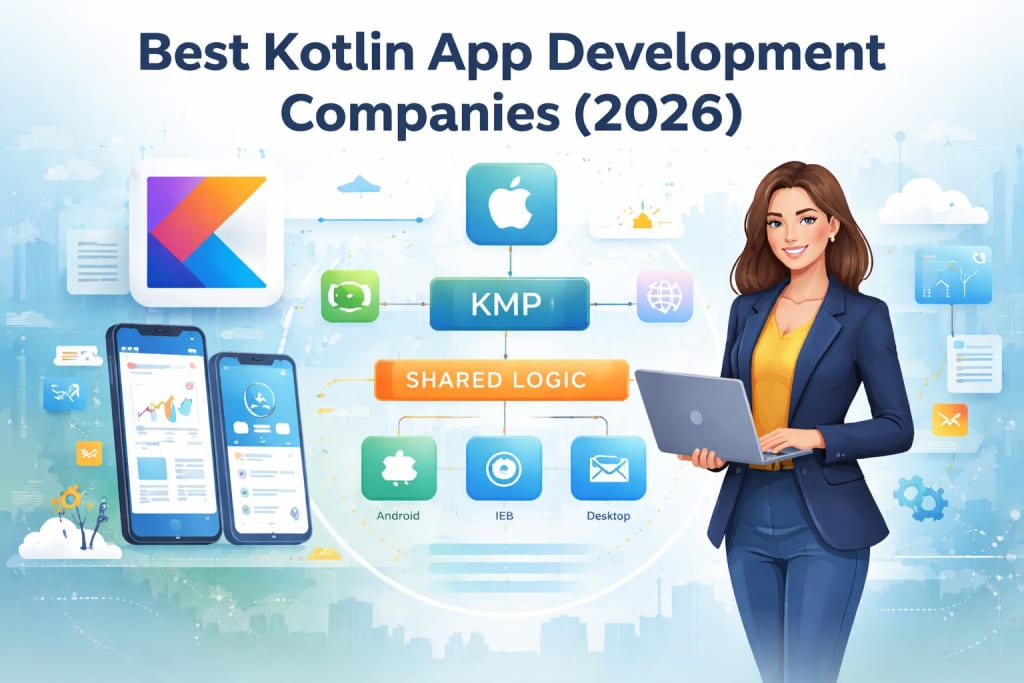
I reckon finding a solid dev team is harder than picking a winner at the races. You want speed, but you also want a build that does not fall apart when users flood in. That is why Kotlin app development companies are so busy lately.
It is 2026 and the tech world has mostly moved on from the clunky Java days. Most of us are stoked about how Kotlin has matured. It is not just for Android anymore. If you are fixin' to launch a new product, you need to know who actually knows their stuff.
We are seeing a significant shift in how apps get built this year. It is all about writing code once and running it everywhere without losing that native feel. I might be wrong, but I think the days of separate iOS and Android teams are numbered.
Comparing the Heavy Hitters in the Kotlin App Development Space
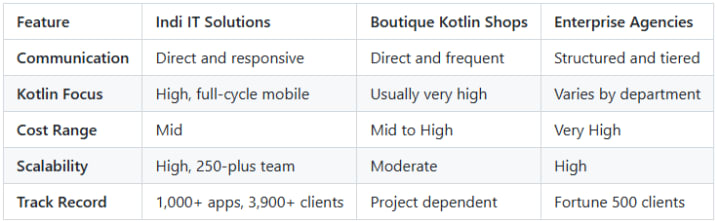
Four types of agencies dominate this market right now. Here is how they stack up before you sign anything.
Not all companies are built the same way. Some are giant factories with thousands of employees. Others are boutique shops that give you real personal attention. You have to decide which one fits your style and your budget.
1. Indi IT Solutions: Full-Cycle Kotlin and Mobile Specialists
Indi IT Solutions sits at the top of this list for a reason. Twelve-plus years of mobile development, over 1,000 apps shipped, and a team of 250-plus covering Kotlin, Android, iOS, Flutter, AI, and blockchain. They have worked with more than 3,900 clients, including 35 Fortune 1000 companies.
Real talk. Their FitLife app cleared 100,000 downloads with a 40% sales increase for the client. The GreenGrocer project hit a 95% on-time delivery rate. Clutch, G2, and Good Firms have all recognised them. Those are receipts, not marketing copy.
2. Boutique Kotlin Shops: Personal and Focused
Smaller specialist firms tend to have a very high Kotlin focus. You can actually talk to the lead developer without going through five project managers. It is a braw way to get things done when you are on a tight deadline and need quick answers.
They tend to be more agile in how they work with clients. Expect direct communication, faster pivots, and a team that actually cares about your specific use case. The tradeoff is that their capacity to scale up quickly is more limited.
3. Enterprise Dev Agencies: Scale When You Need It
On the other end, you have the big guns like Fueled and WillowTree. These agencies handle apps for Fortune 500 companies. They have massive resources and can scale a team quickly. But you are going to pay a significant premium for that kind of muscle.
They are great if you have a large, complex project that needs a lot of hands. For most startups or mid-sized firms, it can feel like overkill. You might end up feeling like just another ticket number in their system.
Finding Your Match Among Kotlin App Development Companies
Not every Kotlin shop is built for your project. Knowing what to look for saves you sixty grand and a lot of grief.
Picking a partner is a proper headache if you do not know what to look for. You see a lot of shops claiming they do everything. They say they are masters of every language under the sun. Honestly, that usually means they are average at all of them.
You want a team that lives and breathes the Kotlin ecosystem. They should be talking about the K2 compiler like it is the best thing since sliced bread. If they are still pushing old patterns, they are all hat and no cattle.
Why the Language Choice Matters for Your Bottom Line
Kotlin reduces boilerplate code by about 40% compared to Java. That is not just a geeky stat. It means your developers spend less time typing and more time solving your actual business problems. You save money because the build is faster and bugs are rarer.
I have seen projects go off the rails because of simple null pointer exceptions. Kotlin kills those off at the source. It is a braw choice for anyone tired of seeing their app crash in the middle of a user's purchase.
Maybe you are looking for someone closer to home to manage all of this. A local development partner in your time zone keeps communication tight when things get sus during a late-night sprint. Whether you are based in New Jersey or Arizona, proximity to your dev team matters more than people admit.
The Shift Toward Kotlin Multiplatform (KMP) in 2026
One shared codebase for Android, iOS, web, and desktop. This is not a future idea — it is already in production.
KMP is the real star of the show right now. Unlike other tools, it lets you share logic while keeping the UI native. Your app feels right on an iPhone and right on a Pixel. It is a tidy way to work without doubling your team size.
"Kotlin Multiplatform is not about forcing one UI on everyone. It is about sharing the hard parts, like data storage and networking, so you can focus on the user experience." — Roman Elizarov, Former Kotlin Lead at JetBrains
Think about it this way. You do not have to pay two teams to write the same login logic. You pay one team to do it well once. Then you let them polish the interface for each specific device. It saves heaps of time and keeps the codebase clean.
And that is the thing about 2026. Most businesses that have tried KMP are not going back. The logic-sharing model is just too efficient to ignore once you have seen it working in production.
Technical Performance Metrics You Should Care About
Good agencies show you the numbers. Great ones bring them up before you ask.
You should not just take their word for it. Ask for the numbers. How much did they improve build times for their last client? What is the crash-free rate of the apps they have launched recently? If they cannot answer those questions cleanly, walk away.
Speed Gains with the New K2 Compiler Architecture
Kotlin 2.0 introduced the K2 compiler, and it is fast. Compilation speeds have increased by up to 2x in some real-world cases. This means your developers spend less time waiting and more time shipping actual features your users care about.
If your dev partner is on the latest version, your iteration cycles will be much tighter. You can test new features and fix bugs in half the time. It is a proper advantage in a competitive market where speed to market is everything.
Cross-Platform Efficiency vs Traditional Flutter Methods
A lot of folks ask if they should just use Flutter instead. Honestly, Flutter is fine, but it uses Dart. Kotlin is a more mature language that most developers already know well. Plus, Kotlin Multiplatform gives you genuinely native UI components on each platform.
Flutter draws its own interface elements, which can sometimes look slightly off on certain devices. Kotlin uses the actual components provided by Apple or Google. Your power users will notice the difference, even if they cannot put a name to it.
What the Future Holds for Kotlin Stakeholders
The mobile app market is heading past $700 billion. Kotlin is positioned right at the centre of that growth.
I reckon we are just scratching the surface of what Kotlin can do. With the growth of AI-assisted coding, the language's clean syntax makes it a good fit for modern tooling. It is easy for machines to read and easy for humans to review and correct.
Market Projections and Adoption Rates for 2028
The mobile app market is projected to hit over $700 billion by 2026. A large portion of that will be built on Kotlin. As more teams realize that KMP can also target web and desktop, the adoption rate will only climb further.
"KMP is becoming the default choice for teams that want to share logic without compromising on the native platform experience." — Hadi Hariri, Developer Advocate at JetBrains
What this means for you is fairly straightforward. Investing in Kotlin now means building on a platform with long-term support. You are not betting on a trendy framework that might vanish next year. You are building on something Google and JetBrains are both actively funding.
Actually, scratch that. No tech is 100% safe long-term. But Kotlin has the backing of two major organizations and a massive developer community. That is about as solid as it gets in this industry right now.
"Just moved our entire shared library to KMP and the performance boost is no cap. Best dev decision we made this year. #Kotlin #MobileDev" — @CodeWithKev, X.com
So, where does that leave you? Find Kotlin app development companies that understand your goals and can back their claims with real project data. Do not just look at the price tag. Look at their code quality and how they handle the KMP world.
Getting this decision right means a fast, stable app that users actually keep on their phones. Take your time, ask the hard questions, and you will find the right fit. Good luck with your build, mate.
About the Creator
Keep reading
More stories from Samantha Blake and writers in 01 and other communities.
Top 10 Ecommerce App Development Companies in USA 2026
The ecommerce industry is no longer just growing — it is transforming at a pace that leaves unprepared businesses behind. Global ecommerce sales are projected to surpass six trillion dollars in 2026, and mobile commerce alone accounts for the lion's share of that growth. Whether you are launching a direct-to-consumer brand, building a multi-vendor marketplace, or digitizing an established retail business, the foundation of your success is the app you put in front of your customers.
By Samantha Blakea day ago in 01




Comments
There are no comments for this story
Be the first to respond and start the conversation.